edited volume · anthology
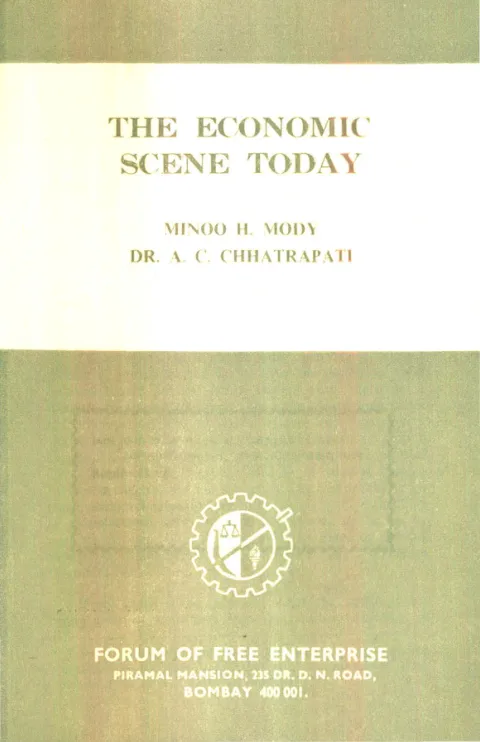
The Economic Scene Today
By mh-mody, a-c-chhatrapati
Published by M. R. PAI for the Forum of Free Enterprise, "Piramal Mansion", 235 Dr. Dadabhai Naoroji Road, Bombay-1 and printed by B. D. Nadirshaw at Bombay Chronicle Press, Sayed Abdulla Brelvi Road, Fort, Bombay-1. · Bombay · 1981
20 pages
The Economic Scene Today
Summary
A short Forum of Free Enterprise booklet pairing two addresses on the Indian economy at the turn of the 1980s: Minoo H. Mody’s presidential address at the ASSOCHAM workshop in New Delhi on industrial policy and macroeconomic management, and Dr. A. C. Chhatrapati’s lecture at the Forum in Bombay on 22 January 1981 on the new wave of farmers’ agitations. Read together, the two pieces frame industrial licensing and the suppression of agricultural prices as twin failures of three decades of planned development, and argue that the next phase of policy should accept the entrepreneurial logic now visible in both the factory and the field rather than treating either sector as a passive subject of administrative control.
Key points
-
This Forum of Free Enterprise booklet pairs Minoo H. Mody’s presidential address to the ASSOCHAM workshop in New Delhi on industrial policy with Dr. A. C. Chhatrapati’s 22 January 1981 Forum lecture in Bombay on the new farmers’ agitations.
-
Mody describes a ‘varying picture of prosperity and crisis’: a bumper kharif harvest offsetting the prior year’s 3 percent GNP decline, even as industrial production fell 1.8 percent and capacity utilisation dropped across steel, cement, aluminium and electric motors.
-
He calls the new Industrial Policy’s relaxations ‘welcome but timid’ and proposes a five-year ‘open season’ suspending licensing in the core sector, opening state-sector activities to private participation, and accepting deferred-credit imports from a recessionary West.
-
Mody opposes the Wanchoo Committee’s proposals to end the interest deduction or levy a 1 percent tax on capital, arguing they would deepen rather than ease the existing investment famine facing Indian industry.
-
Quoting the economist M. Adiseshiah, Mody calls the licence and exemption system the principal generator of black money and the parallel economy, noting that 40 percent of Indians remained below the poverty line after thirty years of planning.
-
Dr. A. C. Chhatrapati argues that thirty years of development have turned the once-fatalistic Indian farmer into an entrepreneur who reads price signals like an industrialist, explaining the sudden, non-political agitations spreading across several states.
-
He documents the gap between manufactured and agricultural price indices widening to 14 percent in 1979-80 and roughly 30 percent by late 1980, while support prices rose only about 10 percent against a 40 percent general price increase.
-
Chhatrapati notes that Agricultural Prices Commission recommendations were ‘repeatedly set aside’ by state governments, and prescribes parity-based support prices, an enforcement agency, better storage and orderly regulated markets as remedies.
Essays
Pragmatic changes in Development Policy Needed.
By Minoo H. Mody
Mody surveys what he calls a “varying picture of prosperity and crisis”: a bumper kharif harvest is set to reverse last year’s 3 per cent decline in GNP, but industrial production has fallen 1.8 per cent in the first half, capacity utilisation is dropping across steel, cement, aluminium and electric motors, and continuing labour unrest belies the dip in lost mandays. He treats the new Industrial Policy’s relaxations as welcome but timid, and presses for a clean break — a five-year “open season” suspending licensing in the core sector, abandonment of the Mahalanobis-era accent on heavy industry at the expense of wage goods, opening of state-sector activities to private participation, and willingness to absorb deferred-credit machinery imports from a recessionary West rather than clinging to the “dogma of self-reliance.”
On the macro side he warns that two Wanchoo Committee–style tax proposals (ending the interest deduction or a 1 per cent tax on capital) would compound rather than ease the investment famine, that import substitution is again hardening into dogma, and that an inflationary build-up is being driven not only by oil and infrastructural mismanagement but by a structural shift in the terms of trade toward agriculture as farmers’ and farm-workers’ agitations spread. He closes by quoting the economist M. Adiseshiah on controls as the “main generator of black money and the parallel economy,” and argues that with 40 per cent of Indians still below the poverty line after thirty years of planning, pragmatic changes in development philosophy — not fresh ideological commitments — are what the situation demands.
- Frames the economy as one of “prosperity and crisis”: a bumper agricultural harvest set against industrial production declining 1.8 per cent and falling capacity utilisation.
- Reads the new Industrial Policy as a half-measure and proposes a five-year suspension of licensing in the core sector to test liberalisation in practice.
- Rejects the Mahalanobis emphasis on heavy industry, arguing that the squeeze on wage-goods industries explains the stagnation of the seventies.
- Calls for opening state-sector activities to private participation and for accepting deferred-credit imports of plant and equipment from recession-hit Western suppliers.
- Opposes the Wanchoo Committee’s proposed disallowance of interest or 1 per cent tax on capital as further burdening an industry already starved of investment.
- Identifies three drivers of the inflationary build-up: oil prices, mismanagement of infrastructure and the state sector, and structural pressure from the agricultural lobby.
- Quotes M. Adiseshiah to argue that the licence and exemption system is the principal source of black money and corruption.
Economic Rationale of Farmers’ Agitation
By Dr. A. C. Chhatrapati
Chhatrapati asks why farmers — historically resigned to invaders, the zamindari system, and “the theory of karma” — are now mounting sudden, non-political mass agitations across several states. His answer is that thirty years of post-Independence development have produced “adoption of capitalistic farming as in developed countries,” turning the cultivator into an entrepreneur who reads price signals the same way an industrialist does. Inflation has therefore exposed a sectoral imbalance: manufactured-product prices have been allowed to rise (the gap with farm prices widened to 14 per cent in 1979-80 and to roughly 30 per cent in the last quarter of 1980) while agricultural prices have been deliberately held down through support prices that have risen only about 10 per cent against a 40 per cent general price increase, with Agricultural Prices Commission recommendations “repeatedly set aside” by state governments.
The essay treats the resulting farmers’ agitations — including those in Maharashtra around sugar co-operative wages — as the rational protest of a producer who buys inputs at retail and sells output at wholesale, faces weather risk without crop insurance, and finds that one-time concessions like debt relief offer no enduring solution. Chhatrapati’s policy prescription is parity-based support prices, an effective agency to enforce them, better post-harvest storage and orderly regulated markets, and a recognition that the largest sector of the economy is now a serious claimant in the inflation battle that Government will have to reckon with.
- Reads the farmers’ agitations as a new phenomenon: led by non-politicians, driven by purely economic grievances rather than ideology or caste politics.
- Argues that education, technology and market exposure have produced “capitalistic farming” — the farmer is now an entrepreneur, not a fatalist tilling the soil.
- Documents a widening gap between manufactured- and agricultural-product price indices: from 3-10 per cent through 1978-79 to 14 per cent in 1979-80 and roughly 30 per cent in monthly data from late 1980.
- Shows that support prices for 1980 rose only about 10 per cent over 1977-78 against a 40 per cent general price index rise, exposing the failure of the support-price mechanism.
- Criticises debt relief and ad hoc concessions as “populist gimmicks” inadequate to the structural risk of agriculture, and argues for crop insurance, parity-based support prices and orderly regulated markets.
- Frames the agitation as inflation’s last sectoral revolt: with industry and organised labour already extracting their share, the largest sector of the economy is now demanding its own.
Generated by the v1.5 extraction pipeline. Awaiting editorial review.
Metadata and summary are AI-extracted from the source PDF and reviewed for editorial accuracy. The original work is available via the Read PDF tab above (where present); paragraph-level citation inside the PDF is deferred to a future engagement.