speech
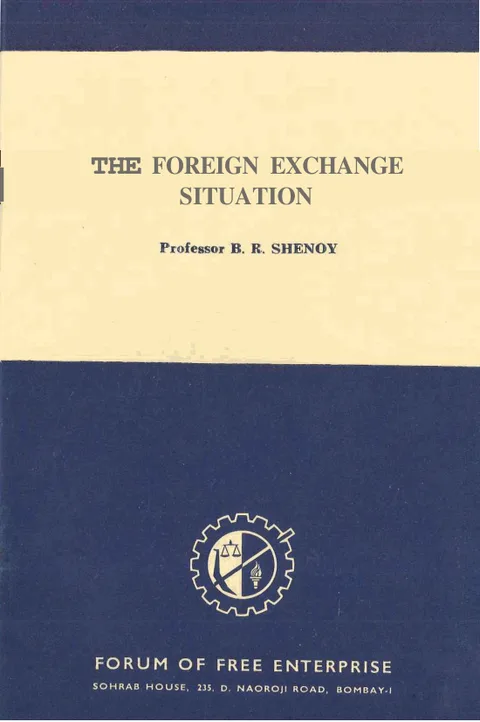
The Foreign Exchange Situation
By B. R. Shenoy
FORUM OF FREE ENTERPRISE SOHRAB HOUSE, 235, D. NAOROJI ROAD, BOMBAY-1 · Bombay · 1958
17 pages
The Foreign Exchange Situation
By B. R. Shenoy
Summary
In this edited text of a lecture delivered under the auspices of the Forum of Free Enterprise in Bombay on March 24, 1958, the economist B. R. Shenoy diagnoses India’s foreign exchange crisis as a self-inflicted consequence of trying to close the savings gap in the Second Five Year Plan through inflation rather than genuine saving. He opens by framing economic growth as a function of invested savings, contrasting the communist ‘direct method’ of forced resource acquisition with the democratic ‘indirect method’ that limits investment to what the community is willing to save. The drain on India’s reserves, he argues, which began in April 1956 and ran to about Rs. 563 crores over two years, is the automatic reflex of deficit-financed over-investment: inflationary finance raises domestic incomes and consumption, pulls imports up and pushes exports down, and so produces persistent payments difficulties.
Key points
-
Shenoy attributes the foreign exchange crisis directly to inflationary (deficit) financing of the Second Five Year Plan rather than to import liberalisation alone.
-
He frames economic growth as a function of invested savings and contrasts communist forced saving with the democratic method limited to voluntary saving.
-
The reserve drain from April 1956 ran to roughly Rs. 563 crores over two years (including IMF drawings of Rs. 95 crores), pushing reserves below the danger line of about Rs. 280 crores.
-
He marshals detailed trade data showing Indian exports remained below the pre-war level while imports stayed high, producing endemic post-war payments deficits.
-
Remedial measures he proposes are, first, cessation of inflationary finance, and second, an adjustment of the rupee’s exchange value, preferably by ‘floating’ it.
-
He argues devaluation alone would have no lasting value unless preceded by ending over-investment, and its incidence would fall on black-market import-licence prices, gold smugglers’ gains, and industrial subsidies.
-
He warns that tightening import restrictions as a ‘remedy’ could be worse than the disease by curtailing essential imports and harming production, employment and income.
-
He points to vast gaps between landed costs and market prices of imports, and between internal and external gold prices, as standing obstacles to liberalisation.
Generated by the v1.5 extraction pipeline. Awaiting editorial review.
Metadata and summary are AI-extracted from the source PDF and reviewed for editorial accuracy. The original work is available via the Read PDF tab above (where present); paragraph-level citation inside the PDF is deferred to a future engagement.