
speech
The Fundamental Rights Case
Published by M. R. PAI for the Forum of Free Enterprise, 235, Dr. Dadabhai Naoroji Road, Bombay-400 001, and printed at TATA PRESS Ltd., Bombay 400 025. · Bombay · 1973
14 pages
The Fundamental Rights Case
By N. A. PALKHIVALA
Summary
This 14-page Forum of Free Enterprise booklet reproduces N. A. Palkhivala’s analysis of the Supreme Court’s April 24, 1973 judgments in the Fundamental Rights Case (the Kesavananda Bharati case), decided by a 13-judge Bench. Palkhivala opens by situating the case in the scheme of the Constitution: Part III enumerates the Fundamental Rights and Part IV the Directive Principles, which he argues operate on different planes (ends versus permissible means) so that there can be no genuine conflict between them. He then traces the constitutional crisis that produced the case, beginning with Article 13(2) before the 24th Amendment and the Supreme Court’s construction of “law” in Golaknath’s case to include constitutional amendments.
The bulk of the booklet attacks the 24th and 25th Amendments. Palkhivala argues the 24th Amendment armed Parliament to take away or abridge any Fundamental Right, while the 25th substituted “amount” for “compensation” in Article 31(2) and inserted Article 31-C, which he calls “a monstrous outrage on the Constitution.” He enumerates seven essential features of the Constitution that Article 31-C subverts and lists four attributes of a totalitarian State implicit in it.
The closing pages narrate the split outcome: six judges (including retiring CJ Sikri and Justices Shelat, Hegde and Grover, whom Palkhivala notes were superseded for the Chief Justiceship) held the amending power limited and Article 31-C void; six others upheld unlimited power. Justice Khanna decided midway, holding the amending power cannot alter the basic structure of the Constitution — and because his view became the greatest common denominator with the six pro-citizen judges, his judgment became the law of the land. Palkhivala concludes that the final guarantee of citizens’ rights is the integrity of Supreme Court judges committed only to the Constitution.
Key points
-
Frames Part III (Fundamental Rights) and Part IV (Directive Principles) as operating on different planes — ends versus permissible means.
-
Traces the background from pre-24th-Amendment Article 13(2) through Golaknath’s case.
-
Argues the 24th Amendment armed Parliament to abridge any Fundamental Right, and the 25th replaced “compensation” with “amount” in Article 31(2).
-
Condemns Article 31-C as “a monstrous outrage on the Constitution” subverting seven essential features.
-
Identifies four attributes of a totalitarian State implicit in Article 31-C, rebutting the Government with a W. B. Yeats quotation.
-
Reports the 13-judge split: six for the citizen, six for the State.
-
Explains that Justice Khanna decided midway on the basic-structure doctrine, and his view became the majority law of the land.
-
Concludes the final guarantee of rights is the personality and integrity of Supreme Court judges.
Generated by the v1.5 extraction pipeline. Awaiting editorial review.
Metadata and summary are AI-extracted from the source PDF and reviewed for editorial accuracy. The original work is available via the Read PDF tab above (where present); paragraph-level citation inside the PDF is deferred to a future engagement.
People in this work
Related across the archive
 Primary workThe Supreme Court's Judgment on the Constitution (42nd Amendment) Act, 1976
 Primary workRESHAPING THE CONSTITUTION
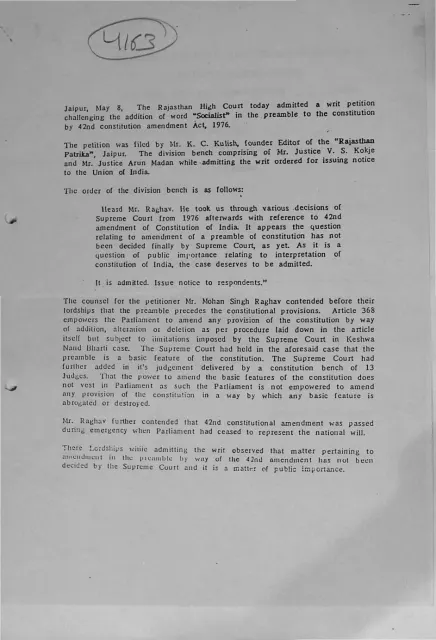 Primary workRajasthan high court today admitted a high petition
 ExcerptExamination of Objections to Limitations of Amending Power
 ExcerptThe Role of Judiciary in Parliamentary Democracy by Justice M.C. Chagla