edited volume · anthology
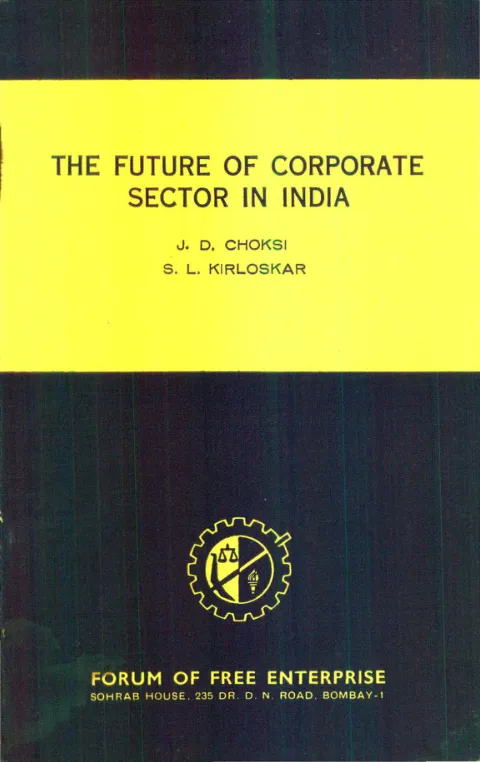
The Future of Corporate Sector in India
By J. D. Choksi, S. L. Kirloskar
Forum of Free Enterprise, Sohrab House, 235 Dr. D. N. Road, Bombay-1 · Bombay · 1968
28 pages
The Future of Corporate Sector in India
By J. D. CHOKSI, S. L. KIRLOSKAR
Summary
Issued as a Forum of Free Enterprise booklet, ‘The Future of Corporate Sector in India’ gathers two contributions on the place of private industry in late-1960s India. Part I, ‘The Corporate Sector & Political Parties’ by J. D. Choksi (based on a talk delivered under FFE auspices in Bombay on June 20, 1968), is a wide-ranging indictment of government over-regulation of business; Part II, ‘The Stock-Holders and the End of the Managing Agency’ by S. L. Kirloskar, defends the managing agency system against the imminent legislative move to abolish it. Both pieces argue that economic decisions are being driven by political motive rather than economic logic, and that India’s corporations should be placed above politics yet subject to the law. The rendered pages contain the whole of Choksi’s part and the opening of Kirloskar’s part.
Key points
-
J. D. Choksi argues that twenty-five years after independence India’s political leadership shows ‘almost complete amnesia’ on economic matters, with industrialists sharing blame for ceding the field to politicians.
-
Choksi cites indiscriminate licensing, price controls and constant company-law amendments as having set back the economy, using the steel industry’s price-distribution machinery under the Joint Parliamentary Committee as his central illustration.
-
Choksi defends the managing agency system as a sound structure already restrained by the Company Law, calling its proposed abolition an amazing waste of public funds and time.
-
On corporate political funding, Choksi favours a transparent, audited system of election finance over an outright ban, warning that a ban would merely drive contributions underground as black money.
-
Choksi insists corporations and industries should be placed above politics, yet always remain subject to the laws of the nation, echoing the volume’s title theme of a corporate sector free from partisan capture.
-
S. L. Kirloskar contends that the bill to abolish the managing agency system is already before Parliament, which is swayed more by political expediency than by economic argument.
-
Kirloskar notes that a post-war generation conditioned to accept economic restraint as natural is gaining influence and turning hostile to institutions like the managing agency.
-
Kirloskar argues no decisive case has actually been made against the managing agency system, since both the Monopolies Commission and a recent government committee failed to clinch it.
-
Kirloskar traces the managing agency’s historical origin to a scarcity of venture capital and entrepreneurial talent, cautioning stockholders against assuming today’s apparent capital availability removes the need for it.
Essays
The Corporate Sector & Political Parties
By J. D. CHOKSI
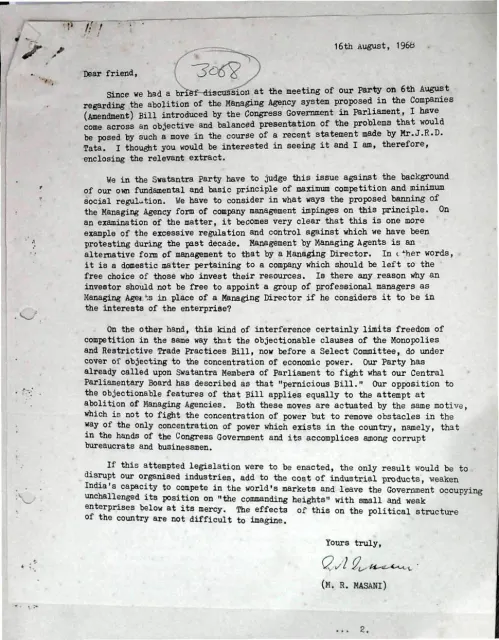
J. D. Choksi, writing as a ‘non-political industrialist,’ argues that twenty-five years after independence India’s political leadership has shown ‘almost complete amnesia’ on economic matters, and that professionals and industrialists erred in leaving government and economic policy to politicians. He surveys the damage done by indiscriminate licensing, price controls, and constant amendment of the company law, taking the steel industry and the J.P.C. price-fixing machinery as his central illustration of how government distribution policy paralyses a basic industry. He defends the managing agency system as a sound organisational structure that the Company Law already adequately restrains, calling its proposed abolition ‘an amazing instance of the complete waste of public funds and public time.’ Choksi closes by turning to the proposed ban on corporate contributions to political funds, arguing for a transparent, audited system of election funding rather than a ban that merely drives money underground, and insisting that corporations be placed above politics but always subject to the laws of the nation.
- Twenty-five years of independence have produced economic ‘amnesia’ among India’s political leaders; industrialists share blame for ceding the field.
- Indiscriminate licensing, price controls, and incessant company-law amendments have set the economy back.
- Steel is the central illustration: government price-distribution policy and the J.P.C. mechanism leave the industry ‘suspended in mid-air.’
- The managing agency system is a legitimate organisational structure already curbed by Company Law; its abolition is a waste of public funds and time.
- On political funding, a transparent, audited system is preferable to a ban that drives money underground (‘black money’).
- Corporations and industries should be placed above politics but always subject to the laws of the nation.
The Stock-Holders and the End of the Managing Agency
By S. L. KIRLOSKAR
S. L. Kirloskar, described as ‘an eminent industrialist,’ opens his contribution by questioning whether it is even worth re-arguing the managing agency case when the abolition bill is already ‘on the anvil’ and Parliament is swayed more by political expediency than economics. He observes that a younger, post-war generation conditioned to accept economic restraint as natural is gaining ascendancy, and that the social and economic thought of the fifties and sixties has been hostile to institutions like the managing agency. He insists that no decisive case has actually been made against the system itself — the Monopolies Commission and a recent government committee both failed to clinch it — and that the move to abolish it is ‘chiefly, perhaps even wholly, political’ rather than driven by economic logic. He begins to re-examine the ‘core’ of the system as a historical response to two scarcities — of venture capital and of entrepreneurial talent — warning stockholders not to be misled by the apparent present-day availability of capital. The rendered pages capture only the opening of his argument.
- The managing agency abolition bill is already ‘on the anvil’; Parliament is driven by political expediency over economics.
- A post-war generation conditioned to economic restraint is rising and is hostile to institutions like the managing agency.
- No decisive case has been made against the system; the Monopolies Commission and a recent committee both failed to clinch it.
- The drive to abolish it is ‘chiefly, perhaps even wholly, political,’ not grounded in economic logic.
- The ‘core’ of the system was a historical answer to scarcity of venture capital and of entrepreneurial talent.
Generated by the v1.5 extraction pipeline. Awaiting editorial review.
Metadata and summary are AI-extracted from the source PDF and reviewed for editorial accuracy. The original work is available via the Read PDF tab above (where present); paragraph-level citation inside the PDF is deferred to a future engagement.