speech · memorial lecture
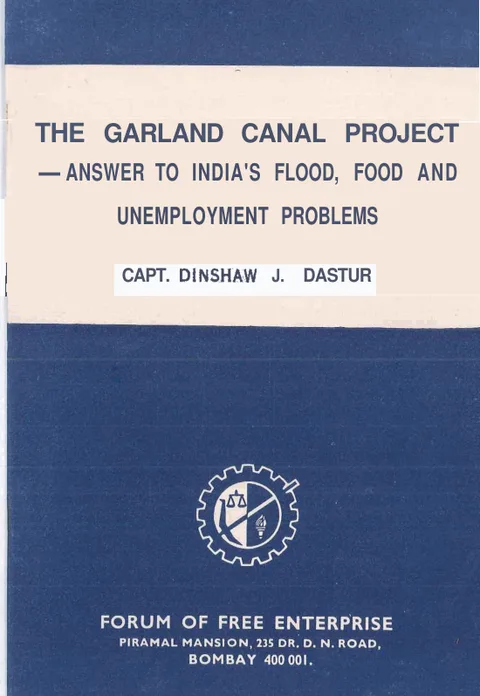
The Garland Canal Project
Answer to India's Flood, Food and Unemployment Problems
Published by M. R. Pai for the Forum of Free Enterprise, 235, Dr. Dadabhai Naoroji Road, Bombay-400001, and Printed by H. Narayan Rao at H. R. Mohan & Co., 9-B Cawasji Patel Street, Bombay-400 001. · Bombay · 1978
11 pages
No. 13 in A. D. Shroff Memorial Lecture
The Garland Canal Project
By CAPT. DINSHAW J. DASTUR
Summary
This pamphlet reproduces the text of the 13th A. D. Shroff Memorial Lecture, delivered in Bombay on 27 October 1978 by Capt. Dinshaw J. Dastur, in which he sets out his ‘Garland Canal Project’ (the Dastur Plan) as a single, integrated answer to India’s recurring floods, food shortages, energy scarcity, transport bottlenecks and mass unemployment. Dastur opens by distinguishing ‘occupation’ (remunerative work in one’s own surroundings) from ‘employment’, arguing that India’s rural exodus, slums and poverty stem from a failure to provide remunerative occupation for its 600 million people where they live, and that industrialisation was wrongly prioritised over agriculture after Independence.
The core of the lecture is an engineering description of two great trans-basin continental canals: a 2,600-mile Himalayan Canal skirting the southern periphery of the Himalayan range at roughly 1,200 ft above mean sea level, fed by integrated lakes, to capture and redistribute the glacial and monsoon flow of the northern rivers; and a Central and Southern Garland Canal looping through the Central Plateau, Deccan and the south down toward Cape Comorin. Linked by pipelines and a herringbone system of subsidiary canals, the scheme is meant to move water purely by gravity, store it in vast integrated lakes, and raise the water table across India’s flat lands.
Dastur enumerates sweeping projected benefits — flood and drought elimination, 540 million acres of irrigated land, India and Bangladesh as ‘granaries of the world’, unlimited hydro-electric power, 8,400 miles of inland navigation, tax-free agricultural income, and even a moderated, more temperate subcontinental climate. He proposes building the project in three phases using the army and two crore (20 million) voluntarily recruited young workers per phase, who would settle on reclaimed land and share in profits and dividends, and estimates the cost at Rs. 15,000-17,000 crores over four to five years. A boxed disclaimer notes the views are not necessarily those of the Forum; a back-matter page profiles A. D. Shroff, founder-president of the Forum of Free Enterprise, in whose memory the lecture is given.
Key points
-
Text of the 13th A. D. Shroff Memorial Lecture, delivered in Bombay on 27 October 1978 by Capt. Dinshaw J. Dastur.
-
Frames India’s central problem as providing remunerative ‘occupation’ in people’s own surroundings rather than ‘employment’ that uproots them.
-
Argues post-Independence India wrongly prioritised industrialisation over agriculture for thirty years.
-
Proposes two trans-basin continental canals: a 2,600-mile Himalayan Canal (~1,200 ft above MSL) and a Central and Southern Garland Canal, linked by pipelines and a herringbone distribution system, moving water entirely by gravity.
-
Claims the scheme would end floods and droughts, irrigate 540 million acres, make India and Bangladesh granaries of the world, and supply unlimited hydro-electric power and 8,400 miles of navigation.
-
Suggests the permanent Himalayan snowline would recede and the subcontinent’s climate become more temperate.
-
Envisions construction in three phases by the army plus two crore voluntary worker-settlers per phase who share in land, profits and dividends.
-
Estimates total cost at Rs. 15,000-17,000 crores over four to five years, framed as modest against the Five Year Plan outlay.
Generated by the v1.5 extraction pipeline. Awaiting editorial review.
Metadata and summary are AI-extracted from the source PDF and reviewed for editorial accuracy. The original work is available via the Read PDF tab above (where present); paragraph-level citation inside the PDF is deferred to a future engagement.