speech
The Gift Tax
Forum of Free Enterprise, Sohrab House, 235, D. Naoroji Road, Bombay-1. Printed by Popular Press (Bom.) Private Ltd., Bombay 7. · Bombay · 1958
18 pages
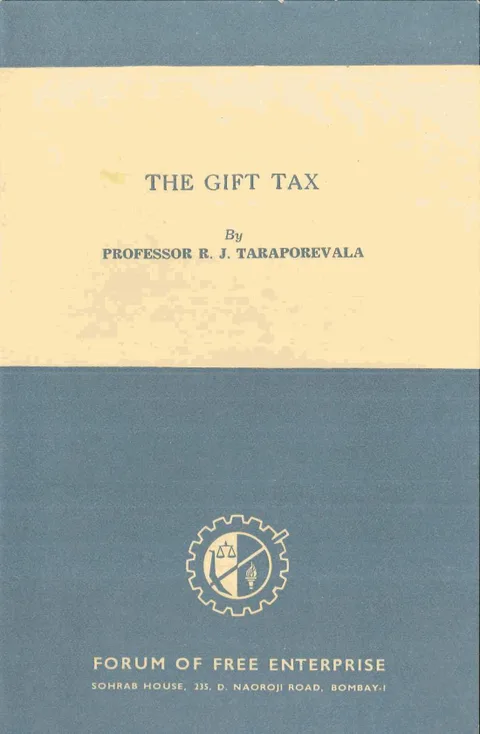
The Gift Tax
By Professor R. J. TARAPOREVALA
Summary
This Forum of Free Enterprise pamphlet reproduces a public lecture delivered in Bombay on 28 March 1958 by Professor R. J. Taraporevala, a sustained critique of the Gift Tax Bill (1958) proposed in the Government of India’s 1957-58 budget. The Finance Minister had justified the new levy as plugging a loophole by which property transferred through gifts to relatives or associates escaped Estate Duty, Income-tax, Wealth-tax and Expenditure-tax. Taraporevala concedes the logic but argues the Bill’s definition of ‘gift’ is so sweeping — covering forgiveness of indebtedness, joint tenancies and bank accounts, bad business bargains, partnership admissions, and bonus or gratuity payments to employees — that it will create severe administrative confusion, hardship and litigation, and will leave wide discretionary power in the hands of gift-tax officers.
Through the bulk of the lecture he works section by section through the Bill’s problems. He warns that joint bank accounts and family arrangements will trap ordinary citizens unless they keep minute records; that treating forgone debts and arm’s-length bad bargains as taxable gifts departs from American gift-tax practice; that taxing the admission of talented but capital-poor young men into partnerships erects an ‘artificial barrier’ against enterprise; and that taxing employee bonus and gratuity as gifts will strain labour relations. He attacks the exemptions as ‘niggardly’ — the Rs. 100 ceiling on charitable gifts to individuals, the discrimination against charities outside Section 15B, the narrow marriage-gift relief confined to female relatives, and the arbitrary reduction of the basic exemption from Rs. 10,000 to Rs. 5,000 — and calls for small gifts to be exempted entirely.
Taraporevala then turns to the structure and incidence of the tax. He argues the rates, though modest now, will inevitably climb (citing how income-tax rose to 84 per cent), and that the basis of charging the tax on the donor rather than the donee is ‘wrong and inequitable’; a donee-based tax related to the recipient’s total wealth, as recommended by the Kaldor Report, would distribute wealth more evenly and better suit the government’s professed socialist goals. He documents how the Bill produces double and even triple taxation in conflict with the Income-tax, Expenditure-tax and Estate Duty Acts, and closes on administration: the existing machinery is inadequate, officials are underpaid and overburdened, and the Taxation Enquiry Commission itself opposed the tax on administrative grounds. His final verdict is that the provisions are ‘excessively wide, harsh and inequitable’, and that it is far better to enact good, well-drafted laws administered fairly than bad laws administered leniently. A closing disclaimer notes the views are not necessarily those of the Forum.
Key points
-
Text of a public lecture delivered in Bombay on 28 March 1958 by Professor R. J. Taraporevala under the auspices of the Forum of Free Enterprise.
-
Critiques the 1958 Gift Tax Bill proposed in the 1957-58 Union budget as a measure to plug avoidance of Estate Duty, Income-tax, Wealth-tax and Expenditure-tax.
-
Argues the Bill’s definition of ‘gift’ is excessively wide — covering debt forgiveness, joint accounts, bad business bargains, partnership admissions and employee bonuses.
-
Warns that joint bank accounts and family arrangements will burden ordinary citizens with onerous record-keeping and litigation.
-
Contends taxing partnership admissions raises an artificial barrier against talented but capital-poor young entrepreneurs.
-
Condemns the exemptions (charitable, marriage, basic allowance) as niggardly and arbitrary, and urges full exemption of small gifts.
-
Holds that the tax should fall on the donee in relation to total wealth (per the Kaldor Report), not on the donor.
-
Shows the Bill creates double and triple taxation conflicting with other direct-tax statutes, and notes the Taxation Enquiry Commission opposed it on administrative grounds.
-
Concludes the provisions are excessively wide, harsh and inequitable, preferring good laws fairly administered over bad laws leniently administered.
Generated by the v1.5 extraction pipeline. Awaiting editorial review.
Metadata and summary are AI-extracted from the source PDF and reviewed for editorial accuracy. The original work is available via the Read PDF tab above (where present); paragraph-level citation inside the PDF is deferred to a future engagement.