edited volume · anthology
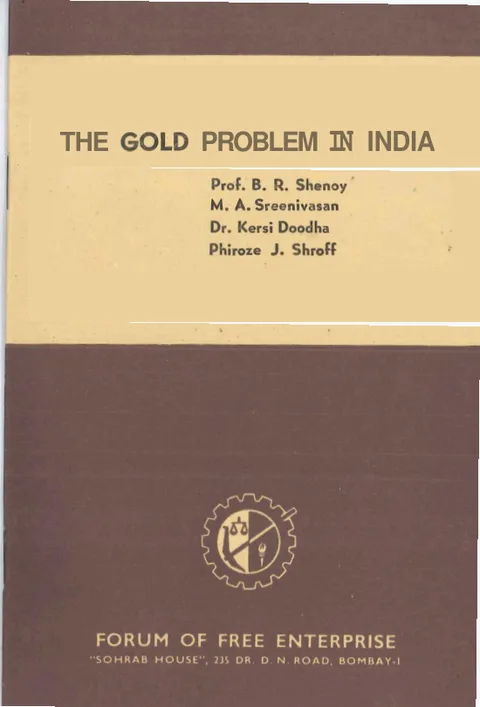
The Gold Problem in India
By B. R. Shenoy, MA Sreenivasan, Phiroze J Shroff
FORUM OF FREE ENTERPRISE, "SOHRAB HOUSE", 235 DR. D. N. ROAD, BOMBAY-1 · Bombay · 1963
22 pages
The Gold Problem in India
Summary
The Gold Problem in India is a Forum of Free Enterprise booklet collecting four essays that examine, from historical, economic and constitutional angles, the gold smuggling problem and the Government of India’s Gold Control Rules that came into force on 10 January 1963. The unsigned Introduction frames the volume as part of the Forum’s practice of stimulating public thinking on national economic problems, presenting Prof. B. R. Shenoy (an authority on the gold problem, Director of the School of Social Sciences, Gujarat University), Mr. M. A. Sreenivasan (former Chairman of the Kolar Gold Mines), Dr. Kersi Doodha (Department of Economics, University of Bombay) and Mr. Phiroze J. Shroff (economist and authority on constitutional law). The argumentative centre, in the rendered pages, is a classical-liberal critique of gold control: the contributors trace smuggling to the gap between official and free-market gold prices, argue that controls treat symptoms rather than causes, and contend that the Rules interfere with fundamental rights and Directive Principles. Across the four pieces the common prescription is to close the price gap and restore confidence in the rupee rather than to police the bullion trade.
Key points
-
The booklet collects four essays on India’s gold smuggling problem and the Gold Control Rules that took effect on 10 January 1963, contributed by B. R. Shenoy, M. A. Sreenivasan, Kersi Doodha, and Phiroze J. Shroff.
-
B. R. Shenoy locates the root cause of smuggling in the gap between the official gold price and the much higher free-market price, which makes smuggling extremely profitable for those involved.
-
Shenoy reviews the government’s escalating policy steps from 21 August 1962 through the 10 January 1963 Gold Control Rules, concluding that controls cannot succeed while the price gap persists.
-
M. A. Sreenivasan, a former Chairman of the Kolar Gold Mines, recounts the nationalisation and decline of the Kolar Gold Fields as a matter of political face-saving rather than economic logic.
-
Sreenivasan urges renewed prospecting and a properly resourced Gold Mining Development Fund rather than coercive campaigns urging citizens to surrender ornaments to the National Defence Fund.
-
Kersi Doodha traces the historic Indian preference for hoarding gold and silver as a store of value back to the transition from barter to a common medium of exchange.
-
Doodha links the propensity to hoard gold to the gap between desired savings and productive investment in a developing economy, and reviews the government’s gold-bonds scheme with scepticism about its inducements.
-
Phiroze J. Shroff argues that the Gold Control Rules, promulgated under section 3 of the Defence of India Act 1962, impose severe restrictions on the age-old business of goldsmiths.
Essays
The Gold Problem in India
By B. R. Shenoy
Shenoy examines the gold problem under four heads: what it is, how and when it arose, whether measures to tackle it have succeeded, and what alternatives exist. He defines the problem as the attachment of Indians to gold combined with the wasteful smuggling and hoarding it produces, and locates the root cause in the gap between the official price and the much higher free-market price of gold, which makes smuggling enormously profitable. He marshals figures on smuggling volumes, premiums on foreign exchange, and the scale of gold hoards, and reviews the Government’s 21 August 1962 and later moves culminating in the Gold Control Rules. His conclusion in the rendered pages is that controls cannot work while the price gap persists; the durable remedy is to let the rupee and the gold price reflect market conditions and to end the inflation that drives the divergence.
- Defines the gold problem as Indians’ attachment to gold plus the smuggling and hoarding it generates.
- Roots smuggling in the gap between the official and free-market prices of gold, which creates large smuggler profits.
- Supplies quantitative estimates of smuggled volumes, foreign-exchange premiums, and hoarded gold (in the thousands of crores).
- Reviews the Government’s escalating policy steps in 1962 leading to the 10 January 1963 Gold Control Rules.
- Argues controls treat symptoms; the real cure is closing the price gap and ending inflation so the rupee holds value.
Gold, Gold, Gold
By MA Sreenivasan
Sreenivasan’s ‘Gold, Gold, Gold’ is a discursive, often ironic reflection on India’s obsession with gold, written by a former Chairman of the Kolar Gold Mines and reproduced from the Swarajya Annual Number 1963. He observes that gold is suddenly in the news as the Government, through bans, seizures and appeals to surrender ornaments to the National Defence Fund, tries to mobilise the metal, and he laments the contradiction of a poor, gold-hungry nation that imported and hoarded gold while neglecting its own mines. Recounting the nationalisation and decline of the Kolar Gold Fields, he argues the mines were treated as a matter of political face-saving rather than economic logic, and he urges renewed prospecting and development of India’s auriferous areas through a properly resourced Gold Mining Development Fund rather than coercive mobilisation drives.
- Treats India’s cultural attachment to gold with irony, noting the metal is suddenly ‘in the news’.
- Criticises the Government’s drive to extract hoarded gold and ornaments for the National Defence Fund.
- Recounts the nationalisation and decline of the Kolar Gold Fields as politically rather than economically driven.
- Argues India neglected and abandoned its own gold mines while importing and hoarding gold.
- Calls for serious prospecting and a properly funded Gold Mining Development Fund to revive domestic production.
The Gold Policy
By Dr. Kersi Doodha
Doodha’s ‘The Gold Policy’ opens with the economic rationale for money, tracing the move from barter to a universally accepted medium and the historic Indian preference for hoarding gold and silver as a store of value. In the rendered pages he turns to estimating the magnitude of gold smuggled into the country and the value of accumulated hoards, working through competing estimates and the difficulty of measuring movements that, in modern times, are largely invisible in the national income. He links the propensity to hoard gold to the gap between desired savings and productive investment in a developing economy, and reviews the Government’s gold-bonds scheme as a device to mobilise hoarded gold, setting out the bond terms before assessing, sceptically, whether the inducements are attractive enough to draw out illicit holdings.
- Begins from first principles on why money and a common medium of exchange emerged from barter.
- Explains the traditional Indian preference for converting trade surpluses into hoarded gold and silver.
- Works through competing estimates of smuggled gold and the value of national gold hoards.
- Connects gold hoarding to the divergence between savings and productive investment in a developing economy.
- Reviews the gold-bonds scheme’s terms and doubts its inducements will draw out ill-gotten hoards.
Constitutional and Legal Aspects of the Gold Control Rules
By Phiroze J. Shroff
Shroff’s ‘Constitutional and Legal Aspects of the Gold Control Rules’ (based on a talk under FFE auspices in Bombay on 11 February 1963) argues that the Rules, promulgated under section 3 of the Defence of India Act 1962, impose severe restrictions that have brought the age-old business of goldsmiths and jewellers to a virtual standstill. In the rendered pages he contends the Rules interfere with the fundamental right to acquire, hold and dispose of property and the right to carry on a trade or occupation, and that they violate several Directive Principles of State Policy by throwing thousands of goldsmiths and dealers out of work. He further argues the Rules are open to challenge as violative of equality before the law and of freedom of conscience and religion, given gold’s ceremonial and religious uses, and warns that the extraordinary powers of search, seizure and confiscation invite abuse.
- Locates the Gold Control Rules in section 3 of the Defence of India Act 1962, in force from 10 January 1963.
- Argues the Rules have brought the goldsmith and jeweller trade to a virtual standstill.
- Contends they violate the fundamental right to property and to carry on trade or occupation.
- Claims conflict with Directive Principles and with equality before the law and religious freedom.
- Warns that powers of search, seizure and confiscation are liable to abuse against ordinary citizens.
Generated by the v1.5 extraction pipeline. Awaiting editorial review.
Metadata and summary are AI-extracted from the source PDF and reviewed for editorial accuracy. The original work is available via the Read PDF tab above (where present); paragraph-level citation inside the PDF is deferred to a future engagement.