
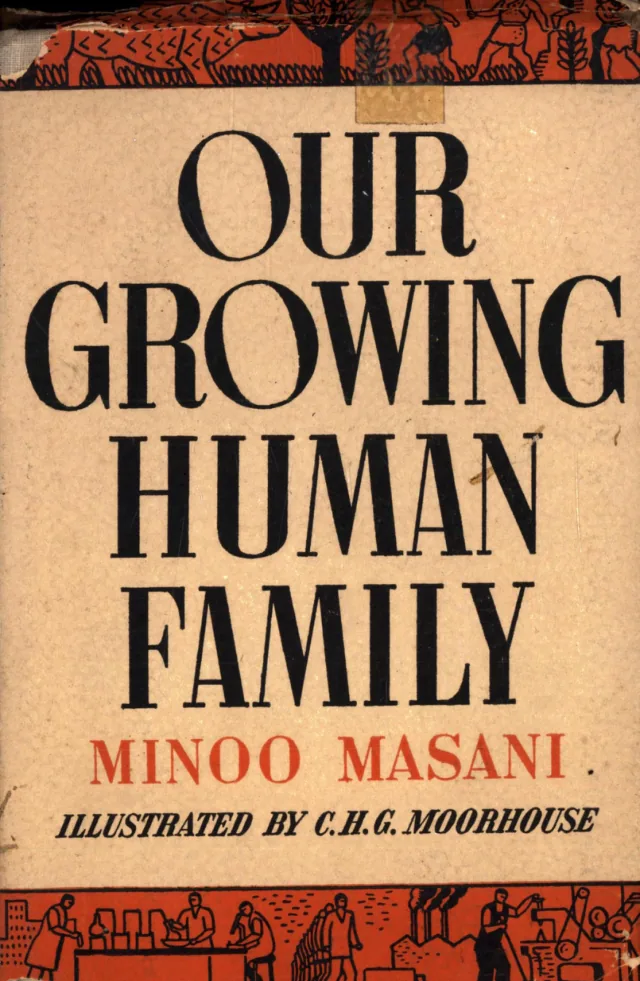
The Growing Human Family
Summary
The Growing Human Family is Minoo Masani’s illustrated popular history of how people have organised themselves, written for school-age readers and addressed to them directly as “you”. It runs through twelve short chapters. It opens by asking why anyone lives in society at all (Ch. 1, “Why Not Live Alone?”), answering with solitude, dependence on others for basic needs, and the evolutionary record in which humans are one late species among many. It then argues (Ch. 2) that the “survival of the fittest” slogan is misread: against Darwin’s popularisers, and drawing on Kropotkin and H. G. Wells, Masani holds that among members of one species the test of fitness is the capacity to combine and give mutual aid, with a lasting pull between that instinct and an inherited streak of aggression.
Chapters 3 to 9 then follow social units in the order they arose, each presented as the answer to the failings of the one before. The tribe (Ch. 3) is the “Each for All” society of hunters and shepherds, with no private property, no marriage and no rulers until war produced chiefs. The agricultural revolution (Ch. 4, “A Wife, a Son, and a Slave”) destroys the tribe and creates the patriarchal family, property in women and children, and the passage from Manu that a wife, son and slave own nothing. The village community and its assembly, the samiti or folk-moot (Ch. 5), reconcile family despotism with village democracy, and give way when nomad conquerors turn villagers into tribute-payers, the beginning of the State. Chapter 6 covers the city (Mohenjo-daro, Pataliputra, Greek city-states, medieval free cities and guilds, garden cities); Chapter 7 the State as kingdom or republic, including the ancient Indian republics; Chapter 8 the nation as the modern “god” (Bharat Mata, Uncle Sam, John Bull), which Masani says is defined by sentiment rather than religion, race or language; and Chapter 9 the empire as the nation-state turned aggressor, driven by the hunt for markets and raw materials, from Persia and Rome to the colonial powers and the “Haves” and “Have-nots” of the 1930s.
The last three chapters turn from history to prescription. Chapter 10, “The Shrinking World”, says speed of travel and communication has outrun political thinking, then explains why the League of Nations failed (a league of governments, unanimity rule, no police force, subject peoples such as India represented by nominees) and why the United Nations Security Council veto repeats the flaw. Chapter 11 sets three tests for a new order: it must be world-wide, a real government to which states surrender part of their sovereignty, and democratic, meaning a federation of free peoples on the model of Switzerland, the United States and Australia, with the end of all rule by one people over another. Nation-states would then break into culturally coherent Regions of garden cities, each with its own parliament and university. Chapter 12 argues that world federation is a beginning only. It offers two tests for any government (the greatest good of the greatest number, and the largest freedom, resting on consent), cites Lincoln and Lord Acton, and sorts rival systems into democracies and dictatorships. Masani finds democracy inadequate but preferable, says planning must not cost liberty, and rejects violent revolution in favour of Buddha, Asoka and Gandhi. It closes on the youth of the human race, Donne’s “No man is an Iland”, and Tagore’s “Where the mind is without fear”.
What distinguishes this printing is its American publication, not its argument. This is the Oxford University Press, New York, 1951 edition (second printing 1953). The jacket reads “Our Growing Human Family”, the title page “The Growing Human Family”, and the Chapter 1 heading “Why Not Live Alone?” differs from the contents entry “Why Live Alone?”. The page images show house-styling toward American usage (“honors”, “labor”, “neighbors”, “plowing”, “airplane”) but only partly, since British forms such as “learnt”, “self-defence” and “two thousand million years” survive. The substance remains pitched at an Indian schoolchild: the narrator recalls retreating to “good old Bombay”, speaks of “our friend the crow” in India, and refers to “your poetry book” and “your history textbook”. The Indian material that carries the argument (samiti, Manu, the Mahabharata, Mohenjo-daro, Pataliputra, Bharat Mata, the Indian National Congress, Gandhi, Tagore) is untouched. For the American reader the text offers Uncle Sam beside John Bull and Bharat Mata, the U.S. President as an example of an elected head, a Washington and New York comparison, Henry Ford’s forty-eight states as the model of federation, and Will Durant tagged “an American writer”. It also lists the United States among the Great Powers that sought markets abroad. I could not collate this printing against the Indian text, so I cannot say which of these American touches were added and which were always there. The 1951 date also shows: Poland is cited as a country that has lost freedom, the Soviet veto is counted at more than forty uses, and 1950s ethnographic terms (“primitive”, “Hottentot”, “Negroes”) appear next to a rejection of any right of “white” peoples to rule others.
Notable passages
"In other words, we would need the company and the warmth of our fellow men and women."
"the earth was not made for Man. Rather, Man just managed to happen rather late in the earth's history."
"what counts is not size or even strength but the instinct or intelligence to combine—to avoid conflict among members of the same species."
"Those who combine live and survive. Those who quarrel and fight are wiped out."
"The path of survival is the path of co-operation. Conflict is the road to death."
Metadata and summary are AI-extracted from the source PDF and reviewed for editorial accuracy. The original work is available via the Read PDF tab above (where present); paragraph-level citation inside the PDF is deferred to a future engagement.