speech · memorial lecture
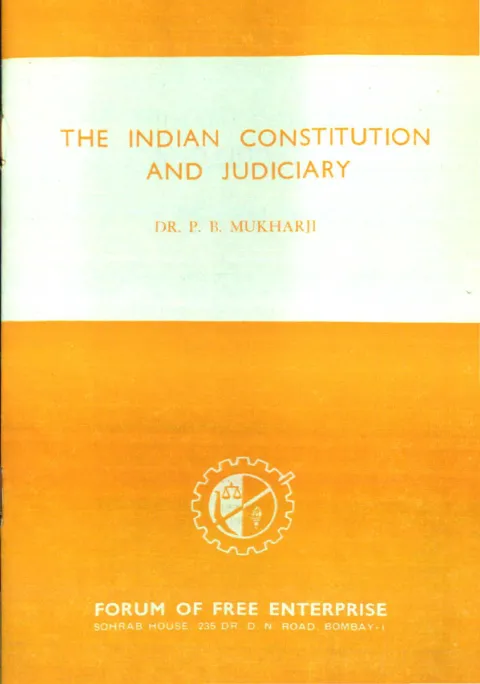
The Indian Constitution and Judiciary
Published by M. R. Pai for the Forum of Free Enterprise, 235, Dr. Dadabhai Naoroji Road, Bombay 400 001 and Printed by S. J. Patel, at Onlooker Press, (Prop. Hind Kitabs Ltd.), Sassoon Dock, Colaba, Bombay-400 005. · Bombay · 1973
12 pages
Part of A. D. Shroff Memorial Lecture
The Indian Constitution and Judiciary
By DR. P. B. MUKHARJI
Summary
Delivered as the first A. D. Shroff Memorial Lecture under the auspices of the Calcutta Centre of the Forum of Free Enterprise on 27 October 1973, this address by Dr. P. B. Mukharji, a former Chief Justice of West Bengal, defends the independence of the Indian judiciary against the contemporary political slogans of a ‘committed judiciary’, ‘servile judges’, and the claim that the Executive alone should determine judges’ calibre. Mukharji treats these ‘battle cries’ as misconceptions, arguing that a judge’s social philosophy is not static but an evolving concept and warning against the reduction of judges to a bureaucracy that merely administers the dictates of Parliament and the Executive.
The lecture traces the widening of the notion of justice from an individual concern, through tribal custom, to the modern welfare state, and grounds judicial duty in two allegiances: first to the judge’s own trained conscience, rooted in reverence for individual freedom, and second to the written Constitution that is the source of his office. Mukharji insists that the Constitution is the supreme law of the land, above Parliament and the Executive, and that although Parliament may amend it and override court decisions by legislation, the sanctity of a written Constitution means it should not be treated as a mere Legislative Act to be changed whenever the government feels ‘the pinch of the judicial verdict’. Separation of powers among Legislature, Executive and Judiciary is presented as the cornerstone safeguarding the purity of law and justice.
In the closing pages Mukharji concedes that judges have never been blind to sociological and economic realities, invoking the stark poverty of India and Bentham’s greatest-good-of-the-greatest-number principle, and acknowledges that economic and social planning poses a genuine problem for law and justice in an atomic, computer, and pollution-stressed age. He frames justice as ‘social happiness’ organically united with social ideals, and ends by clarifying that the commitment of judges he pleads for is a commitment to this evolving conception of social justice and to conscience and the Constitution, not to the ruling party of the day.
Key points
-
First A. D. Shroff Memorial Lecture, delivered 27 October 1973 at the Calcutta Centre of the Forum of Free Enterprise by Dr. P. B. Mukharji, former Chief Justice of West Bengal.
-
Rebuts the contemporary slogans of ‘Committed judiciary’, ‘servile judges’, and the view that the Executive alone should judge judges’ calibre, calling them misconceptions.
-
Argues a judge’s social philosophy is not static but an evolving concept, against the idea that judges of a particular class always decide against another class.
-
Posits a judge’s two allegiances: first to his own trained conscience grounded in individual freedom, second to the written Constitution that is the source of his office.
-
Defends the Constitution as the supreme law of the land, above Parliament and the Executive, and warns it must not be treated as a mere Legislative Act amendable whenever government dislikes a verdict.
-
Treats separation of powers among Legislature, Executive and Judiciary as the cornerstone safeguard of pure law and justice.
-
Acknowledges India’s stark poverty, Bentham’s greatest-good principle, and the strain of modern economic and social planning on the legal system.
-
Closes by reframing the ‘commitment’ of judges he pleads for as commitment to evolving social justice, conscience, and the Constitution — not to the ruling party.
Generated by the v1.5 extraction pipeline. Awaiting editorial review.
Metadata and summary are AI-extracted from the source PDF and reviewed for editorial accuracy. The original work is available via the Read PDF tab above (where present); paragraph-level citation inside the PDF is deferred to a future engagement.