speech · memorial lecture
The Indian Insurance Industry
Published by The A. D. Shroff Memorial Trust, Piramal Mansion, 2nd Floor, 235, Dr. D. N. Road, Mumbai-400 001. (Colophon: Published by M. R. Pai on behalf of the A. D. Shroff Memorial Trust, 235, Dr. Dadabhai Naoroji Road, Mumbai-400 001, and printed by India Printing Works, 42, G. D. Ambekar Marg, Wadala, Mumbai-400031.) · Mumbai · 1999
20 pages
Part of A. D. Shroff Memorial Lecture
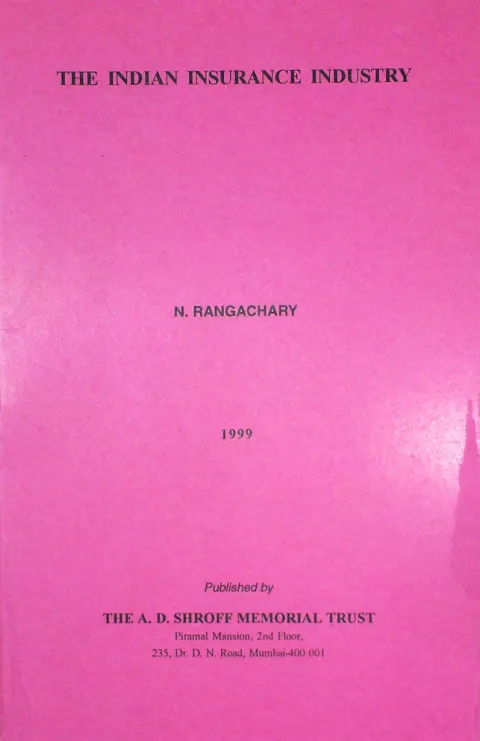
The Indian Insurance Industry
By N. RANGACHARY
Summary
Delivered as the A. D. Shroff Memorial Annual Public Lecture on Insurance for 1998 (given 19 January 1999 in Mumbai), this address by N. Rangachary, Chairman of the Insurance Regulatory Authority of India, makes the case for opening up India’s insurance sector to private and foreign participation. Rangachary opens by noting the controversy around the new IRA, set up by executive resolution in January 1996, and the simultaneous criticism and praise the government drew for moving to end the state monopoly. He situates insurance within a financial sector undergoing transformation from ‘assumed complacency to vibrancy’, arguing that long-term savings generated by life and pension business are the only domestic source of the long-term resources India needs for infrastructure.
The lecture explains what insurance is and why penetration is low — only about 18% of the population is insured, and even the insured understand it poorly — and links the case for wider cover to the breakdown of the joint family, which once acted as a social-security provider. Rangachary recounts the history of state control (life insurance nationalised in 1956, non-life in 1971), and contends that the resulting four-subsidiary GIC structure, sharing common ownership, work norms and staff, has ‘reduced itself to one-horse race’ with little real choice or competition for the customer. He criticises the existing industry’s weak service culture, over-attention to ‘small print’ and legal quibbling, and invokes Gandhi’s ‘customer is the king’ dictum to argue for a customer-focused, technology-enabled, de-layered model.
In the rendered pages Rangachary forecasts the benefits of broadening the market — the ‘sprinkler effect’ of new players — including increased insurance and pension coverage, increased consumer focus, increased employment (citing Asian comparators and projecting over 1 million direct and indirect jobs in five years), improved intermediation, better global management practices and technology, and long-term investment capital for a capital-starved economy. He buttresses the argument with data: India’s life premium is only 0.5% of GDP versus 3.3% in Australia, and pension assets per elderly person rank last among fourteen countries studied. The rendered text ends within the discussion of the new entrants’ capital requirements under the Malhotra Committee and the long-term gains for the economy.
Key points
-
A. D. Shroff Memorial Annual Public Lecture on Insurance for 1998, delivered 19 January 1999 in Mumbai by N. Rangachary, Chairman of the Insurance Regulatory Authority of India.
-
Defends opening up India’s insurance sector to private/foreign players, against critics who argued no further progress was needed.
-
Frames insurance as the chief domestic source of the long-term savings India needs for infrastructure investment.
-
Notes very low penetration (~18% insured) and poor public understanding of insurance, tied to the breakdown of the joint-family social-security system.
-
Recounts nationalisation history — life insurance 1956, non-life 1971 — and argues the four GIC subsidiaries form a complacent monopoly with no real consumer choice.
-
Invokes Gandhi’s ‘customer is the king’ to demand a customer-focused, technology-enabled, de-layered service culture.
-
Forecasts the ‘sprinkler effect’ of new players: wider coverage, more pension funds, consumer choice, and over 1 million new jobs in five years.
-
Supports the case with comparative data — India’s life premium is 0.5% of GDP vs 3.3% in Australia; pension assets per elderly person rank last of 14 countries.
Generated by the v1.5 extraction pipeline. Awaiting editorial review.
Metadata and summary are AI-extracted from the source PDF and reviewed for editorial accuracy. The original work is available via the Read PDF tab above (where present); paragraph-level citation inside the PDF is deferred to a future engagement.