periodical issue
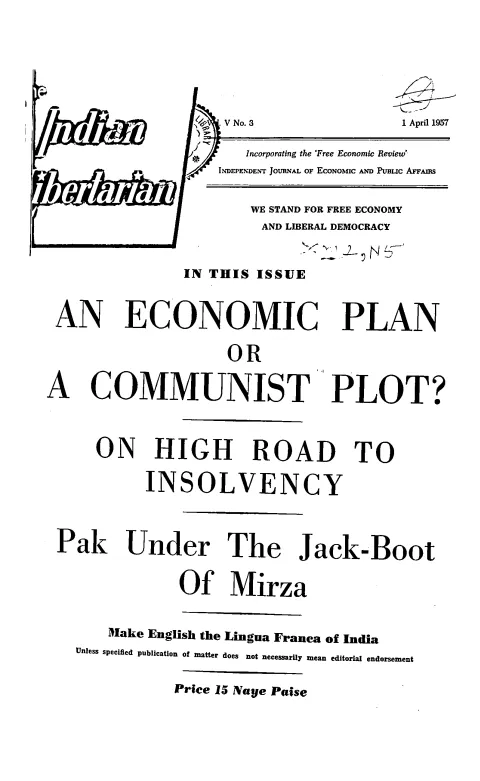
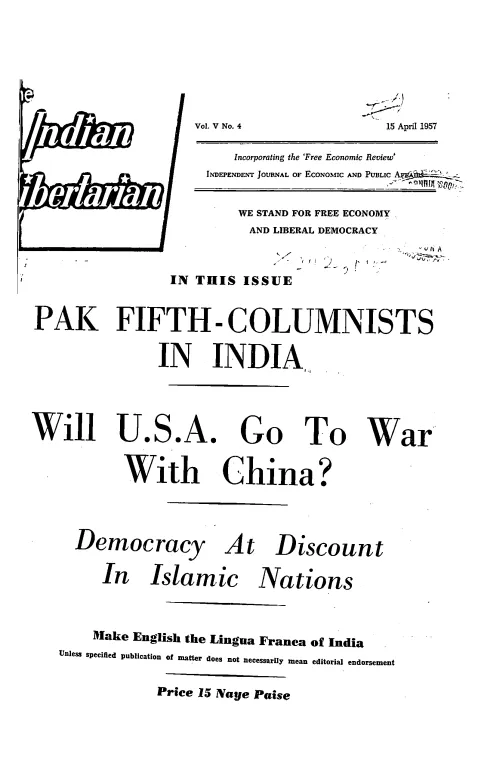
The Indian Libertarian
Independent Journal of Economic and Public Affairs
Libertarian Publishers (Private) Ltd., 26 Durgadevi Road, Bombay 4 · Bombay · 1957
20 pages
The Indian Libertarian
Summary
The 15 April 1957 number of The Indian Libertarian (Vol. V, No. 4), edited by Kusum Lotwala for the Libertarian Publishers (Private) Ltd., Bombay, gathers an editorial, six signed essays, three standing departments and a book notice under the masthead promise to ‘stand for free economy and liberal democracy.’ Its argumentative center is twofold: a sustained alarm at what the editors see as the steady drift of Indian policy under the Second Five-Year Plan towards Soviet-style collectivism (in agriculture, in trade, in the currency, and in school curricula), and a sharply liberal-democratic reading of contemporary foreign affairs — Pakistan’s anti-India fifth-column press, the prospects of war between the United States and Communist China, the Hungarian aftermath of de-Stalinisation, the breakdown of representative government in newly independent Islamic states, and the Suez settlement. Recurring contributors include M. A. Venkata Rao on agriculture and the Suez canal, Dr. K. N. Kini on Sino-American conflict, James Burnham on the post-Stalin Kremlin, the columnists ‘Vigilant’ and ‘Vivek’ on internal subversion and black-marketing, and J. K. Dhairyawan on democracy in Islamic nations; K. D. Valicha closes the issue with a review of J. D. Sethi and K. L. Gauba’s Our Economic Problems.
Key points
-
The unsigned editorial Collapse of Democracy in Islamic Countries reads the post-1918 political history of Egypt, Syria, Saudi Arabia, Jordan and Iraq as a record of repeated democratic failure.
-
A companion editorial, Red Star Over Kerala, treats the swearing-in of the state’s new Communist ministry as a national emergency for liberal democracy in India.
-
The editorial pages attack compulsory cooperative and joint farming schemes as the destruction of independent peasant proprietorship, and warn that schools and youth organisations are the regime’s next instrument.
-
M. A. Venkata Rao’s Agricultural Statesmanship reads the Second Five-Year Plan as a decisive shift toward Soviet-style collectivisation and defends the independent cultivator as democracy’s political mainstay.
-
Venkata Rao closes his essay by invoking Adam Smith’s verdict on colonial monopoly as a classical-liberal parable against the Plan’s home-grown monopolies in food and trade.
-
Dr. K. N. Kini’s essay on a possible U.S.-China war argues that Communist China has grown harder to intimidate since 1953 and that Pakistan is a liability to American strategy.
-
James Burnham’s De-Stalinisation argues that Khrushchev’s Kremlin has abandoned only Stalinism’s most embarrassing features while preserving its substance of terror, party monopoly and expansion.
-
Burnham warns Western observers and Indian neutralists against mistaking Khrushchev’s tactical adjustments after the Hungarian massacre for a genuine structural liberalisation of Communist rule.
Essays
EDITORIAL
The unsigned editorial opens with ‘Collapse of Democracy in Islamic Countries’, arguing that since the First World War the new Islamic states of West Asia — Egypt, Syria, Saudi Arabia, Jordan and Iraq — have repeatedly defaulted on representative government, and reads the rise of Nasser, Sukarno and military regimes as evidence that Islamic political culture is structurally hostile to liberal democracy. The remainder of the editorial section pivots to domestic affairs: ‘Red Star Over Kerala’ on the new Communist ministry; ‘Debauching Indian Economy’ on inflationary deficit financing; ‘Krishna Menon As “Chota” Dictator’ on the Defence Minister’s first major Lok Sabha speech on foreign policy; ‘Destruction Of Agricultural Economy’ attacking the cooperative-farming and joint-farming schemes pressed by the Planning Commission; and ‘Catching The Young’, warning that the regime is using state schools and youth organisations to indoctrinate children along Soviet lines.
- Frames the Islamic world’s post-1918 experiments in self-government as a record of repeated democratic collapse.
- Reads the swearing-in of a Communist ministry in Kerala as a national emergency for liberal democracy.
- Treats deficit financing under the Second Five-Year Plan as deliberate ‘debauching’ of the rupee.
- Attacks compulsory cooperative and joint farming as the destruction of independent peasant proprietorship.
- Warns that Communist-style use of schools and youth organisations is the regime’s next instrument.
Agricultural Statesmanship
By MA Venkata Rao
M. A. Venkata Rao’s ‘Agricultural Statesmanship’ argues that with the Second Five-Year Plan Indian policy has taken a ‘decisive momentum towards Marxism of the Soviet Russian variety’, forcing the eradication of independent peasant agriculture in favour of cooperative and state farming. Drawing the contrast with the Soviet liquidation of the kulaks and with the small-holder economies of Western Europe, he insists that the political mainstay of representative democracy in India is the independent cultivator, and that uprooting him in the name of collectivisation will dissolve both rural liberty and the productive base of the economy. The essay closes by reproducing Adam Smith’s verdict on colonial monopoly as a parable against the Plan’s home-grown monopolies in food and trade.
- Reads the Second Plan as a structural shift towards Soviet-style collectivisation of Indian agriculture.
- Defends the independent cultivator as the political and moral backbone of representative democracy.
- Treats cooperative and joint farming proposals as functional liquidation of the peasant proprietor.
- Argues monopoly arrangements — whether colonial or planned — depress the producing economy.
- Closes with Adam Smith’s Wealth of Nations passage on the colony trade as classical-liberal warning.
Will U.S.A. Risk a War with China
By Dr. K. N. Kini
Dr. K. N. Kini’s ‘Will U.S.A. Risk a War with China?’ weighs Washington’s apparent willingness to use Asian forces — and, if necessary, atomic weapons — against the People’s Republic. He revisits the Korean precedent of ‘making Asians fight Asians’, argues that the Chinese have grown more difficult to intimidate since 1953, and treats Pakistan’s strategic value to the United States as fragile because Karachi’s anti-India obsession compromises any genuine SEATO commitment in the region.
- Reads American Asia policy through the lens of ‘making Asians fight Asians’, from Korea forward.
- Argues Communist China has hardened since 1953 and will not be easily deterred by atomic threats.
- Treats Pakistan as a liability rather than an asset to the United States in any Asian war.
- Assesses SEATO and other alliance frameworks as insufficient anchors for U.S. policy in Asia.
De-Stalinisation
By James Burnham
James Burnham’s ‘De-Stalinisation’ argues that, after the Hungarian massacre and a renewed brutality of tone from the Kremlin, the talk of de-Stalinisation in the West has been overtaken by events. Burnham distinguishes Stalinism as a fused complex — police terror, single-party monopoly, planning, ideological mobilisation, expansion — and contends that the present Soviet leadership has surrendered only the most embarrassing of these features (the personal cult, the most flagrant frame-ups) while preserving the substance. He warns Western observers and Indian neutralists against reading Khrushchev’s tactical adjustments as a structural liberalisation of the Communist order.
- Identifies Stalinism as an indivisible complex of terror, party monopoly, planning and expansion.
- Reads the post-Stalin Kremlin as having dropped surface excesses while retaining the core regime.
- Treats the Hungarian repression as proof that the Soviet system has not been liberalised.
- Cautions Western and Indian opinion against credulous interpretations of ‘de-Stalinisation’.
Pak. Fifth-Columnists in India
By Vigilant
The columnist ‘Vigilant’ surveys what he calls the Pakistani fifth column inside India. Beginning from the observation that Pakistan is ‘perpetually carrying on a campaign of hate and hatred against India’, the column argues that Karachi’s propaganda is being amplified inside India by a network of sympathetic Urdu papers and informal cells, and presses the Indian Government to treat overt and covert Pakistani propaganda inside the country as a security matter rather than a free-speech curiosity.
- Treats Pakistan’s anti-India broadcasts and press as a sustained external propaganda campaign.
- Identifies sympathetic publications inside India as the domestic transmission belt for that campaign.
- Calls on the Government of India to act against the network as a security threat.
Government Encouraged Black Marketing
By Vivek
Writing under the byline ‘Vivek’, the columnist takes T. T. Krishnamachari’s recent budget-debate admission as confirmation that the regime of permits, controls and rationing has itself produced India’s black market. The piece argues that the price-control and licensing apparatus erected since the Second Plan rewards diversion and bribery, and that the Finance Minister’s candour is less a confession than an indictment of the planning system that made black-marketing structurally rational for the trader.
- Reads the Finance Minister’s budget-speech admission as ratification of the columnist’s case against controls.
- Argues India’s black market is an engineered consequence of permits and price-control.
- Treats the planning apparatus, not the trader, as the originating cause of the parallel economy.
Democracy at Discount in Islamic Nations
By J. K. Dhairyawan
J. K. Dhairyawan opens ‘Democracy at Discount in Islamic Nations’ by invoking F. A. Ridley’s recent characterisation of organised Roman Catholicism and organised Islam as the twin evils of the modern age, and proceeds to survey the post-1918 record of representative government across Egypt, Syria, Saudi Arabia, Jordan, Iraq, Iran, Pakistan and Indonesia. The essay argues that none of these states has consolidated a working constitutional order, that political life in each has alternated between military strongmen and clerical reaction, and that this pattern follows from the inability of Islamic legal and social culture to admit the separation of religion and state on which liberal democracy depends.
- Frames the discussion through F. A. Ridley’s pairing of Roman Catholicism and Islam as twin modern evils.
- Surveys post-1918 democratic failure across the principal Islamic states of West Asia and South-East Asia.
- Treats the absence of separation of religion and state as the structural obstacle to representative government.
- Reads the rise of strongmen (Nasser and others) as a symptom of this deeper incompatibility.
THE MIND OF THE NATION
‘The Mind of the Nation’ is a clipping-style department that gathers press extracts on the political and economic mood of the country: ‘Crores Indian Capitalists’ and a Federation of Indian Chambers note on the cost of the Second Plan to private enterprise; ‘Business Community Losing Faith In Itself’; a Times of India tabulation of ‘Grim Economic Prospects’; a short notice on an American university recruiting Indian students; and Venkata Rao’s signed follow-up ‘Another Word on the Suez Canal’, which argues that nationalisation of the canal sets a dangerous precedent for international property and reads the United Nations response as evasive.
- Aggregates contemporary press opinion on private enterprise, business confidence and economic prospects.
- Cites a Federation of Indian Chambers analysis on the burden of the Second Plan on private capital.
- Carries a follow-up note by Venkata Rao on the Suez nationalisation as a precedent for international property.
INDIAN NEWS PARADE
‘Indian News Parade’ is a clipping-style round-up of political news from the subcontinent. The lead item, ‘Jehad Cries In Pakistan’, reports calls for holy war from members of the West Pakistan Assembly. Further notes cover Pakistan’s hope for American support after President Iskander Mirza’s visit, a ‘Roundtable’ on India’s foreign policy, border incidents, the Naga problem, and a panel of items on Communism in Kerala, including reassurances from new leaders that property and faith will be respected. A closing section reports the favourable reception of The Indian Libertarian and its sister magazine Freedom First in Britain.
- Leads with ‘Jehad’ rhetoric in the West Pakistan Assembly as evidence of intensifying anti-India agitation.
- Tracks Pakistan-U.S. diplomatic signals after President Iskander Mirza’s visit.
- Reports on the new Communist ministry in Kerala and its public assurances on property and religion.
- Notes the favourable British reception of The Indian Libertarian and Freedom First.
BOOK REVIEW
K. D. Valicha reviews ‘Our Economic Problems’ by J. D. Sethi and K. L. Gauba (Centre for Economic and Trade Ltd., London, 1956). He treats the volume as a survey of Indian economic policy under the Plan, organised around the realm of pure economics and the political economy of decision-making. Valicha welcomes the authors’ attention to the gap between planned targets and the institutional means of meeting them, sets out the book’s discussion of a new economic system, and closes by recommending the volume as a useful primer for the educated lay reader on the practical limits of the Indian planning model.
- Frames the book as a critical survey of the Indian planning record.
- Notes the authors’ separation of pure economic analysis from political economy.
- Highlights the gap between planning targets and institutional capacity as the central diagnosis.
- Recommends the book to the lay reader interested in the limits of the Indian planning model.
Generated by the v1.5 extraction pipeline. Awaiting editorial review.
Metadata and summary are AI-extracted from the source PDF and reviewed for editorial accuracy. The original work is available via the Read PDF tab above (where present); paragraph-level citation inside the PDF is deferred to a future engagement.