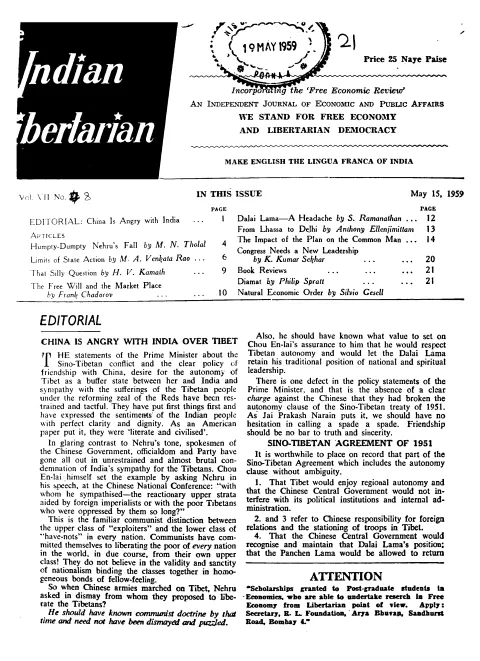
periodical issue
The Indian Libertarian
An Independent Journal of Economic and Public Affairs — Special Tibetan Issue
By A Ranganathan, MA Venkata Rao, M. N. Tholal
The Indian Libertarian — Independent Journal of Free Economy and Public Affairs · Bombay · 1959
28 pages
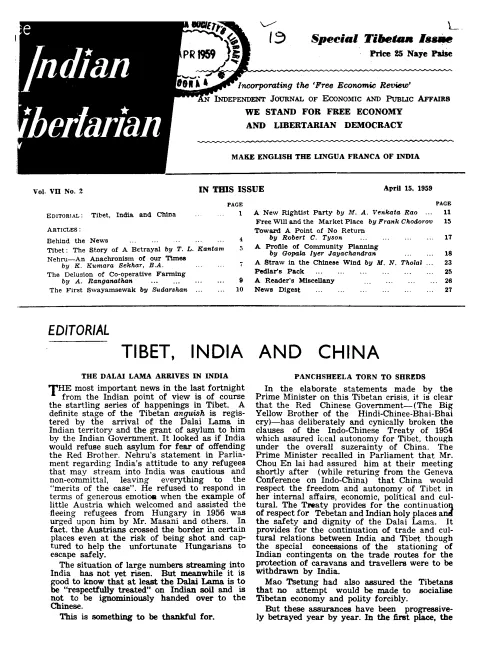
The Indian Libertarian
Summary
The April 15, 1959 number of The Indian Libertarian (Vol. VII No. 2), edited by Edith Iathwala for the Libertarian Social Institute in Bombay, is a ‘Special Tibetan Issue’ whose editorial spine condemns the Nehru government’s handling of the Tibetan crisis as a ‘double standard of morality’. The editorial ‘Tibet, India and China’ and T. L. Kantam’s lead essay ‘Tibet: The Story of A Betrayal’ read the arrival of the Dalai Lama in Indian territory as exposing the bankruptcy of the 1954 Indo-Chinese Panchsheel Treaty and the cynical breaking of Mao Tsetung’s earlier assurances that the autonomy, economy and polity of Tibet would be respected. The remainder of the issue gathers the magazine’s familiar classical-liberal commentary: K. Kumara Sekhar charges that Nehru’s Marxist conditioning makes him ‘an anachronism of our times’; A. Ranganathan attacks the Nagpur Congress resolution on co-operative farming as a delusion drawn from Soviet and Chinese models; M. A. Venkata Rao welcomes the new Independent Parliamentary Group as a long-awaited rightist alternative; Sudarshan offers a sympathetic profile of K. B. Hedgewar and the RSS as the ‘First Swayamsewak’; Frank Chodorov (reprinted) defends free will and the market against bureaucratic planning; Robert C. Tyson warns of an American fiscal point of no return; and Gopala Iyer Jayachandran dissects Community Planning as a third tier of unproductive bureaucracy. The volume mixes Tibet polemic, anti-planning economics, and party-political commentary in roughly equal measure.
Key points
-
This ‘Special Tibetan Issue’ (Vol. VII, No. 2, 15 April 1959) opens with the editorial ‘Tibet, India and China’, which reads the Dalai Lama’s flight into Indian territory as exposing the bankruptcy of the 1954 Panchsheel Treaty.
-
The editorial contrasts Nehru’s cautious, non-committal stance toward Tibetan refugees with Austria’s 1956 welcome of Hungarian refugees fleeing the Red Army, naming this gap a ‘double standard of morality’.
-
T. L. Kantam’s ‘Tibet: The Story of A Betrayal’ narrates the Chinese subjugation of Tibet as a long, premeditated betrayal, tracing historical dynastic ties between India, Tibet and China.
-
Kantam presents the Dalai Lama and the Tashi Lama as the religious-political institutions that Beijing is working to dissolve, and treats the world’s relative silence on Tibet as itself a moral failing.
-
K. Kumara Sekhar’s ‘Nehru—An Anachronism of our Times’ attributes Nehru’s reluctance to break with Beijing to a mind formed by British public-school socialism and Marxist conditioning.
-
A. Ranganathan attacks the Nagpur Congress resolution on co-operative farming as a delusion imported from Soviet and Chinese models, while M. A. Venkata Rao welcomes the newly formed Independent Parliamentary Group as a long-awaited rightist alternative to Congress.
-
Sudarshan offers a sympathetic profile of K. B. Hedgewar and the RSS as the ‘First Swayamsewak’, while Frank Chodorov’s reprinted piece defends free will and the market against bureaucratic planning.
-
Gopala Iyer Jayachandran’s essay dissects Community Planning as a third, unproductive tier of bureaucracy, and Robert C. Tyson warns of an approaching American fiscal point of no return.
Essays
Tibet, India and China (Editorial)
The unsigned editorial frames the arrival of the Dalai Lama in Indian territory as ‘the most important news in the last fortnight’ and as a ‘definite stage of the Tibetan anguish’. It contrasts India’s cautious, non-committal Parliamentary statements about Tibetan refugees with the boldness of little Austria, which welcomed Hungarian refugees from the Red Army in 1956 even at the risk of being shot. The editorial then argues that the 1954 Indo-Chinese Panchsheel Treaty—which guaranteed Tibetan autonomy in internal, economic, political and cultural affairs—has been ‘deliberately and cynically’ broken by Mao Tsetung’s government, and indicts the Indian government’s response as a ‘double standard of morality’ that protects the goodwill of the ‘Red Brother’ at the cost of Tibetan freedom.
- Treats the Dalai Lama’s flight to India as the central foreign-policy event of the fortnight
- Contrasts Nehru’s cautious asylum stance with Austria’s 1956 welcome of Hungarian refugees
- Argues that China has ‘cynically broken’ the 1954 Panchsheel guarantees of Tibetan autonomy
- Accuses Mao Tsetung of betraying his earlier assurance that Tibetan economy and polity would not be forcibly socialised
- Names this divergence between New Delhi’s words and deeds a ‘double standard of morality’
Behind the News
An unsigned ‘Behind the News’ column extends the editorial line by linking the Tibetan question to the wider Asian Cold War. It argues that thanks to a docile press and an inert public opinion the Indian government has been able to engage in ‘unprincipled adjusting’ on Tibet, and that the so-called ‘force of circumstances’ invoked by the Prime Minister is in fact a function of failing to register protest with strength when the issues first arose. The column reads Chinese behaviour over Tibet as part of a longer narrative of expansion and warns that the doctrine of Panchsheela can no longer mask plain national interest.
- Frames the column’s task as exposing what the official handling of Tibet leaves unsaid
- Argues India’s failure to protest forcefully on Tibet earlier is what now constrains its options
- Treats Panchsheela as a slogan no longer congruent with Chinese conduct on the ground
- Connects the Tibetan question to broader Asian Cold War balance
Tibet: The Story of A Betrayal
By T. L. Kantam
T. L. Kantam narrates the Chinese subjugation of Tibet as a long, premeditated betrayal of an isolated ‘pleasure-loving people’. He traces the historical and dynastic links between India, Tibet and China—including marriages between Tibetan rulers and Nepali and Chinese princesses—and then sets out the breach of those traditional bonds by Communist China, whose secrecy and territorial appetite the article tracks through the closing of Tibetan borders, the suppression of religious life and the regimentation of monastic estates. Kantam argues that the religious-political authority of the Dalai Lama and the Tashi Lama is the institutional core that Beijing seeks to destroy, and that the worldwide silence on Tibet is itself a moral indictment.
- Reads the Chinese occupation as a long-planned betrayal of a peaceable Buddhist people
- Traces historical kinship and trade ties between Tibet, India and China to expose Beijing’s revisionism
- Presents the Dalai Lama and the Tashi Lama as the religious-political institutions Beijing wants to dissolve
- Documents the systematic regimentation of Tibetan monastic and economic life under Chinese rule
- Treats the world’s relative silence on Tibet as itself a moral problem
Nehru—An Anachronism of our Times
By K. Kumara Sekhar, B.A.
K. Kumara Sekhar mounts a polemical character study of Jawaharlal Nehru, arguing that the Prime Minister’s mind was formed by British public-school socialism and Marxist conditioning, and that his current discomfort over Tibet exposes that conditioning rather than chastens it. Sekhar reads Nehru’s reluctance to break openly with Beijing as the predictable behaviour of a man whose ideological commitments have made him incapable of seeing Communism as a moral problem. He argues that India’s foreign policy is therefore not the work of an inscrutable statesman but of an ‘anachronism’—a leader whose nineteenth-century European categories no longer fit the post-1949 Asian situation. Sekhar concludes that India must outgrow Nehru’s vanity-driven Marxism if it is to develop a coherent national line.
- Treats Nehru’s mind as shaped by British public-school socialism and second-hand Marxism
- Reads Nehru’s caution on Tibet as ideological loyalty, not strategic prudence
- Argues that India’s foreign policy reflects one man’s vanity rather than national interest
- Diagnoses Nehru as historically out of place—an ‘anachronism of our times’
- Calls for India to outgrow Nehru’s worldview before crafting a fresh national line
The Delusion of Co-operative Farming
By A Ranganathan
A. Ranganathan attacks the Nagpur Congress resolution on co-operative farming as a delusion borrowed from the Soviet collectivisation and from Mao’s commune experiments. He argues that the Congress leadership, having failed to deliver agricultural growth through the first two Plans, is now reaching for a coercive institutional fix that will neither raise productivity nor enlarge peasant freedom. Ranganathan contends that voluntary co-operatives have a place but that ‘co-operative farming’ as a state-imposed model is incompatible with the small-holder character of Indian agriculture, and that the bureaucratic-political ideology imitatively borrowed from Moscow is the real obstacle to peasant prosperity.
- Reads the Nagpur Congress resolution on co-operative farming as an imitation of Soviet and Chinese models
- Argues that the failures of the first two Plans, not peasant resistance, are what produced the resolution
- Distinguishes voluntary co-operatives (acceptable) from state-imposed co-operative farming (rejected)
- Identifies a ‘bureaucratic-political ideology’ borrowed from the USSR as the chief obstacle to Indian agriculture
The First Swayamsewak
By Sudarshan
Sudarshan offers a sympathetic biographical sketch of Dr. K. B. Hedgewar, founder of the Rashtriya Swayamsevak Sangh, presenting his life of ‘sorrow, suffering and sacrifice’ as the model of the first swayamsewak. The piece narrates the Vidarbha origins of the Sangh, the shakha (cell) method of national-cultural training, and the post-Partition trials the organisation underwent. Sudarshan argues that the Sangh’s strength lay in its insistence on character formation and national consciousness as the prerequisites of any political reconstruction, and that the swayamsewak ideal still answers a need that conventional parties cannot.
- Treats K. B. Hedgewar’s biography as the moral template of the swayamsewak ideal
- Locates the RSS shakha system as the institutional core of Hedgewar’s contribution
- Presents character-formation and cultural cohesion as prior to political programme
- Defends the Sangh as still relevant after the post-Partition controversies it weathered
A New Rightist Party
By MA Venkata Rao
M. A. Venkata Rao welcomes the platform of the new Independent Parliamentary Group as the first serious attempt to give India’s political and commercial interests a distinct rightist voice, but argues that liberalism cannot be reduced to a sectional defence of laissez-faire. He develops a fuller liberal programme around fundamental freedoms—of religion, occupation and the press—property rights, the rule of law, and democracy understood not as planning but as the dispersal of decisions. Reading Rajaji and Munshi as natural senior partners of such a movement, Venkata Rao argues that the rightist party must move past purely economic complaint and contest the Congress on the terrain of constitutional principle.
- Greets the Independent Parliamentary Group’s platform as a long-needed rightist alternative
- Argues that mere commercial liberalism is not enough; a full liberal philosophy is required
- Lays out fundamental freedoms, property rights, rule of law, and federal dispersal of power as the platform’s missing core
- Reads Rajaji and Munshi as the natural senior figures of such a movement
- Calls for the new party to challenge the Congress on constitutional, not merely economic, ground
Free Will and the Market Place
By Frank Chodorov
Frank Chodorov’s reprinted essay argues that ‘free will is the starting point of all ethical thinking’ and that the same premise must govern economic life. Markets, on his account, are not engines of exploitation but the institutional form of voluntary cooperation: prices and competition let individuals make choices whose moral character requires the absence of coercion. Chodorov develops the case through the specialisation of labour, the function of capital, and the necessity of profit as a return on respect for property. The first half rendered ends with an argument that bureaucratic substitution of force for choice destroys both the wealth and the moral standing of a society.
- Grounds market exchange in the same free-will premise as ethics
- Treats specialisation, capital and profit as natural consequences of voluntary cooperation
- Identifies coercive substitution for market choice as the destroyer of both wealth and moral agency
- Defends respect for property as the necessary corollary of respect for persons
Toward A Point of No Return
By Robert C. Tyson
Robert C. Tyson warns that the United States is approaching a fiscal ‘point of no return’ at which the cumulative weight of federal spending, the highest peacetime tax rates ever experienced, and the steady give-and-take spiral of demands on government will make further growth in productive industry effectively impossible. The essay reads American industries as confronting common questions even where their specific problems differ, and identifies the bipartisan willingness to spend as the root danger. In the portion rendered Tyson is building toward a programme of disciplined retrenchment as the only way back from the spiral.
- Diagnoses the U.S. fiscal trajectory as approaching a point of irreversibility
- Names the highest peacetime tax rates ever experienced as the threshold variable
- Frames the issue as common to all major American industries, not sectional
- Sets up an argument for disciplined retrenchment of federal spending
A Profile of Community Planning
By Gopala Iyer Jayachandran
Gopala Iyer Jayachandran reads the Community Development and Community Planning programme as the third layer of an already over-bureaucratised state, multiplying offices and reports without adding to productive capacity. He distinguishes ‘community’ as an organic life-form rooted in shared cultural and economic interests from the official Community Project, which he reads as a top-down political instrument that the village neither owns nor controls. The portion rendered develops the argument that genuine community building requires devolution of decision and resources rather than the proliferation of administrative posts; the essay continues past the rendered pages.
- Treats Community Planning as a third tier of bureaucracy rather than as devolution
- Distinguishes organic community life from administered ‘community projects’
- Argues that politicians and big landlords use community schemes to consolidate their hold
- Frames real community-building as requiring devolution of decision and resources
Generated by the v1.5 extraction pipeline. Awaiting editorial review.
Metadata and summary are AI-extracted from the source PDF and reviewed for editorial accuracy. The original work is available via the Read PDF tab above (where present); paragraph-level citation inside the PDF is deferred to a future engagement.