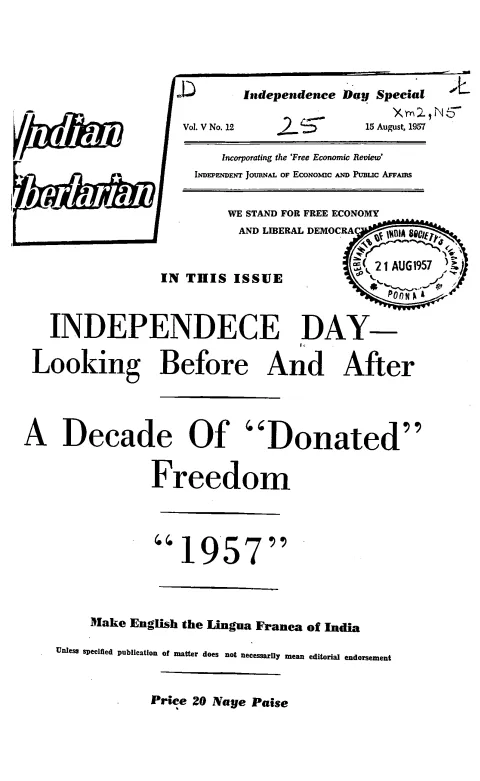
periodical issue
The Indian Libertarian
Independent Journal of Economic and Public Affairs
The Indian Libertarian, Arya Bhuvan, Sandhurst Road, Bombay 4. Published on the 1st and 15th of Each month · Bombay · 1957
24 pages
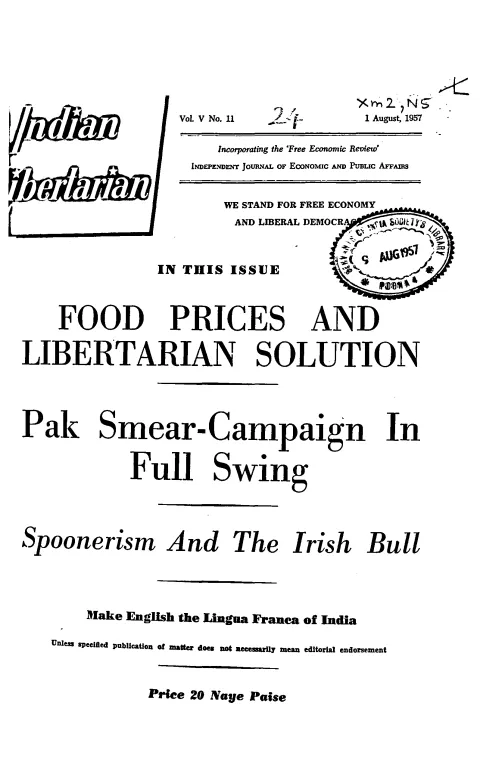
The Indian Libertarian
Summary
This 1 August 1957 issue of The Indian Libertarian (Vol. V, No. 11), edited by Kusum Lotwala and published from Bombay by the R. L. Foundation, frames itself as an “Independent Journal of Economic and Public Affairs” standing “for free economy and liberal democracy.” Its editorial backbone is twofold: a denunciation of Nehruvian foreign policy as dangerously complacent toward Pakistan, Communist China and the Soviet Union; and a libertarian critique of Indian state controls over food grains, foreign exchange and investment under the Second Five Year Plan. Signed contributions come from M. A. Venkata Rao, K. D. Valicha (twice), Sumant S. Bankeshwar, Mehta Puran Chand and the pseudonymous “SCIO” and “Vigilant.”
The issue carries a four-page inserted “Supplement of the Research Department of the R. L. Foundation” (paginated A–D) with essays by B. S. Sanyal on the failure of socialism (“Bread and Circuses”), K. D. Valicha on foreign investment, and a manifesto-style piece, “My Belief and Hope,” by the American co-operative theorist James Peter Warbasse. The remainder of the rendered pages cover defence policy (Mehta Puran Chand on nuclear weapons), a long news-analytic feature on a Pakistani propaganda offensive over Kashmir, a statement of purpose for the Libertarian Social Institute, and reports on the R. L. Foundation’s reading room and seminars. World News and Book Reviews advertised in the table of contents were not in the rendered chunk.
Key points
-
The unsigned editorial, “The Hard Core of Indo-Pak Troubles,” argues Pakistan’s Kashmir claim is a constitutive demand whose fulfilment would mean the gradual absorption of Indian Muslim regions, not a mere frontier dispute.
-
It also praises Acharya Kripalani’s tougher line on Kashmir while criticising the Suhrawardy mission to Washington and Iskander Mirza’s parallel diplomatic offensive in Western capitals.
-
Elsewhere, the editorial accuses Nehru’s government of “dangerous complacency” toward Pakistani rearmament, Chinese expansion into Tibet, and Soviet penetration of West Asia.
-
A second editorial column cites Frank E. Holman’s “Dangers of Treaty Law” to argue American foreign aid is being squandered on regimes hostile to the United States and the free world.
-
M. A. Venkata Rao argues a surplus of food grains and industrial raw materials is the only honest foundation for India’s industrial drive, reading the 1957 price crisis as the product of statutory procurement and ceiling prices.
-
Venkata Rao contrasts India’s controlled economy with nineteenth-century free-trade England and Lancashire’s mills, calling for dismantling controls and restoring the price mechanism to let surplus accumulate through voluntary peasant exchange.
-
He treats the Second Five Year Plan’s economic logic as incompatible with libertarian economics, faulting the Essential Commodities Bill for worsening the food-price crisis.
-
Writing pseudonymously as “SCIO,” a contributor reads Pakistan’s domestic political instability under martial administration as the driver of its external posture toward India over Kashmir.
-
“SCIO” argues Pakistan’s grievance over the Indus waters dispute is being grafted onto the Kashmir grievance to build a case for a military “showdown” with India.
Essays
EDITORIAL
The unsigned editorial, “The Hard Core of Indo-Pak Troubles,” argues that Pakistan’s Kashmir claim is not a frontier dispute but a constitutive demand whose fulfilment would entail the gradual absorption of Indian Muslim regions, and faults the Government of India and “the Pandits” for refusing to recognise this. It praises Acharya Kripalani’s tougher line on Kashmir, criticises the Suhrawardy mission to Washington and Iskander Mirza’s parallel diplomatic offensive in Western capitals, and accuses Nehru’s government of “dangerous complacency” in the face of Pakistani rearmament, Chinese expansion into Tibet, and Soviet penetration of West Asia. A second editorial column reproduces a passage from Frank E. Holman’s “Dangers of Treaty Law” to argue that American foreign aid is being squandered on regimes hostile to the United States and to the free world.
- Reads the Kashmir question as a continuing demand on Indian territory and Indian Muslims, not a border dispute that can be settled by partition of the state.
- Sides with Acharya Kripalani’s criticism of Nehru’s Kashmir and Pakistan policy.
- Treats Suhrawardy’s US visit and Mirza’s European tour as a coordinated diplomatic offensive against India that the Indian government has failed to counter.
- Sees the Chinese conquest of Tibet and Soviet moves in West Asia as part of a single threat that India is refusing to acknowledge.
- Cites Frank E. Holman to argue that the US is funding regimes that work against the free world’s interests.
Food Prices and Libertarian Solution
By MA Venkata Rao
M. A. Venkata Rao opens with the libertarian thesis that a surplus of food grains and industrial raw materials is the only honest foundation for India’s industrial drive, and that the price crisis of 1957 is the predictable consequence of statutory procurement, ceiling prices, controlled rationing, and ad-hoc Essential Commodities legislation. He contrasts this with what he calls a “Different Tale” of nineteenth-century England under free trade and Lancashire mills, and concludes that the libertarian remedy is to dismantle controls, restore the price mechanism, and let surplus accumulate from voluntary peasant exchange rather than from compulsory levy.
- Frames a surplus in food grains and industrial raw materials as the precondition for any genuine industrial drive in India.
- Reads the current shortage and price spike as the direct effect of Government procurement, ceiling prices and the Essential Commodities Bill.
- Contrasts the Indian experience with the free-trade English precedent.
- Calls for restoring free pricing and dismantling rationing and physical controls.
- Treats the Second Five Year Plan’s logic as incompatible with libertarian economics.
Is Pakistan Preparing for a Showdown?
By Scio
Writing under the pseudonym “SCIO,” the contributor surveys the run-up to a possible Pakistani military move on Kashmir following the August 1947 partition. The essay reviews the failure of constitutional processes in Pakistan, divisions within its political class, and the entry of West Pakistan into a martial-administrative phase. It treats the public threats from the Pakistani President as more than rhetoric and warns that Pakistan’s grievance machinery — the “additional grievance” of the Indus waters dispute, the unsettled status of Kashmir — is being assembled into a case for a “showdown.”
- Reads Pakistan’s domestic political instability as the driver of an external posture toward India.
- Argues that the additional grievance of Indus waters is being grafted onto the Kashmir grievance to justify confrontation.
- Treats Pakistani presidential rhetoric as a serious indicator of intent, not merely posturing.
- Frames the prospect of a ‘showdown’ as a likely 1957 contingency.
Spoonerism and the Irish Bull
By K. D. Valicha
K. D. Valicha uses the rhetorical figures of the Spoonerism (transposed sounds) and the Irish Bull (a self-contradicting statement) as a frame for cold-war double-talk. The essay glosses Suhrawardy’s posture toward America, the Soviet record under Stalin and Khrushchev, and the contortions of left-wing Indian commentary. Valicha argues that the language of friendship-with-everyone collapses into incoherence the moment it is tested against the record of Hungary, Korea and similar episodes, and that Indian foreign-policy commentary is full of such Irish Bulls.
- Uses the Spoonerism and the Irish Bull as comic figures for the incoherence of fellow-travelling commentary.
- Reads Suhrawardy’s American overtures as another instance of double-talk.
- Treats Hungary and Korea as decisive falsifications of Soviet self-description.
- Targets Indian left commentary as full of self-contradicting praise.
Our Foreign Policy
By Sumant S. Bankeshwar
Sumant S. Bankeshwar argues that India’s foreign policy has been miscast for a hundred years past as a search for moral leadership when what is needed is a sober assessment of imminent dangers — chiefly Pakistan’s drift into the orbit of foreign powers and the Communist bloc’s pressure across India’s northern frontier. He calls for a re-orientation that recognises Pakistan as a hostile state, identifies the Communist threat as the principal external danger, and ties India’s defence and economic policy to that recognition rather than to non-alignment of a sentimental kind.
- Frames non-alignment as moralistic and inadequate to actual threats.
- Reads Pakistan as the most immediate external danger and as a hostile state.
- Identifies the Communist bloc as the structural long-term threat to India.
- Calls for foreign policy to be aligned with defence and economic policy on realist lines.
Supplement of Research Department of R. L. Foundation
By Edited by B. S. Sanyal
The four-page Supplement of the Research Department of the R. L. Foundation, edited by B. S. Sanyal, gathers three short essays. In “Bread and Circuses,” Sanyal diagnoses the failure of socialism as the conjoined failure of the economic incentive and of personal liberty under directive planning, and warns that the welfare state slides toward paternalism when the disbursing bureaucrat replaces the consumer. “Foreign Investments and India,” by K. D. Valicha, defends private foreign investment as a normal feature of capitalist development and argues against treating it as a form of imperialism. “My Belief and Hope,” by the American co-operative theorist James Peter Warbasse, is a personal credo of voluntary association as the foundation of a free society.
- Sanyal treats socialism’s failure as the failure of incentives and of the consumer’s authority over production.
- Reads the welfare state as tending toward paternalism whenever bureaucratic discretion replaces market signals.
- Valicha defends foreign investment as a normal capitalist flow rather than as imperialism in disguise.
- Warbasse offers a libertarian credo of voluntary co-operation.
Nuclear Weapons for Our Defence
By Mehta Puran Chand
Mehta Puran Chand endorses the case (associated with the Kunzru plea) that the Indian Defence Forces should be equipped with nuclear and thermonuclear weapons, arguing that India’s situation in 1957 resembles the threat environment of 1947–48 closely enough to justify the same kind of decision. A companion column, “The Mind of the Nation,” warns against a perceived rightward drift in public opinion, and a short notice, “Pak Preparation in Full Swing,” reports on high-level military meetings in Karachi involving President Iskander Mirza, Prime Minister Suhrawardy, and former premiers.
- Endorses nuclear and thermonuclear armament for the Indian Defence Forces.
- Draws the analogy with the 1947–48 Kashmir crisis to justify deterrence today.
- The companion notice reports on a Karachi conclave involving Mirza, Suhrawardy and former premiers.
- Implicitly treats Pakistan, not abstract powers, as the principal target of nuclear deterrence.
Pak Smear-Campaign in Full Swing
By Vigilant
Writing under the pseudonym “Vigilant,” the contributor tracks what he calls a Pakistani smear-campaign against India running in parallel through the press, the United Nations and the diplomatic circuit. The essay reads the Suhrawardy mission to Washington, the President’s tour of Europe and an accompanying “Plebiscite Front” propaganda effort as a coordinated assault on India’s Kashmir position. It urges that India answer this offensive by exposing Pakistan’s own conduct in Pakistan-Occupied Kashmir and by refusing to let plebiscite rhetoric set the terms of debate.
- Treats the Suhrawardy and Mirza tours as a single propaganda campaign rather than independent diplomatic moves.
- Identifies a “Plebiscite Front” as the campaign’s organising slogan.
- Argues that India should counter by publicising Pakistan’s conduct in occupied Kashmir.
- Reads Western media coverage as having absorbed too much of the Pakistani case.
WHAT WE STAND FOR—WORK OF THE LIBERTARIAN SOCIAL INSTITUTE
The unsigned statement “What We Stand For — Work of the Libertarian Social Institute” sets out the magazine’s institutional programme: the Libertarian Social Institute is presented as the only Indian body devoted to free-market criticism of current affairs, an explicit counter to socialist orthodoxy in Indian public life. It defends free enterprise as the engine of growth, liberal democracy as the political framework, and the rule of law as the precondition for both.
- Positions the Libertarian Social Institute as the only Indian counter to socialist orthodoxy.
- Couples economic freedom with liberal democracy as a single programme.
- Frames the Institute’s work — library, reading room, seminars, publishing — as criticism of current affairs from a libertarian perspective.
ACTIVITIES OF R. L. FOUNDATION PUBLIC LIBRARY & FREE READING ROOM
A report on the R. L. Foundation Public Library and Free Reading Room lists holdings and donations, including back files of liberal and libertarian periodicals — Marathi, Kannada, Bharat Jyoti, the Eastern Economist, Modern Review, Quest, Thought, Indian Affairs Record, The Political Quarterly, Foreign Affairs, World Affairs Interpreter, Twentieth Century, India Quarterly and others — and frames the reading room as part of the Foundation’s mission of disseminating libertarian and anti-collectivist literature in Bombay.
- Itemises the periodical holdings of the R. L. Foundation reading room.
- Frames the reading room as a deliberate counter-archive to socialist-leaning Indian media.
- Lists overseas titles (Foreign Affairs, The Political Quarterly, etc.) as core acquisitions.
R. L. FOUNDATION HOLDS A SEMINAR
A short notice that the R. L. Foundation has held a seminar on “The Result of Planned Economy” in Bombay, with an introductory address situating the discussion in the libertarian critique of central planning and the food and price controls of the Second Plan.
- Reports a Foundation seminar on the results of planned economy.
- Connects the seminar’s framing to the Venkata Rao critique earlier in the issue.
INDIAN NEWS PARADE
“Indian News Parade” gathers brief items on national politics and policy, including a note on Pak nationals being arrested or planted in Jammu and the political fall-out, and short pieces on “Pak Trade Against India” and the Kashmir border situation.
- Carries short news items connecting domestic politics to the Indo-Pak frame of the issue.
- Reports on infiltration arrests and on bilateral trade frictions.
- Reinforces the issue’s editorial focus on Pakistan as a hostile actor.
Generated by the v1.5 extraction pipeline. Awaiting editorial review.
Metadata and summary are AI-extracted from the source PDF and reviewed for editorial accuracy. The original work is available via the Read PDF tab above (where present); paragraph-level citation inside the PDF is deferred to a future engagement.