periodical issue
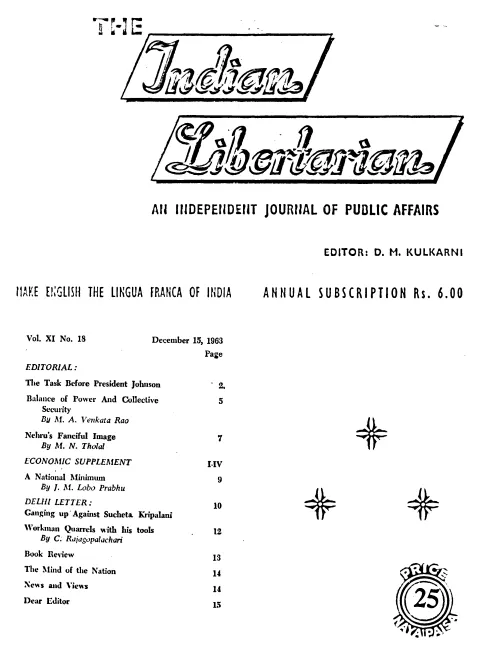
The Indian Libertarian
Independent Journal of Free Economy and Public Affairs
By MA Venkata Rao, M. N. Tholal, A Ranganathan, G N Lawande, J. M. Lobo Prabhu
Libertarian Publishers (Private) Ltd., 26, Durgadevi Road, Bombay 4 · Bombay · 1961
20 pages
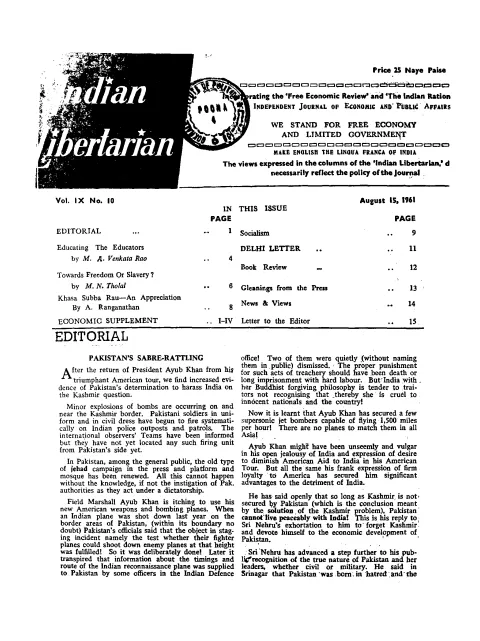
The Indian Libertarian
Summary
This August 15, 1961 issue of The Indian Libertarian (Vol. IX, No. 10), edited by D. M. Kulkarni for Libertarian Publishers (Bombay), opens with an editorial bloc denouncing Pakistan’s renewed ‘sabre-rattling’ on Kashmir after Ayub Khan’s American tour, asking why Pakistanis are nursing such hostility, and reading the Iraq–Kuwait crisis as a colonial parallel to Kashmir, before turning to the impending Orissa elections and the prospects of the Swatantra Party. M. A. Venkata Rao argues that India’s universities are themselves in need of ‘educating’ if liberal democracy is to hold off communism; M. N. Tholal flips the rhetoric of anti-colonialism onto Soviet Russia and China; and A. Ranganathan supplies an appreciation of the late Khasa Subba Rau, editor of Swarajya.
The issue’s bound Economic Supplement (pages I–IV) carries G. N. Lawande on whether the Third Plan can produce a Rostow-style ‘take-off’, J. M. Lobo Prabhu on the economic platforms of the contesting parties, and a reprint of Thomas Paine’s Agrarian Justice. A short comment piece titled ‘Socialism’ lampoons U Nu’s Burmese socialism by parable, a Delhi Letter dissects Master Tara Singh’s Punjabi Suba fast, a book review treats C. Northcote Parkinson’s The Law and the Profits, and the issue closes with Gleanings from the Press, News & Views, and a Letter to the Editor on national unity. Throughout, the magazine defends free economy and limited government against planning, socialism, and what it sees as Nehruvian drift.
Key points
-
The 15 August 1961 issue of The Indian Libertarian, Vol. IX No. 10, edited by D. M. Kulkarni for Libertarian Publishers, opens with an editorial bloc on Pakistan’s renewed hostility over Kashmir following Ayub Khan’s American tour.
-
The editorial’s “Kuwait and Kerala” section reads Iraq’s claim on Kuwait and Britain’s swift counter as a warning for India, cautioning against the Nawab-style oil-state model.
-
“The Orissa Elections” section frames the state’s impending mid-term poll as a test of whether the Swatantra Party and the Ganatantra Parishad can dent Congress hegemony.
-
M. A. Venkata Rao’s “Educating The Educators” argues Indian universities must themselves be reformed before they can produce citizens capable of defending a constitutional, science-based liberal democracy against communism.
-
Venkata Rao locates a deficit of “national civic sense” as the central failure of Indian higher education, given the country’s diversity and provincial chauvinisms.
-
M. N. Tholal’s “Towards Freedom Or Slavery?” turns Communist anti-colonial rhetoric back on its source, arguing Soviet rule over Central Asia and Chinese rule over Tibet constitute textbook colonialism.
-
The issue’s bound Economic Supplement carries G. N. Lawande on whether the Third Plan can produce a Rostow-style “take-off,” J. M. Lobo Prabhu on the contesting parties’ economic platforms, and a reprint of Thomas Paine’s Agrarian Justice.
-
A. Ranganathan supplies an appreciation of the late Khasa Subba Rau, editor of Swarajya, and a book review treats C. Northcote Parkinson’s The Law and the Profits.
Essays
EDITORIAL (Pakistan’s Sabre-Rattling)
The editorial bloc strings together four short pieces. ‘Pakistan’s Sabre-Rattling’ argues that Ayub Khan’s American tour emboldened Pakistan to renew shelling, bombing-plane provocations, and jehad propaganda along the Kashmir border, and reads his public jealousy of US aid to India and refusal to settle Kashmir peacefully as proof that Pakistan was ‘born in hatred’ of India. ‘Why Do The Pakistanis Hate India?’ reaches for psychological and historical causes — Muslim League legacy, fear of Hindu cultural dominance, and the trauma of partition — without endorsing the hate. ‘Kuwait and Kerala’ reads Kassem’s claim on Kuwait and Britain’s swift counter as a sobering parallel for India, and warns against the Nawab-style oil-state model.
The bloc closes with ‘The Orissa Elections’, forecasting that the mid-term poll there will test whether the Congress and the splinter Ganatantra Parishad can hold against a Swatantra-friendly opposition; it treats the contest as a referendum on the self-confidence of non-Congress forces.
- Reads Ayub Khan’s post-tour belligerence as evidence that Pakistan is incapable of settling Kashmir peacefully.
- Treats Nehru’s appeasement-by-economic-development line toward Pakistan as naive.
- Uses the Iraq–Kuwait crisis as a warning about petro-state vulnerability and great-power intervention.
- Frames the Orissa mid-term election as a Swatantra-aligned opportunity to dent Congress hegemony.
- Underlines the journal’s standing masthead: ‘We stand for free economy and limited government.‘
Educating The Educators
By MA Venkata Rao
Venkata Rao argues that the challenge of international communism, led by Soviet Russia, cannot be met by Western ideals alone unless Indian universities are themselves reformed. India’s higher education, he says, is still organized for personal salvation and white-collar absorption rather than for producing citizens capable of defending a constitutional, science-based liberal democracy. He urges that the educator must first be educated — that staff, syllabi, and methods need to be re-thought before the universities can produce the kind of mind that liberalism requires.
The piece reads communism not as merely an economic doctrine but as a religion of the dispossessed that fills the moral vacuum left by inadequate liberal acculturation. India’s diversity, its provincial chauvinisms, and its lack of a ‘national civic sense’ make the task urgent. Without an internal regeneration of the academic class, he warns, the country will not be able to absorb modern science, defend civil liberty, or sustain economic freedom against authoritarian alternatives.
- Treats communism as a quasi-religious challenge that liberal democracy must answer with its own ethical and educational depth.
- Argues that the universities are organized for personal salvation or careerism rather than for civic and scientific competence.
- Locates a deficit of ‘national civic sense’ as the central failure of Indian higher education.
- Holds that the educator class itself must be remade before liberal-democratic values can be taught.
Towards Freedom Or Slavery?
By M. N. Tholal
Tholal turns the Communist anti-colonial vocabulary back on its source. The cry of ‘colonialism, colonialism’ is, he says, the thief crying thief: Soviet Russia inherited and expanded the Tsarist empire over Central Asian Muslim peoples, and Communist China has done the same to Tibet and is doing it to other border peoples. The article walks through the Russian absorption of Bukhara, Khiva, and the Caucasus and contrasts the openness of British and other Western colonialism — which produced its own internal critics and a path to self-government — with the closed character of Soviet rule, where no comparable self-criticism is possible.
The piece warns Indian readers that joining the Communist anti-colonial chorus serves Moscow and Peking, not the colonized. True freedom, he argues, depends on the kind of liberal institutions — press, assembly, courts — that Communist states deny their own subject peoples; without those, independence is only a change of masters, with the new ones immune to either the moral or the political pressure that eventually opened Western empires up.
- Argues that Soviet rule over Central Asia and Chinese rule over Tibet are textbook colonialism that Communists exempt from their own rhetoric.
- Contrasts Western colonialism’s permeability to internal moral critique with the sealed character of Communist empire.
- Treats Indian fellow-travelling on ‘colonialism’ as objectively pro-Moscow and pro-Peking.
- Insists that liberty requires liberal institutions, not merely a change of overlord.
Khasa Subba Rau — An Appreciation
By A Ranganathan
Ranganathan’s appreciation marks the death on 16 June 1961 of Khasa Subba Rau, the editor of Swarajya, calling it one of the saddest events in contemporary Indian journalism. He sketches Khasa’s career through the Presidency College, Bombay, and a long apprenticeship in editorial chairs at The Hindu, Swatantra, Free Press Journal, Indian Daily Mail and the Indian Express before he founded and edited Swarajya from Madras. Throughout, Khasa is portrayed as a stylist of unusual elegance, a fearless commentator on public men, and an editor for whom the small Madras weekly Swarajya became a vehicle for liberal opinion of national reach.
The tribute moves from craft to politics: Khasa’s loyalty to C. Rajagopalachari and the Swatantra cause, his role as one of the magazine’s chief writers in the Madras election fight, and the quality of attention he commanded — Sadanand of the Free Press is said to have reckoned an article of Khasa’s worth a Reuters cable. Ranganathan treats him as a model of a vanishing kind of Indian editor: economical, independent, and willing to lose a job over a sentence.
- Frames Khasa Subba Rau’s death as a singular loss to liberal Indian journalism.
- Traces his editorial passage from The Hindu and the Free Press through Indian Daily Mail and the Indian Express to Swarajya.
- Treats Swarajya, though a small Madras weekly, as the principal vehicle of Rajaji’s Swatantra-aligned liberal opinion.
- Holds Khasa up as exemplar of the independent editor — Sadanand reportedly valued one of his articles at a Reuters cable.
ECONOMIC SUPPLEMENT
By G N Lawande
Lawande opens the Economic Supplement by asking whether the Third Five Year Plan can deliver a Rostow-style economic ‘take-off’. He traces the post-war turn to development planning as an instrument of international cooperation and then sets the Indian record against it: the first two Plans, he argues, have neither produced a self-sustaining rise in income nor matched their own internal targets, with public-sector investments running at high cost and modest yield.
He is sceptical that the Third Plan’s larger outlays and continued reliance on state enterprise can change the trajectory. The supplement argues that without rising consumer demand fed by genuine income growth, private enterprise cannot expand to absorb production, and that the bias toward Plan-financed public investment is starving the private economy of the capital and incentives it needs. The take-off, he concludes, presupposes economic freedoms the current planning model has not delivered.
- Reads the Third Plan in terms of Rostow’s ‘take-off’ threshold and asks whether the conditions for it exist in India.
- Argues that the first two Plans failed to generate the consumer demand a take-off requires.
- Holds that public-sector investment is crowding out and starving private enterprise.
- Treats the planning apparatus, not capital scarcity, as the binding constraint on Indian growth.
Third Plan And Take Off
By Prof. G. N. Lawande, M.A.
Lobo Prabhu surveys the economic platforms on offer at the coming elections and urges voters to discriminate among parties on economic substance rather than slogan. The Congress, he argues, has converted economic planning into an instrument of single-party dominance and is now indistinguishable from the socialist parties on the question of state ownership; the Communists and the PSP press for further nationalisation; only the Swatantra Party defends a programme of private enterprise, secure property rights, and a smaller state.
The piece reads recent Supreme Court litigation over property and trade as a warning that the constitutional protections of 1950 are being thinned by amendment, and asks voters to weigh whether the next Parliament will continue that erosion. Lobo Prabhu treats the election as a real choice between rival economic systems, not a routine contest among personalities.
- Frames the coming election as a referendum on the direction of India’s economic system.
- Argues that Congress economic policy is converging with the socialist parties on state ownership.
- Identifies Swatantra as the only party defending private enterprise and property rights at scale.
- Warns that constitutional amendments are progressively eroding the property protections of the 1950 settlement.
Economic Policies Of Parties
By J. M. Lobo Prabhu
The supplement closes with a reprint of Thomas Paine’s Agrarian Justice, in which Paine argues that the institution of private landed property, while a necessary outgrowth of cultivation, has produced an inequality that did not exist in the ‘natural’ state. The earth, he says, was originally the common property of the human race; once it is enclosed and improved, the cultivator owes a ‘ground-rent’ to the community for the value of the natural inheritance he has appropriated.
Paine proposes a fund, financed by an inheritance tax on landed estates, to pay every adult a one-time sum on coming of age and an annual pension after fifty — not as charity but as restitution for the lost natural birthright. The piece is positioned in the Indian Libertarian context as a classical-liberal defence of property reconciled with a recognised social claim, not as a brief for confiscation.
- Distinguishes between the natural state, in which the earth is common, and the civilised state, in which it is enclosed.
- Argues that landed property creates inequality that requires compensatory provision, not abolition.
- Proposes a one-time sum at majority and a pension after fifty, funded by an inheritance levy on landed estates.
- Frames the scheme as restitution for a lost natural inheritance, not as charity or redistribution.
Agrarian Justice
By Thomas Paine
An unsigned commentary uses U Nu’s Burmese socialism as its target. It opens with a parable: U Nu boasted of a household medicine called ‘Dammed Dagger’ that cured everything — until the family dog ate the medicine and the household discovered, too late, that the dog and the cure had both been laid low together. The article reads Burmese socialism as that cure: a doctrine sold as universal that has in practice damaged the patient.
Moving from parable to comparative politics, the piece argues that the Labour Party in Britain has had to retreat from doctrinaire nationalisation under electoral pressure, and that India should learn the same lesson. State ownership, it argues, has not delivered higher output, better wages, or shorter queues; what it has done, in Burma, in Britain, and increasingly in India, is corrode initiative and make the state both employer and policeman.
- Uses U Nu’s parable of the ‘Dammed Dagger’ to mock universal-cure socialism.
- Reads the British Labour Party’s electoral retreats as evidence that doctrinaire nationalisation fails politically.
- Argues that nationalisation in Burma has produced neither higher wages nor better service.
- Warns that the same state-as-employer model is being entrenched in India.
Socialism
The Delhi Letter, filed by the journal’s Delhi correspondent, reads Master Tara Singh’s fast in support of a Punjabi Suba (a separate Punjabi-speaking Sikh-majority province) as the climactic act of his career. The correspondent doubts the linguistic case for partitioning the Punjab and is openly sceptical of Master Tara Singh’s habit of fasting as a political instrument, but treats the episode as a serious test of the central government’s nerve.
The piece argues that Nehru and the Congress cannot concede a Punjabi Suba without inviting parallel demands elsewhere, but also cannot let a major Sikh leader die in custody without inflaming the community. It treats Master Tara Singh as a figure whose politics belong to an earlier, communal era and warns that the Akali Dal’s confessional framing of a linguistic claim is the real source of the trouble.
- Frames Master Tara Singh’s Punjabi Suba fast as the culminating episode of his political career.
- Disputes the linguistic case for partitioning Punjab and reads the demand as confessional in substance.
- Treats the central government as boxed in between conceding a precedent and creating a martyr.
- Holds the Akali Dal responsible for grafting communal claims onto a language-state framework.
DELHI LETTER: The Master And His Mission
By From Our Correspondent
An unsigned review of C. Northcote Parkinson’s The Law and the Profits (Houghton Mifflin) treats the book as a sequel to Parkinson’s Law that turns the same comic-empirical eye on public finance. Parkinson’s central claim — restated in the review — is that government expenditure rises to consume whatever revenue is available, and that the threshold beyond which taxation crushes the productive economy lies somewhere around a quarter of national income.
The reviewer commends the book’s wit and its targets — the welfare state, post-war British budgets, and the spreading habit of permanent peacetime deficit — and reads it as a useful corrective for Indian readers tempted to assume that bigger budgets are by themselves an index of national progress.
- Reads Parkinson as extending his bureaucratic ‘law’ from staffing to public finance.
- Highlights the claim that expenditure expands to absorb available revenue regardless of need.
- Identifies a tax-share threshold beyond which production is suppressed.
- Recommends the book to Indian readers tempted by big-budget conceptions of development.
Book Review: The Law and the Profits (by C. Northcote Parkinson)
Gleanings from the Press collects short extracts. One, attributed to Robert M. Thornton, picks up the recent omission of Mr. Menon’s bid from the Aligarh Muslim University succession dispute and reads it as evidence of a planned political reshaping of the university. A second cluster of items returns to the Pakistan question raised in the editorial and adds further press commentary on Ayub Khan’s posture toward Kashmir.
The column functions as a digest: it presents excerpts from other publications without elaborate commentary, letting the cumulative weight of the cited press underline the journal’s own line on socialism, planning, and Pakistan.
- Aggregates short press extracts on current controversies rather than offering a single argument.
- Picks up Robert M. Thornton’s note on the Aligarh succession question.
- Reinforces the editorial line on Ayub Khan and Pakistan through corroborating press commentary.
Gleanings from the Press
By Robert M. Thornton (The Freeman)
News & Views collates short reports on the liberal and opposition movement. A ‘Non-Party Programme’ notice records steps to counter the national disintegration the editors see in linguistic and communal agitations; a separate item welcomes the formation of a Swatantra Annual Rally at Bombay and the party’s organisational activity in several states. Brief mentions of M. R. Masani’s interventions, the Forum of Free Enterprise’s programmes, and the counter-revolutionary character of communism round out the column.
The section functions as a movement bulletin: it tells Swatantra-leaning readers what their party and its allied institutions are doing, and underscores the journal’s editorial line that organised liberalism, not Congress reform, is the answer to drift.
- Reads the recent agitations as a symptom of ‘national disintegration’ that a non-party liberal programme must counter.
- Highlights the Swatantra Annual Rally at Bombay as a milestone in the party’s growth.
- Folds in items on the Forum of Free Enterprise’s programmes and counter-revolutionary readings of communism.
News & Views
A single letter to the editor signed M. Amrunath of Bangalore turns to ‘National Unity’ and proposes that the only durable defence against communal and minority-based politics is a hardened commitment to a single, equal citizenship under uniformly applied national law. The writer asks the journal to lend its space and authority to that case in subsequent issues.
- Names communal and minority politics as the principal threat to national unity.
- Calls for a single, equal citizenship under uniform law as the answer.
- Solicits the Indian Libertarian’s editorial support for that line.
Generated by the v1.5 extraction pipeline. Awaiting editorial review.
Metadata and summary are AI-extracted from the source PDF and reviewed for editorial accuracy. The original work is available via the Read PDF tab above (where present); paragraph-level citation inside the PDF is deferred to a future engagement.