periodical issue
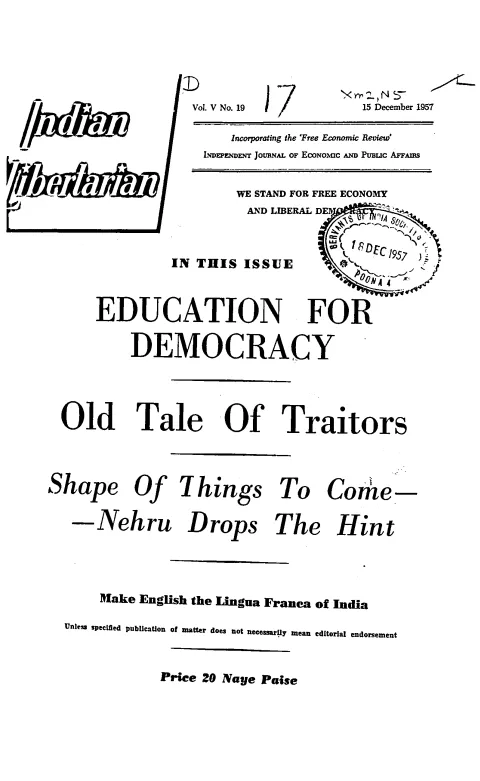
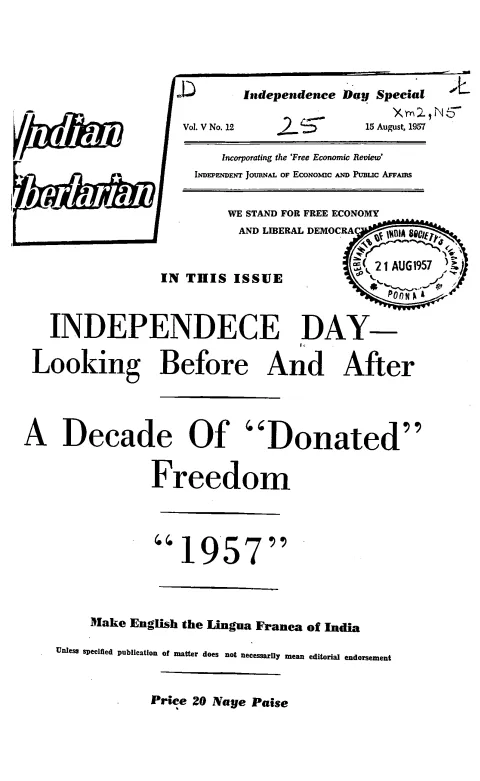
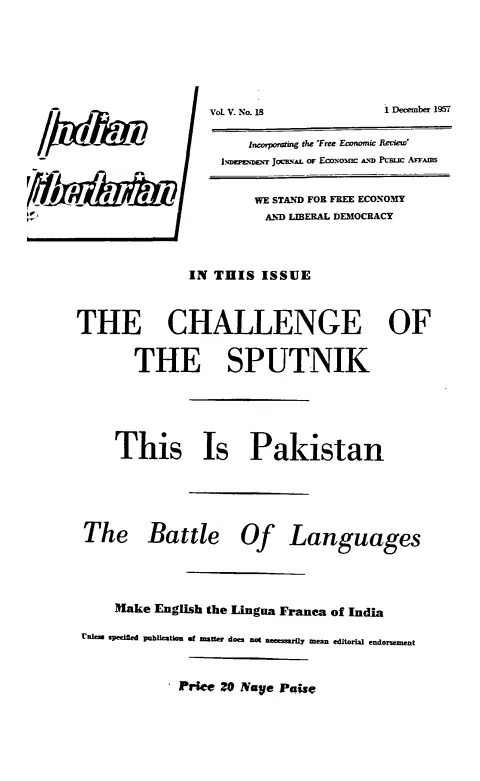
The Indian Libertarian, Vol. V, No. 18
Independent Journal of Economic and Public Affairs
By MA Venkata Rao, B. R. Shenoy
The Indian Libertarian, Arya Bhuvan, Sandhurst Road, Bombay 4 · Bombay · 1957
28 pages
The Indian Libertarian, Vol. V, No. 18
Summary
This 1 December 1957 issue of The Indian Libertarian (Vol. V No. 18), edited by Kusum Lotwala and published from Bombay, opens with a multi-section editorial on India’s Kashmir diplomacy and then ranges across the global Cold War, Pakistan’s internal politics, the language controversy at home, and a programmatic statement of liberal economic doctrine. The featured cover items — ‘The Challenge of the Sputnik’, ‘This Is Pakistan’ and ‘The Battle Of Languages’ — frame the issue’s argumentative centre: that the West has been complacent in the face of Soviet technological prowess, that Pakistan’s hostility toward Kashmir is a betrayal of trust, and that India must accept English as a working lingua franca rather than impose Hindi by fiat. B. R. Shenoy’s lead theoretical essay, ‘My Idea of a Welfare State’, sets the magazine’s classical-liberal frame: a welfare state must be minimal in scope, defined by equality of opportunity rather than directed economic outcomes. The issue’s contributors — M. A. Venkata Rao, Baburao Patel, J. K. Dhairyawan, B. R. Shenoy and the pseudonymous ‘Al-Kafir’ — together press the journal’s standing slogan, ‘We Stand For Free Economy And Liberal Democracy’.
Key points
-
The unsigned editorial defends V. K. Krishna Menon’s performance at the United Nations Security Council on the Kashmir question as brilliant and forceful diplomacy.
-
The editorial reads the British-American resolution proposing a second mission by Dr. Graham as a procedural retreat that revives stale 1948-49 positions on Kashmir.
-
The editorial accuses Pakistani Prime Minister Noon of orchestrating a sabotage campaign against Kashmir and treats the newly announced union of Egypt and Syria as a serious strategic shift in West Asia.
-
B. R. Shenoy’s lead essay, My Idea of a Welfare State, argues that a welfare state must remain minimal in scope, defined by equality of opportunity rather than directed economic outcomes.
-
M. A. Venkata Rao’s The Challenge of the Sputniks reads the Soviet satellite launches as a defeat of Western prestige, quoting Clare Booth Luce on the shock running through American opinion.
-
Venkata Rao urges the free world to fundamentally rethink its containment strategy and proposes a Gandhian register of moral incentives as a supplement to Western strategic doctrine.
-
Baburao Patel’s Biting the Hand that Feeds recounts Sheikh Mohamed Abdullah’s August 1953 arrest and dismissal as Prime Minister of Jammu and Kashmir as a turning point Pakistan has refused to acknowledge.
-
Patel traces the succession of Pakistani leaders from Liaqat Ali Khan through Iskander Mirza as a chain of expedient nationalism built on the Kashmir grievance.
-
J. K. Dhairyawan’s This Battle of Languages Must End invokes Lokmanya Tilak’s pragmatic engagement with the language question to argue for accepting English as India’s working lingua franca.
Essays
EDITORIAL
The unsigned Editorial moves through several theatres of contemporary diplomacy. It opens with a defence of V. K. Krishna Menon’s performance at the United Nations on the Kashmir question, then turns sceptical of a fresh resolution by Britain and the United States to send Dr. Graham back to the subcontinent on what the editor frames as a futile second mission. Further sections survey the role of the Baghdad Pact states in the Kashmir dispute, the announcement of a union of Egypt and Syria, and an accusation that Pakistani Prime Minister Noon is mounting a sabotage campaign on Kashmir. A short closing note welcomes a forthcoming World Conference of Religions to be held in New Delhi.
- Krishna Menon is praised as a brilliant and forceful diplomatist on the Kashmir question at the UN Security Council.
- The British-American resolution proposing a second mission by Dr. Graham is read as a procedural retreat that revives stale 1948-49 positions.
- Baghdad Pact states are seen as drawing Pakistan further into Cold War alignments that complicate Kashmir diplomacy.
- The editor reads the proposed union of Egypt and Syria as a serious strategic shift in West Asia.
- Pakistan’s Prime Minister Noon is accused of orchestrating a sabotage campaign against Kashmir.
The Challenge of the Sputniks
By MA Venkata Rao
M. A. Venkata Rao reads the Soviet Sputnik launches as a turning point in the global balance of prestige and power. Quoting the American writer Clare Booth Luce, he argues that the United States has been outpaced not only in rocketry but in the propaganda and political imagination that flow from it. The essay urges the free world — and Western military planners in particular — to rethink their strategy of containment, to move beyond complacency, and to take up the challenge to democracy that the satellites symbolise. A closing section on ‘Our Gandhian Incentives’ tries to fold the moral resources of Indian thought into a liberal-democratic response to communism.
- Sputnik is read as a defeat of Western prestige as much as a Soviet technical achievement.
- Clare Booth Luce’s reaction is cited as emblematic of the shock running through American opinion.
- The free world is urged to undertake a fundamental rethink of its military and propaganda strategy.
- Venkata Rao calls on democracies to accept the challenge of communism with seriousness equal to its scale.
- A Gandhian register of incentives is proposed as a moral supplement to Western strategic doctrine.
Biting the Hand that Feeds
By Baburao Patel
Baburao Patel’s polemic argues that Pakistan, far from being a good neighbour, has bitten the hand that feeds it. He recounts the treatment of Sheikh Mohamed Abdullah after his August 1953 arrest and dismissal as Prime Minister of Jammu and Kashmir, the political turbulence in Pakistan, and the succession of leaders from Liaqat Ali Khan onward who, on his reading, have used the Kashmir grievance to manage internal failure. The piece sets out what Patel calls ‘India’s Greatest Sacrifice for Pakistan’ and argues that India has been gagged in international forums while Pakistan’s case has been amplified. Sub-sections on ‘The Turn-Coat’, ‘India Is Gagged’ and ‘The Lion’s Threat’ carry the argument forward.
- Patel frames Pakistan as a state that has repaid Indian generosity with hostility on Kashmir.
- Sheikh Mohamed Abdullah’s arrest in August 1953 is read as a turning point Pakistan has refused to acknowledge.
- The succession of Pakistani leaders — Liaqat Ali Khan, Nazimuddin, Bogra, Ghulam Mohamed, Iskander Mirza — is presented as a chain of expedient nationalism.
- Patel argues that India has been diplomatically gagged while Pakistan’s Kashmir narrative has gone unchallenged.
- The essay invokes ‘India’s Greatest Sacrifice for Pakistan’ to argue that goodwill has been a one-way transfer.
This Battle of Languages Must End
By J. K. Dhairyawan
J. K. Dhairyawan argues that the time has come to end India’s protracted battle of languages by accepting English as the country’s working lingua franca. He surveys the historical record — including Lokmanya Tilak’s pragmatic endorsement of an Indian language of administration — and contends that no indigenous tongue has yet been able to take English’s place at the level of higher administration, science and inter-provincial communication. The essay reads the push for Hindi as imposition from above and warns that linguistic chauvinism has begun to fracture national unity.
- Dhairyawan defends English as the most workable lingua franca for a polyglot India.
- He invokes Lokmanya Tilak’s pragmatic engagement with the language question to push back against purist positions.
- The drive to make Hindi the sole national language is read as imposition by majority rather than consent.
- The essay warns that linguistic chauvinism is eroding national unity and damaging higher education.
Hindi: A Reasoned Protest
Presented as a memorandum from the Association for the Advancement of the National Languages of India, ‘Hindi: A Reasoned Protest’ takes formal exception to the recommendations of the Official Language Commission. It argues for the retention of English in higher education and administration, defends the constitutional standing of the country’s other major languages, and warns that any premature switch to Hindi will damage the public services and the universities. A sub-section, ‘From a Libertarian’s Library’, lists supporting titles and signatories ranged behind the protest.
- The memorandum opposes the Language Commission’s recommendations that would phase English out as a link language.
- It argues for the continued use of English in higher education and in administration above the regional level.
- The protest is framed as a defence of India’s multilingual constitutional order rather than as opposition to Hindi as such.
- A ‘From a Libertarian’s Library’ appendix lists names of supporters and allied publications.
My Idea of a Welfare State
By B. R. Shenoy
B. R. Shenoy of the Gokhale Institute of Politics and Economics, Gujarat University, sets out a classical-liberal idea of the welfare state. He argues that welfare cannot mean an open-ended expansion of state action and that any genuinely welfare-oriented state must rest on equality of opportunity rather than directed equality of outcome. The essay distinguishes the economic content of welfare from cultural and political content, defends the role of free markets in raising aggregate welfare, and warns that the ‘minimum state’ — not the maximal one — is the appropriate ideal for India given the size of the country and the limits of administrative capacity.
- Shenoy defines a welfare state as one resting on equality of opportunity, not enforced equality of outcome.
- He argues that state action must be measured by necessity rather than by ambition.
- Economic welfare is separated analytically from political and cultural welfare.
- The ‘minimum state’ is offered as the ideal for India, given the country’s scale and administrative limits.
- Shenoy treats the free market as the principal engine of rising material welfare.
This is Pakistan
By Al-Kafir
Writing under the pseudonym ‘Al-Kafir’, the author reads the appointment of I. I. Chundrigar as the new Prime Minister of Pakistan as the latest twist in an unstable parliamentary game. The piece surveys the manoeuvring between the Muslim League and the Republican Party, the ‘apparent victory’ on the issue of separate electorates, the local strength of the Muslim League in West and East Pakistan, and the role of Sir Feroz Khan Noon and Dr. Khan Sahib in shaping events. The argument is that Pakistan’s politics has become a contest of expedients rather than a settled constitutional order.
- Chundrigar’s appointment is read as a tactical adjustment rather than a settlement of Pakistan’s political instability.
- The contest between the Muslim League and the Republican Party is presented as a struggle of factions, not of programmes.
- The piece narrates the ‘apparent victory’ over the question of separate electorates.
- The Muslim League’s regional strongholds in West and East Pakistan are surveyed.
- Sir Feroz Khan Noon and Dr. Khan Sahib are positioned as central operators in the latest reshuffle.
Generated by the v1.5 extraction pipeline. Awaiting editorial review.
Metadata and summary are AI-extracted from the source PDF and reviewed for editorial accuracy. The original work is available via the Read PDF tab above (where present); paragraph-level citation inside the PDF is deferred to a future engagement.