periodical issue
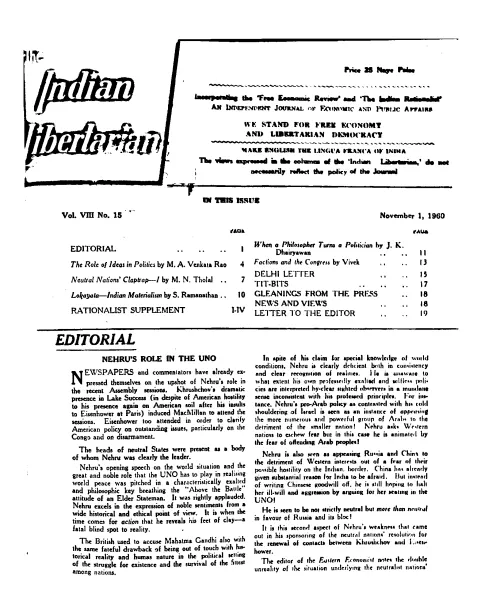
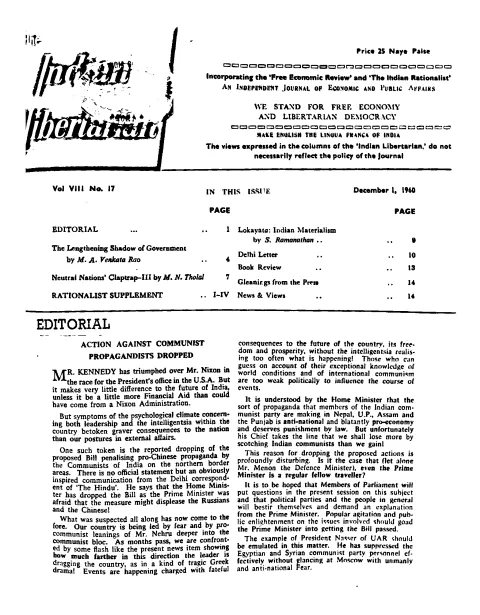
The Indian Libertarian
An Independent Journal of Economic and Public Affairs
By MA Venkata Rao, M. N. Tholal
Libertarian Publishers (Private) Ltd., 26, Durgadevi Road, Bombay 4 · Bombay · 1960
20 pages
The Indian Libertarian
Summary
This issue of The Indian Libertarian (Vol VIII, No. 17, December 1, 1960), an independent journal of economic and public affairs published in Bombay and edited by Miss K. R. Lotwala for Libertarian Publishers, opens with a long editorial that uses the just-concluded Kennedy–Nixon presidential contest as a foil for the journal’s central anxiety — that Nehru’s government has dropped a Bill penalising pro-Chinese Communist propaganda in the northern border areas and is therefore failing to defend India against communist subversion. The editorial sweeps across the trouble spots of the Cold War (Cuba, Berlin, Laos, the Congo, South Vietnam, Algeria) and pairs domestic complacency with an appeal to the new American president-elect, Mr. Kennedy, to take a firmer line abroad.
The rest of the issue carries M. A. Venkata Rao’s article ‘The Lengthening Shadow of Government’ (a classical-liberal critique of the post-1917 drift toward unlimited governmental activity, public-sector enterprise and bureaucratised education), the third instalment of M. N. Tholal’s polemic ‘Neutral Nations’ Claptrap’ (attacking the Afro-Asian ‘fellow-traveller’ bloc at the U.N.), a four-page Rationalist Supplement containing S. Ramanathan on ‘The Innate Weakness Of Rationalism’ and Denis Cabell on ‘Humanism And Shelley’, plus a longer Ramanathan essay on ‘Lokayata: Indian Materialism’, a Delhi Letter on ‘China Bamboozling India’, Erich Godinger’s review of A Concise History of the Communist Party of the Soviet Union, and the regular Gleanings from the Press and News & Views columns. The unifying thread is the journal’s standing line — ‘WE STAND FOR FREE ECONOMY AND LIBERTARIAN DEMOCRACY’ — applied to both external Cold-War posture and internal anti-statist economics.
Key points
-
The 1 December 1960 issue, Vol VIII, No. 17, opens with an editorial that uses the Kennedy-Nixon contest to attack Nehru’s government for dropping a Bill penalising pro-Chinese Communist propaganda in the northern border areas.
-
The editorial cites the Home Minister’s withdrawal of the Bill for fear of displeasing Russia and China as proof of pro-Communist leanings at the top of the Congress government, unlike Nasser’s suppression of Communists.
-
The editorial surveys Cold War trouble spots, including Cuba, Berlin, Laos, the Congo, South Vietnam, and Algeria, and appeals to the incoming Kennedy administration to abandon Eisenhower-era passivity.
-
M. A. Venkata Rao’s ‘The Lengthening Shadow of Government’ traces the post-1917 rise of unhampered state activity from socialism through the Welfare State into India’s Three Plans.
-
Venkata Rao faults the Second and Third Plans for taxing private incomes to fund a Public Sector that crowds out private enterprise, and criticises the bureaucratisation of universities through civil-service-style salary grades.
-
Venkata Rao calls Cooperative Farming a half-way house to collective farms on the road to full socialism, predicting the stagnation and loss of liberty such systems tend to produce.
-
M. N. Tholal’s third instalment of ‘Neutral Nations’ Claptrap’ attacks Afro-Asian sponsors of a U.N. resolution calling for Eisenhower-Khrushchev talks as posturing as honest brokers.
-
The Rationalist Supplement carries S. Ramanathan on ‘The Innate Weakness Of Rationalism’ and ‘Lokayata: Indian Materialism’, plus Denis Cabell on ‘Humanism And Shelley’ and a review of Soviet Communist Party history.
Essays
EDITORIAL: Action Against Communist Propagandists Dropped; The American President-Elect: Mr. Kennedy; The P.M., The Press and Mr. Khrushchov
The unsigned editorial argues that Kennedy’s narrow win over Nixon will make little practical difference to India and uses the occasion to attack the Nehru government for quietly dropping a Bill that would have penalised pro-Chinese Communist propaganda in India’s northern border areas. The editorial cites the Delhi correspondent of ‘The Hindu’ reporting that the Home Minister withdrew the Bill because its measure might displease Russia and China, and treats this as proof of the ‘psychological climate’ of pro-Communist leanings inside the country’s leadership and intelligentsia. It contrasts Nehru’s softness with President Nasser’s effective suppression of Egyptian and Syrian Communist Party personnel.
The editorial then turns outward, listing ‘Trouble Spots in the World Scene’ — Cuba (Castro’s drift into the Soviet bloc), Latin America, Berlin (the Khrushchev–Ulbricht squeeze), Laos, the Congo, South Vietnam, Algeria, Turkey — and appeals to the incoming Kennedy administration to abandon Eisenhower-era passivity and confront communism abroad. The piece closes with a hope that ‘popular agitation and public enlightenment’ will force Nehru to revive the Bill.
- Kennedy’s election will make ‘very little difference to the future of India’ beyond possibly more financial aid.
- The Home Minister has withdrawn a Bill penalising pro-Chinese Communist propaganda in border areas because it might displease Russia and China.
- The editorial reads this as confirmation of ‘pro-Communist leanings’ at the top of the Congress government.
- Contrasts Nehru’s leniency with Nasser’s effective crackdown on Egyptian/Syrian Communist Party cadres.
- Surveys Cold-War trouble spots — Cuba, Berlin, Laos, the Congo, South Vietnam, Algeria — and urges Kennedy to act decisively.
The Lengthening Shadow of Government
By MA Venkata Rao
Venkata Rao argues that the era since the 1917 October Revolution is dominated by ‘Leftist ideas’ whose common feature is unprecedented faith in the unhampered free play of governmental activity. He traces this from explicit socialism and communism into the Welfare State and into India’s own Three Plans, faulting Cooperative Farming, the Second Plan and the Outline of the Third for using public funds to displace private enterprise rather than supplement it. He warns that bureaucratised industry, banks and education are turning Public Sector concerns into ‘fortresses’ protected from competition and accountability.
The piece then attacks the bureaucratisation of higher education — the conversion of Universities into ‘state colleges’ where civil-service grades and centralised salary scales replace academic autonomy — and contrasts this with the American system of competing private and state universities. The closing pages return to economic policy: the Third Plan and Cooperative Farming, the author warns, are merely ‘a half-way house to Collective Farms’ and a back-door route to full socialism, which by experience produces stagnation, indifference to economy and a population habituated to surveillance.
- The post-1917 epoch is defined by an ‘unprecedented faith in the unhampered free play of governmental activity’.
- Welfare-statism is a softer carrier of the same statist instinct that animates Marxism.
- The Second and Third Plans tax private incomes to fund a Public Sector that crowds out private enterprise rather than complementing it.
- Bureaucratisation of universities — civil-service-style grades and central salary scales — destroys academic autonomy, unlike the competitive American system.
- Cooperative Farming is a ‘half-way house’ to collective farms; the goal is full socialism, with predictable losses of liberty and efficiency.
Neutral Nations’ Claptrap-III
By M. N. Tholal
The third instalment of M. N. Tholal’s series attacks what he calls the ‘claptrap’ of neutralism on display at the U.N. General Assembly. He argues that the Afro-Asian sponsors of resolutions calling for talks between Eisenhower and Khrushchev posture as honest brokers while in practice carrying water for the Soviet bloc. The Assembly’s mood, he writes, is shaped less by genuine peace-seeking than by the desire of new nations to assert their importance by lecturing the Great Powers.
Tholal contrasts the rhetoric of the non-aligned with their tolerance of communist coercion and asks what ‘neutral’ is supposed to mean when one side is openly engaged in subversion. He links the U.N. theatre to a broader misrepresentation of communism in the Indian press and intelligentsia — a misreading that, in his telling, has hardened into reflex.
- Afro-Asian neutralism at the U.N. is, in practice, a fellow-traveller posture rather than impartial mediation.
- Assembly resolutions calling for Eisenhower–Khrushchev talks flatter the sponsors more than they advance peace.
- Indian press and opinion-makers consistently misrepresent communism as a normal political position.
- Tholal frames neutralism as a pose that depends on ignoring Soviet subversion.
RATIONALIST SUPPLEMENT: The Innate Weakness of Rationalism (by S. Ramanathan); The Need for Excellence; What is Humanism?; Humanism and Shelley (by Denis Cobell); Superstitions about Jewels and Stones
By S. Ramanathan; Denis Cobell
In the Rationalist Supplement S. Ramanathan offers a self-critical account of why organised Rationalism has failed to take hold in India. He locates the failure in three factors: the absence of a galvanising founder-figure of Mr. Lotwala’s stamp, the inherent weakness of Rationalism as a doctrine that offers analysis without sustenance, and the active organised opposition of religious bodies, leaders and magnates who can outspend and out-organise the rationalists. He treats Rationalism less as a settled philosophy than as a critique that must continually attach itself to ongoing reformist work to remain alive.
Ramanathan closes by arguing that the rationalist temper survives in India in dispersed form — embedded in social-reform agitation and in ‘one of pre-eminence’ essays scattered through other movements — but lacks the dense institutional life enjoyed by faiths and revivalist organisations. He calls for collaboration with congenial reform currents rather than separatist purism.
- Three factors retard Rationalism in India: lack of a founder-figure, weakness of the doctrine itself, and well-funded religious opposition.
- Rationalism functions best as a critical adjunct to broader social-reform movements, not as a stand-alone faith.
- Religious organisations command resources and emotional reach that small rationalist circles cannot match.
- Ramanathan urges collaboration with cognate reform currents rather than ideological purity.
Denis Cabell argues that Percy Bysshe Shelley’s poetry — for all its mythological surface — is in substance a vehicle for humanist and rationalist values that a modern secularist can endorse. He reads The Revolt of Islam, Queen Mab and the political poems as sustained polemic against church and crown, and notes Shelley’s willingness to wear personal disgrace (the Court of Chancery removing his children from his care) rather than recant.
Cabell sets Shelley against Wordsworth and Coleridge, whom he treats as poets who began as radicals and finished as apologists for Lord Eldon, Lord Sidmouth and Castlereagh. The essay ends by reprinting Shelley’s short poem ‘The Sinner’, presenting it as a compact statement of the humanist temper the article has been describing.
- Shelley’s poetry is, at heart, humanist polemic against church and state.
- Personal cost — including loss of custody of his children — proves the seriousness of his rationalist commitments.
- Wordsworth and Coleridge are contrasted as elder poets who ‘apostatised’ into apologists for Eldon, Sidmouth and Castlereagh.
- The essay closes with Shelley’s poem ‘The Sinner’ as a humanist credo.
Lokayata: Indian Materialism
By S. Ramanathan
Ramanathan’s longer essay surveys Lokayata — the Indian materialist tradition — and argues that the Tantra practices long denounced as obscurantism in fact carry an older, this-worldly current that mainstream Indian historiography has misread. He sets out two contradictory readings of the Tantras: the orthodox view that treats them as decadent ritualism, and a materialist counter-reading that treats them as continuous with the Lokayata insistence on bodily life and material causes.
The essay then walks through evidence — textual, ritual and lexical — that the materialist current was domestically Indian rather than a foreign import, and was suppressed less by argument than by social power. Ramanathan presents this as a usable past for modern Indian rationalism, which need not import its naturalism wholesale from Europe.
- Two opposed readings of Tantra: orthodox condemnation vs a materialist reclamation.
- Lokayata is presented as an indigenous, this-worldly current that pre-dates and parallels later European materialism.
- Suppression of the materialist tradition was a matter of social power, not philosophical defeat.
- Modern Indian rationalism can root itself in this lineage rather than borrow only from Europe.
Delhi Letter: China Bamboozling India; Politics of Claptrapmanship?; Akali Antics; Chaliha Riding High Horse; Kairon vs. Golwalkar
By From Our Correspondent
The anonymous Delhi Letter, titled ‘China Bamboozling India’, argues that the Nehru government keeps treating Chinese overtures at face value while Peking uses talks as cover for further military and propaganda gains in the border regions. The correspondent reads the recent flurry of diplomatic notes as a deliberate tactic to divide Indian opinion between those who want a settlement at almost any cost and those who insist on the integrity of the McMahon Line.
The column also surveys domestic political weather: Sardar Patil’s manoeuvres, the deference shown to Mr. Krishna Menon at Defence, and the awkward position of provincial Congress bosses (including Mr. Kairon in the Punjab) whose patronage machines are being asked to absorb central directives they did not author. The throughline is that India’s external softness toward China and its internal protection of Congress factional bosses share a common cause — the Prime Minister’s reluctance to confront uncomfortable colleagues.
- Chinese diplomatic notes are read as cover for military and propaganda consolidation, not genuine negotiation.
- Government policy is splitting Indian opinion between settlement-at-any-price and McMahon-Line firmness.
- Domestic patronage politics — Patil, Krishna Menon, Kairon — are interpreted through the same lens of Nehru’s reluctance to discipline allies.
- The piece treats external and internal pliancy as a single failure of resolve.
Book Review: The Soviet Party and the Body Social: A Concise History of the Communist Party of the Soviet Union, by John Reshetar (Praeger)
By Erich Godhagen
Erich Godinger reviews ‘A Concise History of the Communist Party of the Soviet Union’ by John Boehmer (Praeger, 1960). The review treats the book as a clear-headed scholarly digest of the CPSU’s evolution from the Bolshevik faction through Stalinist consolidation to the post-Stalin manoeuvres, and praises it for tracing the gap between Party doctrine and the actual instruments of coercion. Godinger reads the book as ammunition for an Indian reader who needs to see, in compact form, that the Soviet ‘body social’ is largely the construct of an entrenched apparatus rather than an organic expression of working-class consent.
- Reviews John Boehmer’s ‘A Concise History of the Communist Party of the Soviet Union’ (Praeger, 1960).
- Treats the book as a useful primer for separating CPSU doctrine from its coercive practice.
- Locates the book’s value in showing the Soviet state as an apparatus phenomenon, not a popular expression.
- Framed as ammunition for Indian readers tempted by Communist claims.
Gleanings from the Press: English in India
The Gleanings column reprints short extracts from other journals — including a note on ‘English in India’ arguing that English is here to stay as a working medium of higher education and administration, and a defence of Hindu College Calcutta’s role in the early life of Indian rationalism. The selections are curated to reinforce the journal’s standing line that the lingua-franca question should be settled pragmatically rather than by linguistic chauvinism.
- Reprints arguments that English remains indispensable for higher education and inter-State communication.
- Selections curated to back the journal’s standing slogan: ‘Make English the lingua franca of India.’
- Frames the language question pragmatically rather than ideologically.
News & Views: Anti-Indian Propaganda by Reds in Border Areas; MLA Among Three Named by Prime Minister; Neutralists Routed in Diet Elections in Japan; Family Planning in India; Change of Instruction Medium in Colleges a Hazardous Experiment; etc.
The News & Views column gathers short notices on the political and intellectual events of the fortnight: anti-Indian propaganda by ‘Reds’ in the border areas, named after Mr. Frank Anthony in a Parliamentary exchange; rural-credit and family-planning debates; a tribute to Kennedy as the Democratic challenger to entrenched policies; and the standard appeal that the new third Plan must not crowd out private enterprise. The column’s editorial frame stays inside the journal’s settled positions on Cold-War alignment, planning and civil liberty.
- Reports on anti-Indian propaganda by Communists in border areas via a Parliamentary exchange.
- Carries shorter notices on family planning, rural credit and the third Plan.
- Holds the line that the Plan must complement rather than displace private enterprise.
- Treats Kennedy as the harbinger of a firmer line abroad.
Generated by the v1.5 extraction pipeline. Awaiting editorial review.
Metadata and summary are AI-extracted from the source PDF and reviewed for editorial accuracy. The original work is available via the Read PDF tab above (where present); paragraph-level citation inside the PDF is deferred to a future engagement.