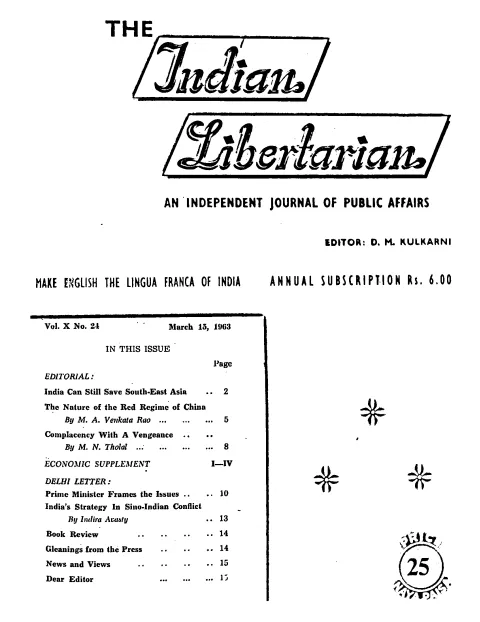
periodical issue
The Indian Libertarian
An Independent Journal of Public Affairs
By MA Venkata Rao, M. N. Tholal, C. Rajagopalachari
Libertarian Publishers (Private) Ltd., 26, Durgadevi Road, Bombay 4 · Bombay · 1962
16 pages
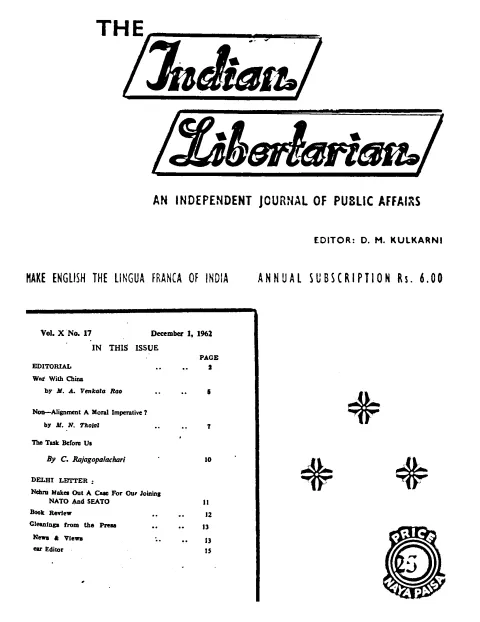
The Indian Libertarian
Summary
The December 1, 1962 number of The Indian Libertarian (Vol. X No. 17, edited by D. M. Kulkarni) is an Indo-China-war issue. Almost every page in the rendered set responds, directly or obliquely, to the Chinese offensive that opened in late October 1962 and to the political fallout the conflict was producing inside India. The unsigned editorial, M. A. Venkata Rao’s essay ‘War With China’, M. N. Tholal’s ‘Non-Alignment A Moral Imperative?’, and C. Rajagopalachari’s short ‘The Task Before Us’ together frame Peking’s aggression as the moment at which India’s official non-alignment, its earlier appeasement of the Chinese leadership, and its faith in negotiated settlement must all be discarded. A ‘Delhi Letter’ from the magazine’s correspondent then reports on Nehru beginning to argue in Parliament for India’s drawing closer to NATO and SEATO. Shorter standing departments — a Book Review, ‘Gleanings from the Press’, ‘News & Views’, and a ‘Dear Editor’ column — round out an issue that reads throughout as a Liberal / Swatantra-leaning rebuke of Congress defence and foreign policy, and as a celebration of the parliamentary agitation that forced V. K. Krishna Menon’s resignation as Defence Minister.
Key points
-
The unsigned editorial ‘Hate Communism to Win the War’ argues India’s military reverses in NEFA and Ladakh stem from decades of refusing to treat Communism as a hostile ideology, embracing Peking instead through ‘Hindi-Chini bhai-bhai’ rhetoric.
-
M. A. Venkata Rao’s ‘War With China’ reads the Chinese advance as the predictable harvest of a foreign policy that trusted declarations rather than credible military power, revisiting the McMahon Line and Panchsheel record.
-
Venkata Rao calls for rapid rearmament, conscription, and civil discipline, along with abandoning the vocabulary of non-alignment in responding to what he frames as Chinese totalitarian aggression.
-
M. N. Tholal’s ‘Non-Alignment A Moral Imperative?’ distinguishes tactical non-alignment from its moral justification, concluding Nehru’s version left India militarily and diplomatically isolated in the face of Chinese aggression.
-
C. Rajagopalachari contributes the short piece ‘The Task Before Us’, joining the issue’s shared call for India to discard appeasement and non-alignment’s language toward China.
-
A Delhi Letter from the magazine’s correspondent reports Nehru beginning to argue in Parliament for India to draw closer to NATO and SEATO.
-
The issue reads throughout as a celebration of the parliamentary agitation that forced V. K. Krishna Menon’s resignation as Defence Minister.
-
Standing departments, a Book Review, ‘Gleanings from the Press’, ‘News & Views’, and a ‘Dear Editor’ column, round out the December 1962 Indo-China war number edited by D. M. Kulkarni.
Essays
EDITORIAL
The unsigned editorial ‘Hate Communism to Win the War’ argues that India’s military reverses in NEFA and Ladakh are the inevitable product of a national leadership that, since independence, refused to treat Communism as an enemy ideology and instead embraced Peking with the ‘Hindi-Chini bhai-bhai’ rhetoric. The editor catalogues what he reads as the Government’s wilful blindness — from accepting Chinese occupation of Tibet to brushing aside reports of road-building in Ladakh — and insists that winning the war now requires a moral revolution at home: Indians must learn to hate Communism with the same conviction with which they once hated foreign rule, and the press, Parliament and party platforms must stop dressing up totalitarian aggression as a ‘misunderstanding’ between sister civilisations.
- Frames the Sino-Indian war as a ‘full-fledged’ though undeclared conflict forced on India by ‘treacherous Chinese Communists’.
- Reads the loss of Indian territory in NEFA and Ladakh as the consequence of the Government’s refusal to recognise Communism as a hostile ideology.
- Attacks the long record of Indian appeasement — Tibet, the McMahon Line, the Hindi-Chini-bhai-bhai posture — as the moral ground on which the present invasion grew.
- Calls on the press, Parliament and the citizenry to abandon non-alignment’s vocabulary and treat the war as an ideological as much as a territorial defence.
- Argues that hatred of Communism, openly preached, is the precondition for the national mobilisation the war demands.
War With China
By MA Venkata Rao
M. A. Venkata Rao’s ‘War With China’ opens with the observation that, despite Nehru’s preaching of peace and settlement through negotiation in every international forum, war on a major scale has now overtaken India. Venkata Rao reads the Chinese advance into NEFA and Ladakh as the predictable harvest of a foreign policy that placed faith in declarations rather than power, and uses the occasion to revisit the long Sino-Indian diplomatic record — the McMahon Line, the Panchsheel agreement, the early Chinese roadworks in Ladakh — to argue that the warning signs were available to anyone willing to read them. He then turns to the question of the conduct of the war: rearmament, conscription, civil discipline and, above all, the abandonment of the political vocabulary of non-alignment when responding to a fellow Asian state that has chosen totalitarian aggression.
- Reads the Chinese offensive as the inevitable consequence of Nehru’s pacifism and of India’s refusal to back diplomacy with credible military power.
- Surveys the long record of Sino-Indian disputes — the McMahon Line in NEFA, Aksai Chin and the Ladakh roadworks — to argue that the war was foretold by Peking’s earlier conduct.
- Treats ‘Panchsheel’ and the Hindi-Chini-bhai-bhai posture as ideological props that disarmed Indian opinion in the years before the attack.
- Calls for a rapid reorientation of national policy: rearmament, civil discipline, and the open naming of Chinese Communism as the adversary.
- Connects the failure on the frontier to a deeper failure of Indian liberalism to insist on hard-headed realism in foreign policy.
Non—Alignment A Moral Imperative ?
By M. N. Tholal
M. N. Tholal’s ‘Non-Alignment A Moral Imperative?’ addresses a question that the Chinese invasion has made painfully concrete for every patriotic Indian: can non-alignment still be defended as the country’s foreign-policy posture, and on what grounds? Tholal works through the standard moral case for non-alignment — that India must keep its distance from both Cold War blocs in order to speak with a free conscience — and then tests it against the Chinese aggression. He concludes that the doctrine, as practised by Nehru, has degenerated into an alibi for refusing necessary alliances and for misreading the totalitarian character of the Chinese regime. The essay is at once a brief in liberal foreign policy and a polemic against a moralism that has, in his view, become indistinguishable from cowardice.
- Frames non-alignment as a doctrine now to be judged by its consequences during the Chinese aggression rather than by the rhetoric of its founders.
- Distinguishes between non-alignment as a tactical posture and non-alignment as a ‘moral imperative’, rejecting the second formulation.
- Argues that Nehru’s policy treated Peking as an honest interlocutor and so left India militarily and diplomatically isolated.
- Reads the war as forcing a choice: alliance with the democracies, or a continued and dangerous illusion of neutrality.
- Holds that genuine liberal foreign policy must be willing to name totalitarian aggression and to ally accordingly.
The Task Before Us
By C. Rajagopalachari
Rajaji’s short ‘The Task Before Us’ opens with the observation that the agitation, inside and outside the Congress, has at last forced the resignation of V. K. Krishna Menon as Defence Minister, with the Prime Minister holding out to the very end. He treats the resignation as a triumph of democratic pressure but warns that NEFA is not yet recovered and that the war will require more than a cabinet reshuffle. The bulk of the piece sketches the ‘task before us’: a serious ministry of supplies covering both civil and military needs, an end to the doctrinal hostility to American and other Western aid, a frank reckoning with the Communist sympathisers still inside the Government, and a willingness to fight a long war without taking refuge in the slogans of non-alignment.
- Reads the resignation of V. K. Krishna Menon as a victory of public agitation over Cabinet inertia, but insists the larger battle has barely begun.
- Calls for a coordinated ministry of supplies covering both civil and military procurement under a single overall minister.
- Urges India to abandon the doctrinal hostility to Western aid and to align openly with the democracies for the duration of the conflict.
- Argues that Communist sympathisers inside the Government must be identified and removed if the war effort is to be credible.
- Frames the war as a test of Indian liberal nerve as much as of military capacity.
DELHI LETTER : Nehru Makes Out A Case For Our Joining NATO And SEATO
By From our Correspondent
The unsigned ‘Delhi Letter’ from the magazine’s parliamentary correspondent reports on Nehru’s speech of 20 November in Parliament, in which the Prime Minister, while not yet abandoning non-alignment in name, began to make the case for India drawing much closer to the Western alliance system. The correspondent reads Nehru’s qualified embrace of NATO and SEATO as an admission that the policy of equidistance has collapsed under Chinese fire, and reports the response of opposition members — Swatantra and PSP voices among them — who pressed the Government to be explicit about the alliances now being sought.
- Reports Nehru’s 20 November parliamentary speech as the first official signal that non-alignment is being quietly reconsidered.
- Reads the Prime Minister’s case for closer cooperation with NATO and SEATO as a tacit acknowledgement that the old foreign policy has failed.
- Records opposition demands — from Swatantra and other benches — that the Government speak plainly about the alliance it is now seeking.
- Treats the Delhi mood as one of relief at Krishna Menon’s exit and unease at the Government’s continuing reluctance to name the United States as a needed ally.
Book Review
A short Book Review notice introduces ‘Cultural Anthropology’ by Nirmal Kumar Bose, published by Asia Publishing House. The reviewer treats the volume as a standard, methodologically careful introduction to the field for Indian students and notes Bose’s long professional association with the discipline. The notice is brief and largely descriptive, with the reviewer recommending the book to teachers and students of anthropology.
- Reviews Nirmal Kumar Bose’s ‘Cultural Anthropology’ (Asia Publishing House).
- Treats the volume as a serviceable introductory text for Indian university students.
- Notes the author’s long-standing professional engagement with Indian anthropology.
Gleanings from the Press
‘Gleanings from the Press’ reprints short excerpts from other Indian newspapers on the Chinese aggression and on the government’s handling of it, presenting them as evidence that even the moderate press is now uneasy with Nehru’s diplomacy. The selection leans heavily on commentary about anti-Communism and the long credulity of Indian opinion toward Peking.
- Excerpts other Indian newspapers’ editorial responses to the Chinese invasion.
- Treats the gathered commentary as evidence of a hardening national mood against Peking and against the Hindi-Chini-bhai-bhai posture.
News & Views
‘News & Views’ is a short news-digest department. The items in this issue cover U.S. arms shipments to India, Ladakh casualty figures, a story about Chavan and the ‘Red Napoleons’, a Bengal Socialist Party plea on Chinese aggression, demands that Tibet be liberated, the Bangalore Libertarian Social Institute, and a brief Ladakh dispatch. The cumulative effect is to underscore the war’s diplomatic, military and ideological theatres simultaneously.
- Reports U.S. arms shipments and Western equipment arriving for the Indian war effort.
- Carries casualty and prisoner statistics from Ladakh fighting.
- Records political statements — from Rajaji, the Bengal Socialist Party and others — on Tibet, China and the conduct of the war.
- Notes the founding meeting of the Libertarian Social Institute, Bangalore.
Dear Editor
The ‘Dear Editor’ column carries a short letter signed P. Kodanda Rao on ‘Insulting Friends’, commenting on remarks in the Indian Parliament about the United States and arguing that India cannot afford the luxury of insulting the friends from whom it is now asking for arms.
- Letter from P. Kodanda Rao on Indian parliamentary rhetoric toward the United States.
- Argues that India cannot accept Western military aid and simultaneously abuse the Western powers in Parliament.
Generated by the v1.5 extraction pipeline. Awaiting editorial review.
Metadata and summary are AI-extracted from the source PDF and reviewed for editorial accuracy. The original work is available via the Read PDF tab above (where present); paragraph-level citation inside the PDF is deferred to a future engagement.