periodical issue
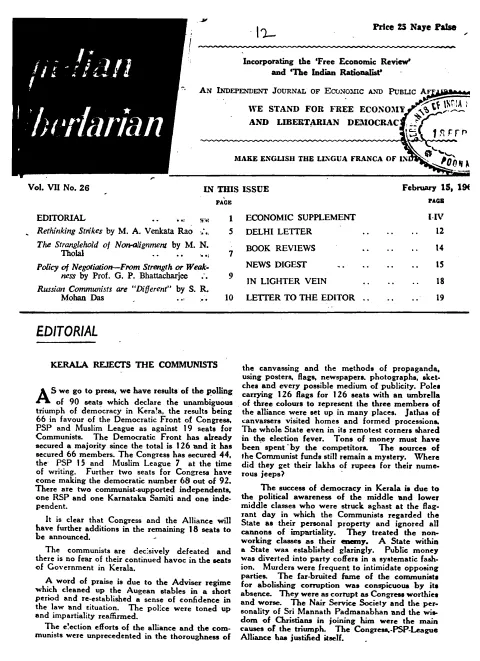
The Indian Libertarian
Independent Journal of Economic and Public Affairs; Incorporating the 'Free Economic Review' and 'The Indian Rationalist'
By MA Venkata Rao, M. N. Tholal, G N Lawande
Printed and Published by D. M. Kulkarni at the Libertarian Publishers (Private) Ltd., 26, Durga Niwas, V. P. Road, Bombay 4 · Bombay · 1959
24 pages
The Indian Libertarian
Summary
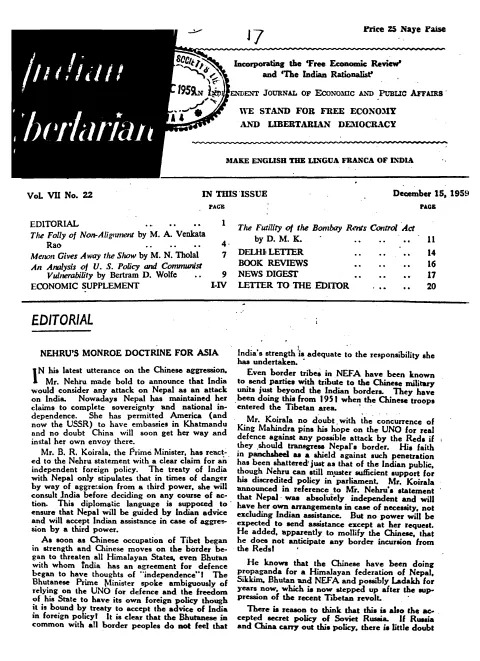
The 15 December 1959 issue of The Indian Libertarian (Vol. VII No. 22) is dominated by a single argumentative line: Indian non-alignment has become a strategic liability and the country’s foreign and economic policies need to be re-thought against the backdrop of Chinese aggression on the Himalayan frontier. The lead editorial treats Nehru’s pledge to defend Nepal against an attack as an Asian Monroe Doctrine without the means to back it; M. A. Venkata Rao argues that the doctrine of non-alignment was always a moralistic disguise for left-leaning sympathies; M. N. Tholal reads Krishna Menon’s recent speeches as inadvertent admissions of military weakness; and Bertram D. Wolfe contributes a long analytic essay on the structural vulnerabilities of communism that U.S. policy fails to exploit. A four-page Economic Supplement turns to domestic questions — G. N. Lawande on the conditions under which foreign aid actually accelerates development, and the columnist ‘Piem’ on the case for a larger private-sector role in the Third Plan. The issue closes with D. M. K.’s polemic against the Bombay Rents Control Act, a Delhi Letter on appeasement in non-alignment, and a book review of Ram Gopal’s India of Vedic Kalpasutras. Taken together, the issue is a coordinated classical-liberal critique of the Nehruvian foreign-policy consensus and of the planning state, written in the immediate aftermath of the Sino-Indian border crisis.
Key points
-
The lead editorial, ‘Nehru’s Monroe Doctrine for Asia’, argues Nehru’s pledge to defend Nepal against Chinese attack is a unilateral guarantee India lacks the strength to honour, since Nepal maintains embassies with America, the USSR and China.
-
It notes that Bhutan has likewise begun speaking of independence and may follow Nepal’s example in opening diplomatic ties with third powers.
-
A companion piece cites Sukarno’s expulsion of Chinese petty traders from Indonesia as proof that even friendly Asian states find Peking impossible to live with.
-
The editorial cluster reports Rajagopalachari conceding from a Swatantra platform that India’s non-alignment has produced neither friends nor security.
-
M. A. Venkata Rao’s ‘The Folly of Non-Alignment’ argues Indian foreign policy is a moralised tilt toward the communist bloc, tracing errors from the 1950 refusal to back South Korea to accepting China’s occupation of Tibet.
-
Rao treats Krishna Menon’s continuation as Defence Minister as proof Nehru cannot or will not correct course, and calls for explicit alignment with the democratic West.
-
M. N. Tholal’s ‘Menon Gives Away the Show’ reads Krishna Menon’s recent speeches as inadvertent admissions of shortages in equipment, roads and trained personnel on the Himalayan frontier.
-
Tholal treats Lt. Gen. Thimayya’s resignation as further evidence that civil-military relations had broken down under Menon’s ministry.
-
Bertram D. Wolfe contributes a long analytic essay on the structural vulnerabilities of communism that U.S. policy fails to exploit, alongside an Economic Supplement on foreign aid and the Third Plan’s private-sector role.
Essays
EDITORIAL (Nehru’s Monroe Doctrine for Asia)
The unsigned lead editorial, ‘Nehru’s Monroe Doctrine for Asia’, responds to Nehru’s announcement that India would treat any Chinese attack on Nepal as an attack on India. The editors argue that this commitment is a unilateral guarantee that the Nepalese government under B. P. Koirala has not solicited and that India lacks the strength to honour: Nepal continues to have embassies in Khatmandu from America, the USSR and now China, and even Bhutan has begun to speak of ‘independence’ and may follow Nepal in opening ties with third powers. The same editorial cluster contains two further pieces — ‘Indonesia Has Trouble With China’, which uses Sukarno’s expulsion of Chinese petty traders to argue that even ostensibly friendly Asian states find Peking impossible to live with; and ‘C. R. Admits the Failure of Non-Alignment’, which reports Rajagopalachari’s Swatantra speech accepting that India’s foreign policy has produced neither friends nor security. The editorial position is that non-alignment, far from being a posture of strength, has left India diplomatically isolated at precisely the moment its northern frontier is under armed challenge.
- Nehru’s pledge to defend Nepal is framed as an Asian Monroe Doctrine without the military or diplomatic capacity to back it
- Nepal’s continued multi-power embassies in Kathmandu are read as evidence that Kathmandu does not in fact regard itself as an Indian protectorate
- Bhutan is beginning to talk of independence and may follow Nepal in dealing directly with third powers
- Indonesia’s expulsion of Chinese petty traders is cited as proof that even non-aligned Asian states cannot coexist with Peking on Peking’s terms
- Rajagopalachari (C. R.) is quoted as conceding from a Swatantra Party platform that non-alignment has failed
- The editors treat Sino-Indian friendship and ‘Panchsheel’ as a shield against penetration whose credibility has now collapsed
The Folly of Non-Alignment
By MA Venkata Rao
M. A. Venkata Rao’s ‘The Folly of Non-Alignment’ argues that India’s foreign policy is not a neutral posture at all but a sympathetic tilt toward the communist bloc dressed in the moral vocabulary of Panchsheel and peaceful co-existence. He attacks the continuation in office of Krishna Menon — characterised as the architect of the disastrous Tibet policy and a man whose loyalties run leftward rather than to India — and reads Nehru’s reluctance to dismiss him as evidence that the leadership is captured by its own ideology. The article tracks the long sequence by which the Nehru-Menon line, from refusing to support South Korea in 1950 to accepting the Chinese occupation of Tibet, has gradually conceded territory and strategic depth. Rao argues that the Sino-Soviet world treats Indian non-alignment as a convenient cover under which to pursue advances against the free world, while the Indian public is told the policy preserves peace. He calls for an explicit reorientation: an alignment with the democratic West, a clear renunciation of the illusion that China can be befriended, and an open ideological repudiation of the planning-state apparatus that gives the Nehru-Menon foreign policy its domestic support.
- Non-alignment is described not as neutrality but as a moralised tilt toward the communist bloc
- Krishna Menon’s continuation as Defence Minister is treated as proof that Nehru cannot or will not correct course
- The 1950 refusal to back South Korea and the acceptance of the Chinese seizure of Tibet are presented as the originating errors of the doctrine
- Panchsheel is read as a moral fig leaf used by Peking to mask territorial ambition
- Rao calls for explicit alignment with the democratic West and an ideological break with planning-state socialism
Menon Gives Away the Show
By M. N. Tholal
M. N. Tholal’s ‘Menon Gives Away the Show’ reads Krishna Menon’s recent speeches as a series of inadvertent admissions that the Defence Ministry has been caught unprepared by the Chinese on the Himalayan frontier. Tholal contrasts Menon’s earlier confident claims about Indian preparedness against speeches that now concede shortages of equipment, road infrastructure and trained personnel, and treats Lt. Gen. Thimayya’s resignation episode as further evidence that the civil-military relationship has broken down. The piece is unsparing toward what Tholal calls the rudeness and insolence of Menon’s parliamentary style and treats his diplomatic posturing on disarmament and on Tito as substitutes for the harder work of actually equipping the army. Tholal’s underlying argument is that Menon’s continued tenure is itself a foreign-policy statement — one that signals to Peking that India will not take its own defence seriously.
- Menon’s speeches are mined for admissions of unpreparedness in equipment, roads and trained troops
- The Thimayya resignation episode is cited as evidence of a broken civil-military relationship under Menon
- Menon’s rhetorical style — described as rude and insolent — is treated as itself politically damaging
- Diplomatic posturing on disarmament and Tito is presented as a substitute for genuine defence preparation
An Analysis of U. S. Policy and Communist Vulnerability
By Bertram D. Wolfe
Bertram D. Wolfe’s ‘An Analysis of U. S. Policy and Communist Vulnerability’ — reprinted from the November 1959 New Leader — argues that American Cold War strategy under-rates the structural fragilities of the Soviet and Chinese systems. Wolfe contends that the communist states, far from being monolithic and inevitable, suffer from chronic legitimacy deficits, from the strategy-versus-tactics tension that bedevils any vanguard party, and from the long-run untenability of forced collectivisation. The essay traces the Leninist doctrine of strategy and tactics through Russian collectivisation and into Maoist applications, and treats the Russian peasant rising and the Hungarian revolt as evidence that the system is structurally fragile rather than ideologically secure. The article is, by Indian Libertarian standards, a long and technical piece of Cold War analysis; its function in this issue is to supply the argumentative arsenal with which the editors and Venkata Rao attack non-alignment.
- Wolfe argues that U.S. Cold War strategy systematically over-estimates communist solidity
- The Leninist strategy-tactics distinction is treated as a permanent source of intra-bloc instability
- Forced collectivisation in Russia and Maoist applications in China are presented as long-run structural weaknesses
- The Hungarian revolt and the Russian peasant rising are cited as evidence of latent vulnerability inside the bloc
Foreign Aid and Economic Development
Opening the four-page Economic Supplement, G. N. Lawande’s ‘Foreign Aid and Economic Development’ sets out the conditions under which external assistance actually accelerates development rather than entrenching dependence. Lawande draws a sharp line between aid that reinforces the recipient’s own savings and investment capacity and aid that substitutes for domestic effort; the former is productive, the latter corrosive. He works through the standard donor instruments — grants, soft loans, food aid, technical assistance — and argues that what determines their usefulness is not the size of the inflow but the absorptive capacity, planning quality and savings rate of the recipient. The piece is written for an Indian audience reading it in the run-up to the Third Plan: Lawande’s implicit message is that foreign aid is a complement to, never a substitute for, a domestic policy regime that rewards productive investment.
- Foreign aid is productive only when it complements, not substitutes for, domestic savings and effort
- Donor instruments — grants, soft loans, food aid, technical assistance — are surveyed and ranked by their fit with recipient capacity
- Absorptive capacity and planning quality are treated as the binding constraints on aid effectiveness
- The piece is positioned as a corrective for Third Plan expectations that foreign aid will close the savings-investment gap on its own
ECONOMIC SUPPLEMENT (Foreign Aid and Economic Development by Prof. G. N. Lawande; Private Sector and Third Plan by “Faces”)
By G N Lawande
The Economic Supplement’s second piece, ‘Private Sector and Third Plan’ by the columnist ‘Piem’, makes the classical-liberal case for a larger and more genuinely autonomous private sector in the upcoming Third Five Year Plan. Piem reviews the record of the Second Plan, arguing that public-sector industrial projects have over-run their budgets and under-delivered output while the private sector has met or exceeded its targets despite a regulatory environment designed to constrain it. The piece treats the Planning Commission’s enthusiasm for further nationalisation and licensing as not merely inefficient but as a direct threat to the household savings on which the Plan’s investment targets depend. Piem’s prescription is to liberalise licensing, narrow the public sector to genuine natural monopolies and infrastructure, and let private enterprise carry the bulk of new industrial investment.
- The Second Plan’s public-sector projects are characterised as over-budget and under-performing relative to private targets
- Further nationalisation and tighter licensing are framed as a threat to household savings mobilisation
- Piem argues for narrowing the public sector to natural monopolies and infrastructure
- The piece reads as the editorial line of the Indian Libertarian inside the Third Plan debate
The Futility of the Bombay Rents Control Act
By D. M. K.
D. M. K.’s ‘The Futility of the Bombay Rents Control Act’ argues that rent control in Bombay, originally a wartime emergency measure to protect tenants from the housing pressure created by refugee inflow, has hardened into a permanent regime that now produces the opposite of its intended effect. The piece works through how frozen rents have collapsed new private construction, how protected tenancies have created a privileged class of long-term occupants, and how the resulting black market in ‘pugree’ payments and side-deals transfers most of the value the law was meant to capture for tenants into the hands of intermediaries and landlords. D. M. K. then turns to the technicalities — the standard-rent formula, the categories of permitted increase, the special protections for refugee tenants — and shows how each provision has produced predictable evasion. The article reads as a classical-liberal case study in how a well-meaning intervention in a price system, sustained past its emergency rationale, ends up entrenching scarcity and unfairness rather than relieving them.
- Rent control is treated as a wartime emergency measure that has outlived its rationale
- Frozen rents are charged with collapsing new private rental construction in Bombay
- The ‘pugree’ black market is presented as the predictable consequence of binding price ceilings
- Protected tenancies create a privileged class of incumbents at the expense of new entrants and refugees
DELHI LETTER (Appeasement Implicit in Non-alignment — From Our Correspondent)
By From Our Correspondent
No summary was extracted for this article. Listed for completeness.
BOOK REVIEWS
The ‘Delhi Letter’ from the magazine’s Delhi correspondent argues that appeasement is now structurally implicit in Indian non-alignment. The correspondent surveys recent diplomatic traffic — the American presidential visit, Khrushchev’s overtures, Indian dealings with Pakistan under Ayub Khan and with the smaller Arab and Asian states — and concludes that the policy of refusing alignment in fact obliges India to soften its responses to whichever great power is exerting immediate pressure. The piece is unimpressed by the parliamentary debate on the Chinese aggression, which it finds long on platitudes about peace and short on operational decisions about the frontier. Eisenhower’s expected visit is treated as a political opportunity that the government is unlikely to use; the correspondent also notes the absence of any serious public discussion of the Sino-Indian boundary question’s diplomatic options. The letter functions as the Delhi-eye-view complement to the volume’s broader editorial line.
- Non-alignment is recast as appeasement in operational form
- The Eisenhower visit is treated as a missed opportunity for a public foreign-policy reset
- Parliamentary debate on the Chinese aggression is judged long on rhetoric and short on operational substance
- Indian dealings with Ayub Khan’s Pakistan are noted as evidence that even managed neighbours read the Indian posture as weakness
NEWS DIGEST
The issue’s Book Reviews open with a notice of Ram Gopal’s ‘India of Vedic Kalpasutras’ (National Publishing House, Delhi, 1959), a study of the Vedic Kalpasutra literature — the texts of Apastamba, Baudhayana, Gautama and Vasishtha — as a source for Vedic social and religious life. The reviewer situates the book against the existing scholarship of Dr. P. V. Kane and other Dharmasastra commentators, treats Ram Gopal’s reconstruction of the period as careful and well-evidenced, and notes a few points of methodological disagreement. Only the first review is visible on the rendered final page; subsequent reviews continue past page 20 and are not included in the rendered set.
- Ram Gopal’s ‘India of Vedic Kalpasutras’ is reviewed as a careful reconstruction of Vedic society from the Kalpasutra literature
- The review situates the book against the standard Dharmasastra scholarship including Dr. P. V. Kane
- Only the first review is visible on the rendered page; the Book Reviews section continues past page 20
Generated by the v1.5 extraction pipeline. Awaiting editorial review.
Metadata and summary are AI-extracted from the source PDF and reviewed for editorial accuracy. The original work is available via the Read PDF tab above (where present); paragraph-level citation inside the PDF is deferred to a future engagement.