periodical issue
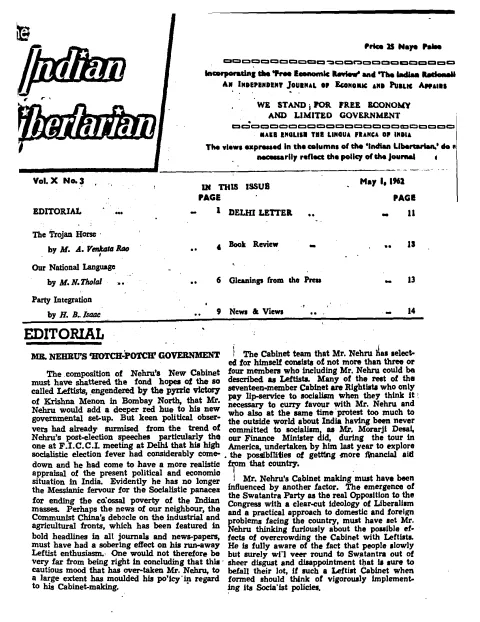
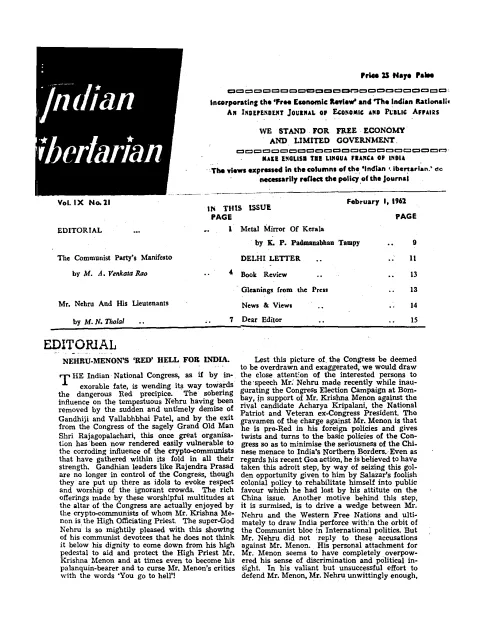
The Indian Libertarian
An Independent Journal of Economic and Public Affairs — Vol. IX No. 21, February 1, 1962
By MA Venkata Rao, M. N. Tholal
Libertarian Publishers (Private) Ltd., 26, Durgadevi Road, Bombay 4 · Bombay · 1962
16 pages
The Indian Libertarian
Summary
The 1 February 1962 issue of The Indian Libertarian (Vol. IX No. 21), edited from Bombay under the masthead ‘We stand for free economy and limited government,’ opens with a hard-edged editorial against what it calls the Nehru-Menon drift of the Indian National Congress towards a ‘Red precipice,’ diagnosing crypto-communist capture after the deaths of Vallabhbhai Patel and the exit of C. Rajagopalachari, and warning that Jawaharlal Nehru’s defence of V. K. Krishna Menon over the Kashmir, Goa and China questions has put national security in the hands of a fellow-traveller faction. The remainder of the issue extends this argument across registers: M. A. Venkata Rao dissects the Communist Party of India’s election manifesto as a Trojan horse for Soviet-style total nationalisation; M. N. Tholal sketches a wry political-organisational portrait of Nehru’s lieutenants through the figures of Devadas Gandhi, Maulana Azad and Rafi Ahmed Kidwai at the High Command; and K. P. Padmanabhan Tampy supplies a cultural piece on the artisan caste of Aranmula in Kerala that perfected the metal mirror. Standing departments — a Delhi Letter on Election Commissioner Sukumar Sen, a book review of Joseph S. Thompson’s Taxation’s New Frontier, Gleanings from the Press, News & Views on Krishna Menon’s overtures to Peking and Moscow, and a Dear Editor letter on ‘taxation, the foundation of theft’ — round out a number whose argumentative centre is the defence of a free economy, parliamentary opposition and constitutionalism against what the journal sees as a one-party drift in Indian politics.
Key points
-
The unsigned editorial Nehru-Menon’s Red Hell For India argues the Congress party is drifting toward the dangerous Red precipice now that the moderating influence of Vallabhbhai Patel and C. Rajagopalachari is gone.
-
The editorial treats Nehru’s public defence of Defence Minister V. K. Krishna Menon over Kashmir, the Goa action and the China border as evidence that the Prime Minister has been captured by crypto-communist lieutenants.
-
The editorial reads India’s Goa policy as a foolish colonial Salazar-comparison gambit designed to insulate Menon from charges of pro-Peking sympathies.
-
Companion sub-leaders in the editorial call for a real parliamentary opposition and cite Pakistan’s Ayub Khan basic democracies experiment as a cautionary mirror for Indian constitutional democracy.
-
M. A. Venkata Rao’s The Communist Party’s Manifesto reads the CPI’s 1962 election programme as a Trojan horse for the wholesale nationalisation of agriculture, industry, banking, foreign trade and the press.
-
Venkata Rao cites Khrushchev’s national democracy doctrine to argue the CPI cannot recognise a national interest distinct from the global Soviet bloc, and warns that its cooperative-farming proposals would be coercive.
-
M. N. Tholal’s Mr. Nehru And His Lieutenants traces the careers of Devadas Gandhi, Rafi Ahmed Kidwai, Maulana Azad and Khaliquzzaman to argue that Nehru’s Congress lieutenants have been successively co-opted, neutralised or eased out.
-
Tholal reads the Congress High Command’s editorial appointment manoeuvres, including a rebuff to Devadas Gandhi at the Hindustan Times, as a contest for recruiting compliant subordinates rather than a contest of programmes.
-
K. P. Padmanabhan Tampy contributes a cultural piece on the Aranmula artisan caste of Kerala, credited with perfecting the traditional metal mirror.
Essays
EDITORIAL — Nehru-Menon’s ‘Red’ Hell for India
The unsigned editorial ‘Nehru-Menon’s Red Hell For India’ opens by declaring that the Indian National Congress is ‘wending its way towards the dangerous Red precipice’ now that the sobering influences of Vallabhbhai Patel and the ‘Grand Old Man’ C. Rajagopalachari are gone, leaving the party ‘easily vulnerable to the corroding influence of the crypto-communists.’ The piece treats Nehru’s public defence of Defence Minister V. K. Krishna Menon — over the China border, the Goa action, and Kashmir — as the decisive evidence that the Prime Minister has been captured by his pro-Red lieutenants; it reads the Kashmir plebiscite refusal and the ‘foolish colonial’ Salazar-comparison gambit on Goa as adroit manoeuvres to insulate Menon from the charge of pro-Pekingese sympathies. The editorial then widens out into companion sub-leaders — ‘Democracy and Party System,’ ‘Here and There,’ ‘One Party Rule’ and ‘Nehru Drops the Mask Again’ — which together argue that constitutional democracy in India needs a real opposition, warn against Indira Gandhi’s elevation and Lal Bahadur Shastri’s manoeuvres inside the Congress machine, and read the Pakistani ‘basic democracies’ experiment of Ayub Khan as a cautionary mirror.
- Frames the 1962 Congress as captured by crypto-communist lieutenants after the loss of Patel and the exit of Rajagopalachari.
- Reads Nehru’s public embrace of Krishna Menon over Kashmir, Goa and the China border as the symptomatic act of that capture.
- Treats Goa policy as a ‘foolish colonial’ Salazar-style diversion designed to rehabilitate Menon over the China question.
- Calls for a real opposition and constitutionalist party system against the one-party drift of Indian politics.
- Uses Pakistan’s Ayub Khan ‘basic democracies’ as a foil to defend Indian parliamentary democracy on classical-liberal terms.
The Communist Party’s Manifesto
By MA Venkata Rao
M. A. Venkata Rao reads the Communist Party of India’s election manifesto as a coherent application of Marxist-Leninist programme to Indian conditions, and as a Trojan horse for the wholesale nationalisation of agriculture, industry, banking, foreign trade and the press. He notes that the CPI cannot, on Soviet doctrine, recognise a permanent national interest distinct from the global proletariat, and that its ‘national-democratic’ section in any country is in the last instance an executive of the Soviet bloc; the manifesto’s nominally moderate calls for cooperative farming, public-sector expansion and reservation of basic industries to the state are therefore read as the visible edge of a programme whose end point is the liquidation of private property and constitutional liberty.
- Treats the CPI manifesto as the Indian application of a fixed Soviet political vocabulary, not as an autonomous Indian programme.
- Reads the demand for nationalisation of foreign trade, banks, plantations, mines and the press as the manifesto’s operative core.
- Cites Khrushchev’s ‘national democracy’ line as the doctrinal frame within which the CPI’s programmatic moderation must be understood.
- Warns that Soviet-style cooperative farming would be coercive and would dispossess the peasantry under the cover of pooling.
- Links the manifesto’s industrial programme to the Soviet pattern of total state direction of investment, wages and prices.
Mr. Nehru And His Lieutenants
By M. N. Tholal
M. N. Tholal’s column on ‘Mr. Nehru And His Lieutenants’ offers a sceptical biographical-organisational sketch of how Nehru and Defence Minister Krishna Menon hold the Congress together through a thinning circle of subordinates. Tholal recalls the Lucknow conference and traces the careers of Devadas Gandhi at the Hindustan Times, the late Rafi Ahmed Kidwai, Maulana Azad and Khaliquzzaman to argue that successive ‘lieutenants’ have been either co-opted, neutralised or eased out, leaving Nehru increasingly without a real Congress establishment to discipline him. The piece reads the High Command’s choices in editorial appointments — the rebuff to Devadas Gandhi at the Hindustan Times, the Managing Director shuffle, the elevation of Rafi Kidwai’s hand — as a politics of competition for recruiting duffers rather than a contest of programmes.
- Argues that Nehru’s lieutenants have functioned more as instruments than as a check on the Prime Minister.
- Reads the editorial battles at the Hindustan Times around Devadas Gandhi as a microcosm of Congress patronage politics.
- Treats Rafi Ahmed Kidwai’s manoeuvres as the template for the High Command’s mode of operation.
- Suggests that ‘competition in recruiting duffers’ is the real organisational principle of the post-Patel Congress.
- Frames the Lucknow conference as the moment at which the lieutenant system displaced collective leadership.
Metal Mirror Of Kerala
By K. P. Padmanabhan Tampy
K. P. Padmanabhan Tampy’s ‘Metal Mirror of Kerala’ is a short cultural feature on Aranmula, ninety miles north of Trivandrum, where a Vishnu temple of the Chaturveda Bhattatiripads sustains an old artisan caste that has perfected the manufacture of a polished metal mirror — the Aranmula Kannadi — from a closely guarded alloy. Tampy traces the legend through which the Kannadi family of metallurgists settled at Aranmula under the patronage of the temple and the Pandalam royal house, and describes the work as one of the most remarkable surviving instances of indigenous Indian metallurgy, a craft secret transmitted within a single Brahmin family. The essay sits in the issue as a cultural counterpoint to the political polemic, but its libertarian charge is implicit: a guild that has preserved its trade secret across centuries without state direction.
- Locates the Aranmula metal mirror in the ritual and economic life of a temple-based artisan settlement.
- Treats the Kannadi family’s tradecraft as a hereditary, closely guarded metallurgical secret.
- Frames the craft as an indigenous achievement that has survived without state patronage.
DELHI LETTER — Election Commissioner’s Amazing Performance
By (From Our Correspondent)
The Delhi Letter, ‘Election Commissioner’s Amazing Performance,’ attacks Sukumar Sen for what it reads as an open partiality to the Communist Party of India in the design of the 1962 general elections. The correspondent argues that the Election Commissioner has given the CPI the rights and amenities of a recognised national party — symbol, election broadcasts, time on All India Radio, party representatives at counting tables — on the strength of a vote share earned in the Hindi belt and elsewhere that does not, in the correspondent’s reading, warrant the all-India status conferred. The column extends the indictment to the Congress’s use of state machinery for party purposes and to the alleged collusion of Sen’s secretariat with the CPI’s national managers, all in a register that treats free and fair elections as the constitutional question of the moment.
- Frames Election Commissioner Sukumar Sen’s recognition of the CPI as a national party as an act of partiality, not neutrality.
- Reads the allocation of broadcasting time and counting-table representation to the CPI as a constitutional grievance.
- Treats the Congress’s use of state machinery for electioneering as part of the same one-party drift the editorial diagnoses.
- Calls for the Election Commission to be brought under tighter parliamentary scrutiny.
Book Review — Taxation’s New Frontier
A brief book notice of Joseph S. Thompson’s ‘Taxation’s New Frontier’ (Federal Tackle Realty Co., San Francisco), commending its single-tax case against taxes on labour and capital and in favour of taxing land values — a Henry George-line argument the reviewer treats as the natural ally of the journal’s broader case against the regulatory and fiscal state.
- Treats Joseph S. Thompson’s monograph as a contemporary single-tax brief.
- Endorses the shift of the tax base from labour and capital to land value.
Gleanings from the Press — Silence is Golden
The ‘Gleanings from the Press’ department reprints a short editorial titled ‘Silence Is Golden,’ lifted from a press source (credited ‘M.T.W., Progress, Australia’), arguing that the loudest political voices are rarely the wisest and commending a temperate civic restraint as a public virtue.
- A reprinted short comment on the public virtue of restraint in political speech.
- Sourced from an overseas liberal press venue (‘Progress’, Australia).
News & Views
The News & Views column leads with ‘Krishna Menon’s Mysterious Talk of Peaceful Settlement with China and Russia,’ reading the Defence Minister’s overtures as a pre-election manoeuvre rather than a substantive opening, and stitches together short notes on Saurashtra politics around K. M. Munshi, on the Rajagopalachari (‘C. R.’ / Rajaji) Swatantra Party intervention, and on an alleged domestic crisis in the Soviet Communist Party. The column treats Menon’s diplomatic dramatics, the Congress’s reluctance to debate them in Parliament, and the use of state machinery for electioneering as parts of a single picture in which constitutional opposition is being squeezed.
- Reads Krishna Menon’s talk of a peaceful settlement with China and Russia as a pre-election performance.
- Notes K. M. Munshi’s stand in Saurashtra against the Congress establishment.
- Treats Rajagopalachari and the Swatantra opposition as the only credible alternative voice in the campaign.
- Records an alleged domestic crisis inside the Soviet Communist Party as background to CPI strategy.
Dear Editor — Taxation, The Philosophy of Theft
The ‘Dear Editor’ letter of the issue, headed ‘Taxation, The Foundation of Theft,’ argues that taxes which are not directly tied to identifiable services rendered by the state — roads, courts, defence — amount in principle to theft, and that the modern Indian state’s expansion of its taxing power without correspondingly expanding the services it owes the taxpayer is the central libertarian grievance. The letter writer signs off from Devon, England, and the editor prints the letter under the column without comment.
- Treats taxation without a clear quid-pro-quo of state services as a form of expropriation.
- Reads the post-independence Indian state’s fiscal expansion as the central libertarian grievance.
- Signed by a correspondent writing from Devon, England, suggesting the journal’s overseas readership.
Generated by the v1.5 extraction pipeline. Awaiting editorial review.
Metadata and summary are AI-extracted from the source PDF and reviewed for editorial accuracy. The original work is available via the Read PDF tab above (where present); paragraph-level citation inside the PDF is deferred to a future engagement.