periodical issue
The Indian Libertarian
An Independent Journal of Public Affairs
Libertarian Publishers (Private) Ltd., 26, Durgadevi Road, Bombay-4 · Bombay · 1963
16 pages
The Indian Libertarian
Summary
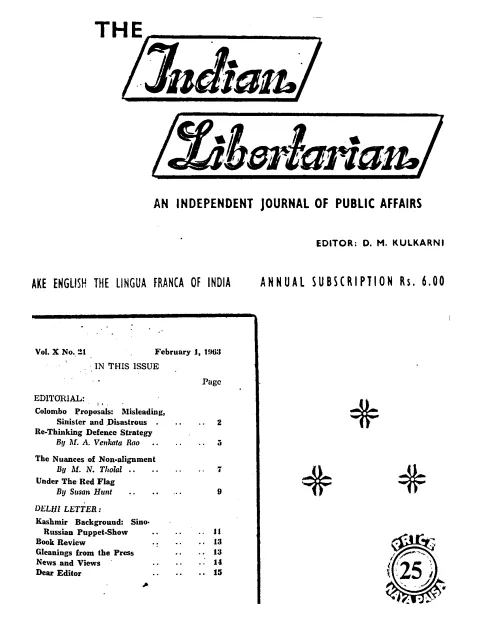
The 1 February 1963 issue of The Indian Libertarian (Vol. X No. 21), edited by D. M. Kulkarni and issued from Bombay by Libertarian Publishers, is dominated by the aftermath of the Sino-Indian war and the diplomatic fallout from the Colombo Conference of neutral powers. The unsigned editorial castigates Nehru’s government for entertaining the Colombo Proposals as a basis for negotiation with Peking, M. A. Venkata Rao calls for a wholesale rethinking of India’s defence philosophy and an Asian collective-security pact, and M. N. Tholal subjects the doctrine of non-alignment to a sustained critique. The reportage section combines Susan Hunt’s first-person account of refugees fleeing Communist China into Hong Kong with a Delhi Letter linking the Kashmir question to a Sino-Russian ‘puppet-show,’ a review of Lord Radcliffe’s Reith Lectures on power, gleanings from the press on a proposed Congress ‘private army,’ news briefs from Washington, Phnom Penh and elsewhere, and reader correspondence on university federalism and Madras sales tax.
Key points
-
The unsigned editorial ‘Colombo Proposals: Misleading, Sinister and Disastrous’ argues the proposals freeze rather than reverse Chinese gains in Bhutan, NEFA and Ladakh, and demands complete Chinese withdrawal to the pre-1962 line.
-
The editorial accuses Nehru and Krishna Menon of misrepresenting the Colombo Proposals to Parliament and holds up De Gaulle’s distrust of Anglo-American dominance as a model of independent foreign policy.
-
M. A. Venkata Rao argues that the NEFA debacle disproves ‘panchsheel’ confidence in communist neighbourliness and calls for an Asian collective-security pact modelled on ANZUS, drawing in Malaya, the Philippines, Indonesia, Australia, New Zealand and the United States.
-
Venkata Rao criticises self-reliance rhetoric as incompatible with India’s national budget and industrial base, insisting rearmament requires active Western and Commonwealth partnership.
-
M. N. Tholal’s essay recasts non-alignment as a timid ‘Safety First’ doctrine that left India exposed to communist subversion, proposing interdependence with Western democracies as a more realistic guarantee of sovereignty.
-
Susan Hunt’s Hong Kong despatch describes refugees continuing to escape Communist China across a fortified border, blaming the Great Leap Forward and the commune system for famine conditions on the mainland.
-
Hunt notes that food parcels mailed from Hong Kong relatives sustain families on the mainland, and that émigré associations and churches carry out most resettlement work for new arrivals.
-
A Delhi Letter links the Kashmir question to what it calls a Sino-Russian ‘puppet-show’, while a separate review covers Lord Radcliffe’s Reith Lectures on power.
-
The issue carries press gleanings on a proposed Congress ‘private army’ and reader correspondence on university federalism and the Madras sales tax.
Essays
EDITORIAL: Colombo Proposals: Misleading, Sinister and Disastrous
The unsigned editorial argues that Prime Minister Nehru and Defence Minister Krishna Menon are misrepresenting the Colombo Proposals as a diplomatic gain when in fact they leave large tracts of Indian territory in Bhutan, NEFA and Ladakh under Chinese control. It insists that the only honourable basis for any settlement is a complete Chinese withdrawal to the McMahon Line and the September 1962 positions, and warns that the neutral powers convened at Colombo were sympathetic to Peking rather than to India. A sidebar drawn from De Gaulle’s recent press conference is used to argue that the French President’s distrust of Anglo-American dominance and his preference for a continental European Economic Community should embolden India to develop an independent, hard-headed foreign policy rather than rely on borrowed Anglo-American formulae.
- The Colombo Proposals are read as misleading because they freeze rather than reverse Chinese gains in Bhutan, NEFA and Ladakh.
- Nothing short of a complete Chinese withdrawal to the pre-aggression line is acceptable to the editorial.
- Nehru’s and Krishna Menon’s public statements are charged with deceiving Parliament and the country.
- De Gaulle’s distrust of the Anglo-American bloc and championing of a European Common Market is held up as an example of self-respecting foreign policy.
- Indian liberals are urged to break with sentimental non-alignment and seek an outright alliance with the West against communist expansion.
Re-Thinking Defence Strategy
By MA Venkata Rao
M. A. Venkata Rao argues that India’s defence philosophy and military doctrine require radical revision in the light of the NEFA debacle. Pious confidence in ‘panchsheel’ neighbourliness with communist powers has been refuted by events; what India needs instead is a frank acknowledgement that communist states cannot be trusted and an active programme of collective security with the non-communist states of Asia. He sketches the case for an Indian-led pact analogous to ANZUS, drawing in Malaya, the Philippines, Indonesia, Australia, New Zealand and the United States, and complementing this external alliance with a domestic rearmament budget that does not pretend India can defend itself alone.
- Defence policy must be rebuilt on the premise that communist neighbours are intrinsically untrustworthy.
- An Asian collective-security pact, modelled on ANZUS, is proposed as the geopolitical answer to Chinese aggression.
- Self-reliance rhetoric is criticised as incompatible with the realities of the national budget and industrial base.
- Air, naval and ground rearmament require active Western and Commonwealth partnership.
The Nuances of Non-alignment
By M. N. Tholal
M. N. Tholal mounts a polemical critique of non-alignment as a doctrine of ‘Safety First’ that, in his reading, has left India neither safe nor respected. Surveying the record from independence to the Sino-Indian war, he argues that the country was always exposed to communist subversion, that non-alignment offered no protection, and that the government’s claim to occupy a moral perch above Cold War rivalries is a self-deception. The essay closes by calling for interdependence with the democracies, presenting alignment with the West not as a loss of sovereignty but as the most realistic guarantee of it.
- Non-alignment is recast as a policy of timid ‘Safety First’ that ignored a standing communist threat.
- India’s claim to a position of judgement above the Cold War blocs is dismissed as self-flattery.
- Interdependence with the Western democracies is proposed as the realistic alternative.
- Nehru’s foreign policy is held responsible for inviting, rather than averting, aggression.
Under The Red Flag
By Susan Hunt
Susan Hunt files a despatch from Hong Kong describing the surge of refugees who continue to break out of Communist China through the New Territories border, despite armed border patrols on both sides. She narrates the human cost of the Great Leap Forward: starvation in the countryside, the failure of the people’s communes, and a thriving traffic in food parcels mailed from Hong Kong relatives to families on the mainland. The piece pairs vignettes of individual escapes with a calmer accounting of how émigré associations and church groups in Hong Kong absorb the new arrivals.
- Refugees continue to escape from Communist China into Hong Kong despite a fortified border.
- The Great Leap Forward and the commune system are blamed for famine conditions on the mainland.
- Food parcels from Hong Kong to relatives in China are described as a vital private lifeline.
- Émigré associations and churches do much of the resettlement work that the colonial administration cannot.
DELHI LETTER: Kashmir Background: Sino-Russian Puppet-Show
By (From Our Correspondent)
The Delhi Letter, filed by ‘Our Correspondent,’ reads the Kashmir tangle as a Sino-Russian ‘puppet-show’ in which Pakistan plays the lead actor and the Colombo Proposals supply the script. The Kashmir talks with Pakistan are framed as a humiliation that Indian negotiators have allowed to slide because they accepted the Colombo formula instead of standing on the integration of Kashmir effected in 1947 and the deposition of Sheikh Abdullah. The correspondent sets the manoeuvres in a wider context of Sino-Pakistani border negotiation, Soviet ambivalence and Western pressure, and warns that the Government of India is being outflanked on every diplomatic front simultaneously.
- The Kashmir talks with Pakistan are treated as a diplomatic defeat masked as a process.
- The Sino-Pakistani border negotiations are read as part of a coordinated squeeze on India.
- Soviet alignment with Peking on Kashmir is exposed as quietly hostile to Indian claims.
- Sheikh Abdullah’s earlier detention and the 1947 accession are invoked as the only honest basis for Indian policy.
Book Review
A. R. Venkataraman reviews ‘The Problem of Power’ by Lord Radcliffe, the published version of the 1951 BBC Reith Lectures. He commends Radcliffe’s argument that the constitutional dispersal of sovereignty and the cultivation of independent counter-weights to executive power matter more for liberty than any electoral formula, and applies the moral to Indian conditions in which a single dominant party is increasingly fused with the state. The review reads as a Liberal endorsement of Acton’s maxim on the corrupting effects of power.
- Radcliffe’s central thesis is that power needs to be divided and restrained, not just legitimised by elections.
- The review uses the British constitutional case as a mirror for Indian one-party drift.
- Acton’s dictum on power and corruption is offered as the moral spine of the argument.
Gleanings from the Press
The ‘Gleanings from the Press’ column reproduces and comments on press reports that the Congress Party is moving to organise its own uniformed volunteer corps. The contributors read this as evidence of a slide from constitutional party politics toward a quasi-militia model on European inter-war lines and warn liberal readers to treat it as a danger to representative government rather than as a routine organisational matter.
- Reports of a Congress ‘private army’ are treated as a constitutional warning sign rather than a routine party-building story.
- The column reads the proposal in the light of European inter-war precedents of party militias.
News and Views
The News and Views column carries short despatches from Washington, Phnom Penh, Taipei and elsewhere. A Washington item argues that the world Cold War contest reduces to coercion versus free choice, with the United States standing for the latter; a Phnom Penh item reports Cambodian disillusionment with Peking’s peace overtures; further briefs cover the resumption of Western arms aid without political strings, alleged communist sabotage in newly-independent African states, and a notice on premier nominations and party suspensions in Indian state politics.
- The world conflict is reframed as a contest between coercion and free choice rather than between economic systems.
- Cambodian sources are cited as evidence that Peking’s professed desire for peace is hollow.
- Western arms aid is welcomed as coming ‘with no strings attached’.
- Communist sabotage and infiltration in post-colonial states are flagged as a continuing threat.
Dear Editor
The ‘Dear Editor’ page carries two letters. The first, on ‘Varsity Regionalism,’ takes up K. M. Munshi’s recent warning that the proliferation of regional universities is fragmenting the Indian academic community along linguistic lines; the second protests an anomaly in the Madras sales-tax regime that, the correspondent argues, penalises the small trader for the convenience of the revenue department.
- K. M. Munshi’s caution against regionalist fragmentation of Indian universities is endorsed.
- A specific anomaly in the Madras sales tax is highlighted as administratively unjust to small traders.
Generated by the v1.5 extraction pipeline. Awaiting editorial review.
Metadata and summary are AI-extracted from the source PDF and reviewed for editorial accuracy. The original work is available via the Read PDF tab above (where present); paragraph-level citation inside the PDF is deferred to a future engagement.