periodical issue
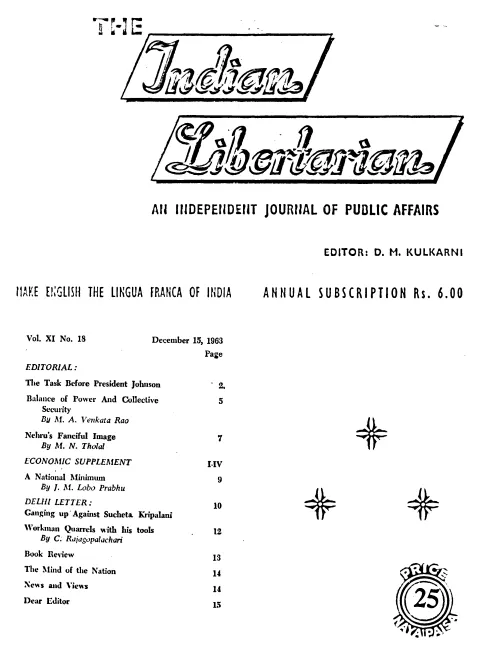
The Indian Libertarian
An Independent Journal of Free Economy and Public Affairs — Vol. VII, No. 26, February 15, 1960
By MA Venkata Rao, M. N. Tholal, C. Rajagopalachari, G N Lawande
The Indian Libertarian · Bombay · 1960
24 pages
The Indian Libertarian
Summary
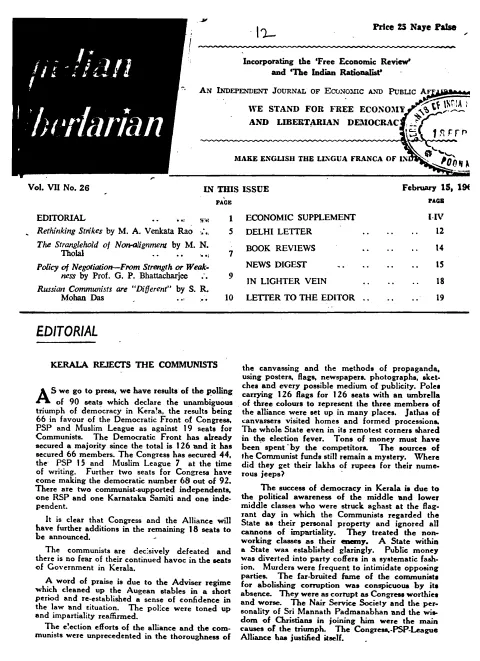
The 15 February 1960 issue of The Indian Libertarian (Vol. VII No. 26) leads with an editorial celebrating the Congress-PSP-Muslim League Democratic Front’s victory over the Communists in Kerala, and tracks two other current concerns of the magazine: Khrushchev and Mikoyan’s high-profile visit to India (read as a Soviet drive to consolidate ideological ground in the subcontinent) and the early Sino-Indian border friction. M. A. Venkata Rao’s signed leader urges a Swatantra-Party rethinking of the right to strike along lines of compulsory arbitration, while M. N. Tholal attacks the Nehruvian doctrine of non-alignment for leaving India militarily exposed to Chinese aggression. Prof. G. P. Bhattacharjee argues that negotiation with Communist powers can only succeed from a position of military strength, and S. R. Mohan Das catalogues evidence against Nehru’s view that Chinese Communists are ‘different’ from their Soviet counterparts. The issue’s centre-fold Economic Supplement, edited by Murari Lotwala, anchors the libertarian case for free enterprise: C. Rajagopalachari draws on Antoine Pinay’s French recovery and Ludwig Erhard’s West German miracle to argue that deficit financing and socialist controls produce bankruptcy rather than prosperity, Prof. G. N. Lawande critiques wasteful public expenditure under planning, and K. S. Wood lays out free-enterprise first principles. The closing departments — a Delhi Letter on the Congress-PSP-League alliance and the patriotism question, two book reviews (A. D. Gorwala on Suhas Chatterjee’s Danger from Communist China and M. A. Venkata Rao on S. Chandrasekhar’s Population and Family Planning in India), a News Digest by G. N. Lawande, and a sharp note by Mahavir Tyagi on corruption in the public sector — round out a number whose ideological centre is consistent: a critique of Nehruvian planning and non-alignment from a classical-liberal and anti-Communist position.
Key points
-
The lead editorial celebrates the Democratic Front of Congress, PSP, and Muslim League winning sixty-six of ninety declared Kerala seats against nineteen for the Communists, crediting the Adviser regime’s restoration of impartial law and order.
-
The editorial reads Khrushchev and Mikoyan’s high-profile India visit as a Soviet ideological-propaganda offensive and treats Khrushchev’s Supreme Soviet no-first-use nuclear pledge as a propaganda gesture rather than a genuine concession.
-
M. A. Venkata Rao’s ‘Rethinking Strikes’ argues political and Communist-led strikes function as economic warfare and urges the Swatantra Party to adopt compulsory arbitration with binding awards as its central labour policy.
-
M. N. Tholal’s ‘The Stranglehold of Non-alignment’ accuses Nehru of treating Panchsheel as a personal article of faith after Chinese violations began and of dressing up military weakness as Gandhian principle.
-
Prof. G. P. Bhattacharjee argues negotiation with Communist powers can only succeed from a position of military strength, while S. R. Mohan Das catalogues evidence against Nehru’s claim that Chinese Communists differ from their Soviet counterparts.
-
The centre-fold Economic Supplement, edited by Murari Lotwala, carries C. Rajagopalachari drawing on Antoine Pinay’s French recovery and Ludwig Erhard’s West German miracle to argue deficit financing and socialist controls produce bankruptcy rather than prosperity.
-
Prof. G. N. Lawande critiques wasteful public expenditure under planning in the same supplement, while K. S. Wood lays out free-enterprise first principles.
-
Closing departments include a Delhi Letter on the Congress-PSP-League alliance, book reviews of works on Communist China and family planning, and a note by Mahavir Tyagi on public-sector corruption.
Essays
EDITORIAL — Kerala Rejects the Communists
The unsigned editorial opens by celebrating the Kerala election result, in which the Democratic Front of Congress, PSP and Muslim League has just won 66 of 90 seats declared against 19 for the Communists. The editors credit the Adviser regime’s cleanup of the law-and-order situation, an unprecedentedly thorough non-Communist campaign, and the middle and lower-middle-class revulsion against the Communist regime’s use of state machinery for party ends (including, in the editors’ framing, intimidation by ‘Communist worthies’ and the misuse of public money). Two further notes treat Khrushchev’s and Mikoyan’s visit to India as a Soviet ideological-propaganda offensive (‘Russian Magnates in India’), and Khrushchev’s Supreme Soviet announcement that the U.S.S.R. will not be the first to use nuclear arms. The editorial column also reports a Sino-Burmese border agreement, applauds President de Gaulle’s defeat of the European-settler insurrection in Algeria, and laments that newly free African states are turning toward one-party rule and centralisation.
- Kerala’s Democratic Front (Congress-PSP-Muslim League) has secured 66 of 90 declared seats against 19 for the Communists.
- Editors credit the Adviser regime’s restoration of impartial law and order for enabling a fair election campaign.
- Khrushchev and Mikoyan’s India visit is read as a Soviet political-ideological offensive aimed at the subcontinent.
- Khrushchev’s Supreme Soviet speech pledging not to use nuclear arms first is treated as a propaganda move rather than a genuine concession.
- De Gaulle’s putting down of the European-settler revolt in Algeria is welcomed as a step toward Algerian self-determination.
- African independence is being marred by drift to one-party rule and Soviet patronage.
Rethinking Strikes
By MA Venkata Rao
M. A. Venkata Rao opens by lamenting that the Swatantra Party’s draft programme has too little to say on labour, despite labour militancy being the country’s most disruptive economic problem. He argues that political and trade-union strikes — used by Communists and others to convert sectional grievances into wider economic warfare — have outgrown the legitimate function of collective bargaining and now threaten the productive base on which workers themselves depend. The article makes a libertarian case for compulsory arbitration with binding awards, on the grounds that in an underdeveloped economy with surplus labour, free collective bargaining systematically fails the unorganised majority of workers while privileging a narrow organised minority concentrated in modern industry. Venkata Rao asks the Swatantra Party to commit explicitly to legally enforceable arbitration as the central plank of its labour policy, framed as protection both for the public and for the unorganised worker.
- Swatantra Party’s labour plank is underdeveloped relative to the urgency of the strike problem.
- Political and Communist-led strikes in India are not collective bargaining but warfare on the wider economy.
- In a labour-surplus underdeveloped country, free collective bargaining favours an organised minority over the unorganised majority.
- Compulsory arbitration with binding awards is presented as the libertarian-compatible remedy.
- Swatantra is urged to make legally enforceable arbitration its central labour policy.
The Stranglehold of Non-alignment
By M. N. Tholal
M. N. Tholal mounts a sustained attack on the Nehruvian doctrine of non-alignment, arguing that the Prime Minister’s foreign policy has produced not a moral ‘third force’ but a country militarily and morally unprepared for the Chinese threat now manifest on the northern frontier. Tholal accuses Nehru of treating the Panchsheel agreement as a personal article of faith long after Chinese troops had begun to violate Indian territory, of underestimating Chinese intentions in Tibet, and of dressing up military weakness as Gandhian principle. He quotes Nehru’s own admission that ‘we are a puny nation’ beside China and the United States, and treats it as a confession that non-alignment has left India dangerously dependent on the goodwill of an adversary. The piece closes by urging realignment with the Western democracies on practical defence grounds, while accepting that India’s domestic socialism need not be abandoned.
- Non-alignment is not a third moral force but a screen for unpreparedness against Chinese aggression.
- Nehru’s faith in Panchsheel persisted long after Chinese incursions had begun.
- The Prime Minister’s own description of India as a ‘puny nation’ beside China and the U.S. is read as an admission of strategic failure.
- The author urges practical defence alignment with the Western democracies.
- Domestic socialism is not the target of the critique; the target is foreign-policy posture.
Policy of Negotiation — From Strength or Weakness
By Prof. G. P. Bhattacharjee
Prof. G. P. Bhattacharjee argues that the Government of India’s preferred response to Chinese aggression on the frontier — negotiation — can succeed only if it is conducted from a clear position of strength. Drawing on the experience of the Soviet leadership at the Camp David talks of September 1959, where the United States was able to extract conciliatory language from Mr. Khrushchev only because America held a credible deterrent, Bhattacharjee maintains that Communist states respect armed capacity, not appeals to international morality. Negotiation initiated from weakness, by contrast, becomes an invitation to further encroachment. The piece reads as a direct rebuttal of the Nehruvian preference for diplomacy independent of military build-up.
- Negotiation with Communist powers must follow, not precede, the building of military strength.
- The 1959 Camp David talks showed Khrushchev moderating only because faced with credible American power.
- Appeals to international morality alone do not deter Communist expansion.
- Indian negotiation with China from a position of weakness will encourage further encroachment.
Russian Communists Are “Different”
By S. R. Mohan Das
S. R. Mohan Das compiles evidence against the official Indian view — endorsed by Nehru — that Chinese Communists are somehow ‘different’ from their Soviet counterparts and so less threatening. Surveying the Chinese occupation of sizeable chunks of Indian territory in Ladakh, the long record of revolutionary activity inside India by the Indian Communist Party, and the way Chinese cadres have been trained in Soviet-aligned doctrine since the early 1950s, Mohan Das argues that the Sino-Soviet bloc is for practical purposes a single ideological enterprise hostile to liberal democracy. He treats Nehru’s wishful distinction between Russians and Chinese Communists as the central intellectual error that has left India militarily and politically unprepared. A concluding section, continuing on page 15, recalls Soviet and Chinese support for armed insurgent movements across Asia and rejects the notion that Russia is now a benign ‘agrarian-reformer’ state.
- Chinese Communists have already occupied substantial Indian territory in Ladakh.
- The Indian Communist Party has been a tool of international Communism since the 1920s.
- Chinese cadres are trained in Soviet-aligned doctrine; the Sino-Soviet bloc functions as a single ideological enterprise.
- Nehru’s claim that Chinese Communists are ‘different’ is the foundational error of Indian foreign policy.
- Soviet support for insurgencies elsewhere in Asia disproves the ‘agrarian reformer’ framing of Russia.
ECONOMIC SUPPLEMENT (Prosperity, Or Bankruptcy? by C. Rajagopalachari; Public Expenditure & Underdeveloped Economy by Prof. G. N. Lawande; What is Free Enterprise? by K. S. Wood)
By C. Rajagopalachari
Rajaji opens the Economic Supplement with a contrast between the French and West German economic miracles and the Indian Second Five Year Plan. The recovery of the franc under Finance Minister Antoine Pinay, he writes, rested on private initiative, honest competition, balanced budgets and the rejection of deficit financing — what Pinay called the ‘indispensable minimum’ of treating Government controls as ‘something like traffic lights’. Rajaji draws the parallel with Ludwig Erhard’s West Germany and with Japan’s post-war recovery: in each case prosperity followed the discarding of socialist illusions, the embrace of competition and a free price mechanism, and the restoration of a stable currency. Against this, India’s policy of deficit financing, controls and currency depreciation can only end, he warns, in bankruptcy — economic, political and moral. The piece closes with a pointed reference to the German Social Democrats’ Bad Godesberg programme, in which even European socialists have abandoned nationalisation in favour of free choice and competition.
- Private initiative, balanced budgets and honest competition are the actual safeguards of prosperity.
- Pinay’s stabilisation of the franc rested on rejecting deficit financing and on treating controls as ‘traffic lights’.
- Erhard’s West German recovery and Japan’s reconstruction confirm the same principles.
- India’s Second Plan, by relying on deficit financing and controls, courts bankruptcy.
- Even the German Social Democrats have, at Bad Godesberg, abandoned nationalisation for free competition.
DELHI LETTER — Who are the Patriots?
By G N Lawande
Prof. G. N. Lawande argues that the achievement of sustained economic progress in an underdeveloped country requires limiting the State’s call on resources to those genuinely productive — the social overheads (roads, irrigation, education, health) that private enterprise cannot supply at adequate scale. The Indian Plans, in his reading, have done the opposite: they have stretched public expenditure into areas where private effort would be more efficient, financed it with deficits that erode the value of money, and crowded out the savings that would otherwise have flowed into productive investment. Lawande draws on comparative data on national savings rates and on the experience of advanced economies to argue that the discipline of accepting national-income limits, rather than wishful planning targets, is what makes capital formation possible.
- Public expenditure in an underdeveloped economy must be confined to social overheads that private enterprise cannot supply.
- The Indian Plans have overextended the State into areas best left to private effort.
- Deficit financing depreciates currency value and crowds out productive private savings.
- Capital formation requires discipline about national-income limits, not ambitious planning targets.
BOOK REVIEWS
K. S. Wood’s short piece sets out the libertarian first principles of free enterprise: that all production proceeds from private decisions about saving and investment, that competition disciplines those decisions, and that a free price mechanism alone communicates the millions of preferences and scarcities that no central planner can compile. The piece reads as a reader’s primer to back up Rajaji’s and Lawande’s longer arguments earlier in the supplement.
- Free enterprise rests on private decisions about saving, investment and risk-taking.
- Competition is the discipline that turns self-interest into public benefit.
- Prices, not planners, transmit information about scarcity and preference.
- Free enterprise is presented as a complete economic system, not merely an absence of regulation.
NEWS DIGEST
The Delhi Letter reads the Kerala Congress-PSP-League alliance, and the corresponding revival of Muslim League ambitions in northern India, against the background of the larger patriotism question raised by the Sino-Indian crisis. The correspondent observes that the Praja Socialist Party is increasingly pulled in two directions — between cooperation with the Congress and a more frankly anti-Communist line — and that the Muslim League, smelling opportunity in the Kerala success, is testing its strength in Uttar Pradesh and beyond. A second section assesses the Soviet leadership’s overtures during the Khrushchev–Mikoyan visit and argues that Russia’s recent emphasis on ‘peaceful means’ should not be taken as a strategic change.
- Kerala’s Congress-PSP-League victory has revived Muslim League ambitions in northern India.
- The PSP is internally divided between cooperation with Congress and a sharper anti-Communist line.
- The Khrushchev–Mikoyan visit’s rhetoric of peaceful coexistence is read as tactical, not strategic.
- Patriotism in 1960 India is being defined against both Communist territorial encroachment and ideological fellow-travelling.
IN LIGHTER VEIN
A. D. Gorwala reviews Suhas Chatterjee’s Danger from Communist China (Bombay 1959). He praises Chatterjee’s marshalling of evidence on the Chinese absorption of Tibet, the encroachment in Ladakh, the use of intimidation and propaganda along the long Himalayan frontier, and the wider regional pattern reaching Burma and Nepal. Gorwala accepts the book’s central conclusion — that the Indian state has misread Chinese intent — and recommends the volume to readers as a corrective to Government complacency.
- Chatterjee documents the Chinese occupation of Tibet and the encroachment in Ladakh.
- The book traces a wider regional pattern reaching Burma, Nepal and Sikkim.
- Gorwala endorses the book’s verdict that Government of India has misread Chinese intent.
- The review is offered as a corrective to official complacency about the northern frontier.
LETTER TO THE EDITOR
By MA Venkata Rao
M. A. Venkata Rao reviews S. Chandrasekhar’s Population and Family Planning in India (Asia Publishing House). The reviewer welcomes Chandrasekhar’s data-driven case that India’s demographic growth is outpacing food production and capital formation, and that the existing official family-planning programme is inadequate in scale and conception. Venkata Rao endorses the book’s plea for a serious commitment to fertility control as a precondition for any liberal economic project, while taking issue with parts of Chandrasekhar’s analysis of the social levers that would actually shift behaviour.
- Indian population growth is outrunning food and capital formation.
- The Government family-planning programme is inadequate in scale and conception.
- Fertility control is treated as a precondition for any liberal economic project.
- Venkata Rao differs with parts of Chandrasekhar’s analysis of behavioural levers.
Essay 12
By G N Lawande
G. N. Lawande’s News Digest summarises a clutch of foreign and domestic developments: the Belgian Government’s handling of the Congo as it moves toward independence, the continuing Chinese aggression on the Indian frontier, the Soviet position behind the Bamboo Curtain, and the call by Swatantra Party leaders for the political opposition to consolidate. A short item welcomes the Government’s belated acknowledgement that population control must be elevated to a national priority.
- Belgian policy in the Congo is treated as a test case for the management of decolonisation.
- Chinese aggression on the Indian frontier remains the central foreign-policy concern.
- Swatantra Party leaders are calling for opposition consolidation against Congress.
- Government has begun to treat population control as a national priority.
Essay 13
A short notice, ‘Let Corruption Flourish’, records the warning by Mahavir Tyagi that public-sector projects worth crores have been carried out with such loose financial controls that systematic corruption has set in, and reproduces in summary the views of figures who argue the only durable remedy is to roll back the public sector and let private enterprise carry these activities.
- Mahavir Tyagi warns that public-sector projects have become vehicles for systematic corruption.
- Loose financial controls are identified as the structural cause.
- The argued remedy is to roll back the public sector in favour of private enterprise.
Generated by the v1.5 extraction pipeline. Awaiting editorial review.
Metadata and summary are AI-extracted from the source PDF and reviewed for editorial accuracy. The original work is available via the Read PDF tab above (where present); paragraph-level citation inside the PDF is deferred to a future engagement.