periodical issue
The Indian Libertarian
An Independent Journal of Economic and Public Affairs
Edited by D. M. Kulkarni, B.A., LL.B., for the Libertarian Publishers Private Ltd., Printed by G. N. Lawande at G. N. Printers (Soham Prakashan Press), Nariman Bldg.-5, R. Dadaji Street, Fort, Bombay 1, and published by him at the office of the Libertarian Publishers (Private) Ltd., 26, Durgadevi Road, Bombay 4 · Bombay · 1961
20 pages
The Indian Libertarian
Summary
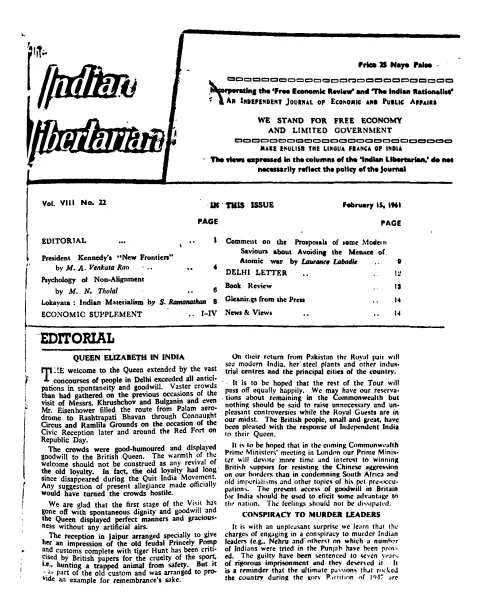
This 15 February 1961 issue (Vol. VIII, No. 22) of The Indian Libertarian — the Bombay fortnightly of the Libertarian Publishers, which ‘stands for free economy and limited government’ — opens with an editorial on Queen Elizabeth II’s visit to India and on a conspiracy to murder Indian leaders, then ranges across foreign policy, ideology, and economics from a classical-liberal, anti-communist stance. M. A. Venkata Rao assesses President Kennedy’s ‘New Frontiers’; M. N. Thoial dissects the ‘psychology of non-alignment’ as self-deception serving the communist bloc; and S. Ramanathan revisits ‘Lokayata’, India’s ancient materialist tradition. A four-page ‘Economic Supplement’ by William Henry Chamberlin is the issue’s analytical core, arguing that forced growth and Soviet-style planning are a ‘mirage’ and that Soviet and Communist-Chinese agriculture is a cautionary failure. Laurence Labadie comments sceptically on disarmament schemes for avoiding atomic war, a ‘Delhi Letter’ attacks the Congress government’s authoritarian drift, and book-review, press-gleaning, and news columns round out the issue. The through-line is that economic freedom and limited government, not planning or non-alignment, secure both prosperity and liberty.
Key points
-
The editorial reads Queen Elizabeth II’s visit to Delhi, Jaipur and beyond as genuine goodwill toward Britain rather than revived loyalism, and hopes it will secure British backing against Chinese border aggression at the coming Commonwealth Prime Ministers’ meeting.
-
A further editorial, “Conspiracy to Murder Leaders”, reflects on a plot uncovered in the Punjab, recalling the passions of the 1947 Partition.
-
M. A. Venkata Rao’s “President Kennedy’s ‘New Frontiers’” weighs the new American administration’s call for sacrifice against the backdrop of communist advances across Asia, Africa and Latin America.
-
M. N. Thoial’s “Psychology of Non-Alignment” attacks India’s non-aligned foreign policy as self-deception that in practice excuses communist aggression while criticising the West.
-
S. Ramanathan’s “Lokayata: Indian Materialism”, the second essay in a series, expounds the ancient Charvaka school as evidence that scepticism and free inquiry are native to Indian thought.
-
William Henry Chamberlin’s four-page Economic Supplement argues that forced state-directed growth is a statist ‘mirage’, contrasting incentive-driven American expansion with the distortions of Soviet planning.
-
Chamberlin’s companion piece contends that collectivised agriculture has been a disaster in both the Soviet Union and Communist China, and urges India to rely instead on individual cultivators, credit and education.
-
Laurence Labadie contributes a sceptical individualist-anarchist critique of contemporary proposals by ‘modern saviours’ for avoiding atomic war through disarmament and world-government schemes.
Essays
Editorial (Queen Elizabeth in India; Conspiracy to Murder Leaders; etc.)
The editorial section leads with ‘Queen Elizabeth in India’, describing the spontaneous warmth of the crowds that greeted the Queen in Delhi, Jaipur, and beyond, and reading the welcome as goodwill toward Britain rather than revived loyalism. It hopes the visit will help win British support against Chinese aggression on India’s borders at the coming Commonwealth Prime Ministers’ meeting. A second editorial, ‘Conspiracy to Murder Leaders’, reflects on a plot uncovered in the Punjab, recalling the passions of the 1947 Partition. Further editorial notes touch on Red China, Sikkim and Bhutan, ‘open societies’ versus ‘planned societies’, and ‘the City of Freedom’.
- Reads Queen Elizabeth II’s India visit as goodwill toward Britain, not revived loyalism.
- Hopes the visit aids British backing against Chinese border aggression.
- ‘Conspiracy to Murder Leaders’ recalls 1947 Partition passions.
- Shorter notes on Red China, Sikkim/Bhutan, and open vs planned societies.
President Kennedy’s “New Frontiers”
By MA Venkata Rao
M. A. Venkata Rao’s ‘President Kennedy’s “New Frontiers”’ takes the measure of the new American administration’s Inaugural Address and programme, weighing Kennedy’s summons to sacrifice and renewed Cold War resolve against the backdrop of communist advance in Asia, Africa, and Latin America. The essay reads the ‘New Frontiers’ rhetoric as a test of whether the free world can match the communist challenge with both vigour and liberty.
- Assesses Kennedy’s Inaugural Address and ‘New Frontiers’ programme.
- Frames it against communist advances worldwide.
- Asks whether the free world can answer the challenge without sacrificing liberty.
Psychology of Non-Alignment
By M. N. Thoial
M. N. Thoial’s ‘Psychology of Non-Alignment’ attacks India’s non-aligned foreign policy as a self-deceiving posture that, in practice, serves the communist bloc. The essay argues that Nehru’s non-alignment is not genuine neutrality but a one-sided indulgence that excuses communist aggression while criticising the West, and it questions the moral and strategic coherence of the stance amid Chinese pressure on India’s borders.
- Attacks non-alignment as self-deception rather than true neutrality.
- Argues the policy effectively favours the communist bloc.
- Questions its coherence given Chinese aggression on India’s borders.
Lokayata: Indian Materialism
By S. Ramanathan
S. Ramanathan’s ‘Lokayata: Indian Materialism’ is the second of a series on Indian materialism, expounding the ancient Lokayata (Charvaka) school as a rationalist, this-worldly current within Indian thought. It treats the materialist tradition as evidence that scepticism and free inquiry are native to India, countering the assumption that Indian philosophy is uniformly otherworldly.
- Expounds the ancient Lokayata/Charvaka materialist school.
- Presents it as a native Indian rationalist, this-worldly tradition.
- Counters the view that Indian thought is uniformly otherworldly.
Economic Supplement (Economic Growth: Reality and Mirage; Lesson from Soviet and Communist Chinese Agriculture)
By William Henry Chamberlin
The four-page ‘Economic Supplement’ by William Henry Chamberlin anchors the issue’s economics. ‘Economic Growth: Reality and Mirage’ argues that forcing a faster growth rate through state direction is a statist illusion, contrasting the steady, incentive-driven expansion of the free-market United States with the distortions and exaggerated claims of Soviet planning, and invoking Steinbeck’s ‘Okies’ to argue that free systems adapt where command ones fail. A companion piece, ‘Lesson from Soviet and Communist Chinese Agriculture’, contends that collectivisation has made farming a disaster in both countries and that India should not imitate the sovkhoz, kolkhoz, or commune but rely on individual cultivators, credit, and education.
- Argues forced, state-driven growth is a ‘mirage’ versus free-market growth.
- Contrasts US incentive-led expansion with distorted Soviet planning claims.
- Uses Steinbeck’s ‘Okies’ to show free systems adapt where command fails.
- Holds Soviet and Chinese collective agriculture to be a failure India must not copy.
- Recommends individual farming, credit, and education over collectivisation.
Comment on the Proposals of some Modern Saviours about Avoiding the Menace of Atomic war
By Laurence Labadie
Laurence Labadie’s ‘Comment on the Proposals of Some Modern Saviours about Avoiding the Menace of Atomic War’ offers an individualist-anarchist critique of fashionable disarmament and world-government schemes. Surveying humanity’s history of absolute sovereignty, it argues that the proposals of would-be ‘saviours’ to avert atomic war misdiagnose the problem, and that genuine peace depends on dismantling coercive, monopolistic state power rather than erecting new supranational authority.
- Individualist-anarchist critique of disarmament and world-government proposals.
- Argues such ‘modern saviours’ misdiagnose the roots of atomic-war danger.
- Locates the real menace in coercive, monopolistic state power.
Delhi Letter: Congress Government Shows the Cloven Hoof
The ‘Delhi Letter’, ‘Congress Government Shows the Cloven Hoof’, is a correspondent’s despatch arguing that the Congress government in Madhya Pradesh and at the centre is revealing an authoritarian streak beneath its democratic professions, citing episodes of administrative high-handedness as evidence of the ruling party’s drift away from liberal norms.
- Argues the Congress government is showing an authoritarian streak.
- Cites Madhya Pradesh administrative episodes as evidence.
- Reads them as drift from liberal-democratic norms.
Book Review
The ‘Book Review’ section notices works on economic development, weighing them against the journal’s free-economy convictions.
- Reviews works on economic development from a free-economy standpoint.
Gleanings from the Press
‘Gleanings from the Press’ reprints and comments on items from other newspapers — including a call to ‘ring down the curtain’ on China and notes on Kashmir, Tibetans crossing into NEFA, and bread riots in China — read through the journal’s anti-communist lens.
- Reprints and comments on press items on China, Kashmir and NEFA.
- Frames them through the journal’s anti-communist viewpoint.
News & Views
‘News & Views’ gathers shorter notes on the cost of maintaining Nehru, private enterprise in Soviet Russia, the same story from East Germany, the landslide of the Indian Communist Party, and the ‘march of poverty’ in India, presenting them as illustrations of the costs of statism.
- Short notes on Soviet/East German private enterprise and Indian communism.
- Comments on the ‘march of poverty’ in India.
- Frames items as illustrations of the costs of statism.
Generated by the v1.5 extraction pipeline. Awaiting editorial review.
Metadata and summary are AI-extracted from the source PDF and reviewed for editorial accuracy. The original work is available via the Read PDF tab above (where present); paragraph-level citation inside the PDF is deferred to a future engagement.