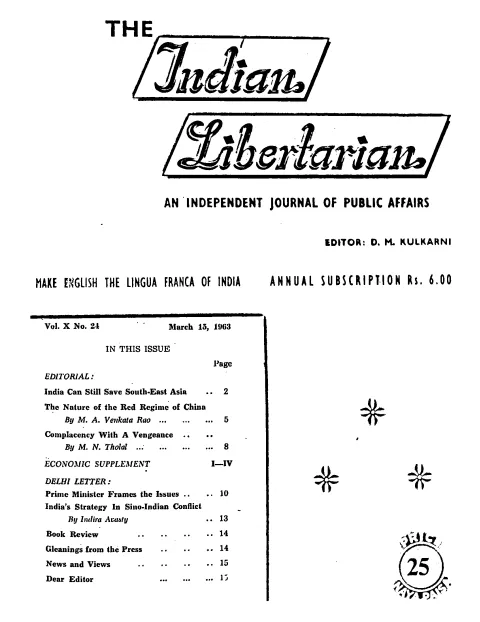
periodical issue
The Indian Libertarian
Independent Journal of Economic and Public Affairs
The Indian Libertarian, Arya Bhuvan, Sandhurst Road, Bombay 4 · Bombay · 1962
18 pages
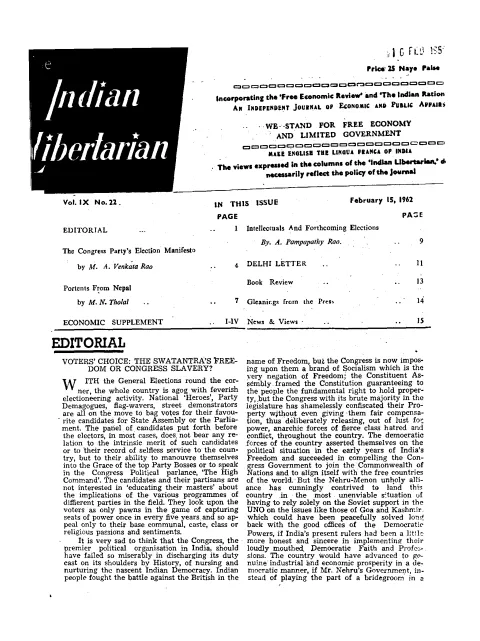
The Indian Libertarian
Summary
This February 15, 1962 issue (Vol. IX No. 22) of The Indian Libertarian, a Bombay fortnightly edited by D. M. Kulkarni that ‘stands for free economy and limited government’, appears on the eve of India’s general elections and is dominated by election commentary. The unsigned editorial frames the contest as a choice between ‘the Swatantra’s freedom or Congress slavery’, accusing the Congress of imposing a ‘brand of Socialism’ under the name of freedom. M. A. Venkata Rao dissects the Congress Party’s election manifesto, M. N. Tholal reads the ‘portents from Nepal’, and A. Pampapathy Rao argues that intellectuals have a stake in the forthcoming elections. The issue also carries a four-page Economic Supplement, ‘Holding The Price Level’ by Waheed A. Gani, a ‘Delhi Letter’ titled ‘On The Road To Slavery Again’, a book review, and ‘Gleanings from the Press’ and ‘News & Views’ columns.
Key points
-
This 15 February 1962 issue of The Indian Libertarian (Vol. IX No. 22), edited by D. M. Kulkarni, appears on the eve of India’s general elections and is dominated by election commentary.
-
The unsigned editorial, ‘Voters’ Choice: The Swatantra’s Freedom or Congress Slavery?’, charges that Congress used its legislative majority to confiscate property and impose socialism in the name of freedom.
-
The editorial closes with a set of ‘Quotable Quotes’, including a line attributed to C. Rajagopalachari about the Swatantra Party.
-
M. A. Venkata Rao examines the Congress Party’s election manifesto as propaganda for continued single-party rule, contrasting its stated promises with the party’s actual record.
-
M. N. Tholal’s ‘Portents From Nepal’ reads King Mahendra’s assertion of royal power against parliamentary government as a warning sign for the wider region.
-
A. Pampapathy Rao’s ‘Intellectuals And Forthcoming Elections’ argues intellectuals cannot remain neutral, framing the choice before voters as one between liberty and collectivist alternatives.
-
The issue also carries a four-page Economic Supplement, ‘Holding The Price Level’ by Waheed A. Gani, and a Delhi Letter titled ‘On The Road To Slavery Again’.
Essays
Editorial: Voters’ Choice — The Swatantra’s Freedom or Congress Slavery?
The lead editorial, ‘Voters’ Choice: The Swatantra’s Freedom or Congress Slavery?’, casts the general election as a contest over India’s economic and political direction. It charges that while the Constituent Assembly framed the Constitution to guarantee fundamental rights, the Congress has used its legislative majority to confiscate property, foment class hatred, and impose socialism in the name of freedom. It also criticises the Nehru-Menon government’s foreign policy on Goa and Kashmir and its alignment away from the democratic powers, and prints ‘Quotable Quotes’ including a Rajagopalachari quip on the Swatantra Party.
- Frames the election as freedom (Swatantra) versus socialist slavery (Congress).
- Argues Congress used its brute majority to confiscate property and stoke class conflict.
- Criticises Nehru-Menon foreign policy over Goa and Kashmir.
- Closes with ‘Quotable Quotes’, including a C.R. (Rajagopalachari) line on the Swatantra Party.
The Congress Party’s Election Manifesto
By MA Venkata Rao
M. A. Venkata Rao examines the Congress Party’s election manifesto, reading it as a self-serving document that promises modernisation while consolidating one-party power. He contrasts the manifesto’s professed aims with the party’s record, invoking the Constituent Assembly’s original intent and warning that continued Congress dominance threatens democratic checks.
- Treats the Congress manifesto as propaganda for continued single-party rule.
- Contrasts the manifesto’s promises with the Congress’s actual record.
- Invokes constitutional first principles against centralising tendencies.
Portents From Nepal
By M. N. Thodal
M. N. Tholal’s ‘Portents From Nepal’ analyses the political situation in Nepal, where King Mahendra’s assertion of royal power against parliamentary government is read as a warning sign for the region. Tholal weighs the King’s actions against the demands of representative government and the pressures of the surrounding Cold War context.
- Reads King Mahendra’s consolidation of power as ominous for representative government.
- Situates Nepal’s crisis within regional and Cold War pressures.
Intellectuals And Forthcoming Elections
By A. Pampapathy Rao
A. Pampapathy Rao argues that India’s intellectuals have a direct stake in the forthcoming elections. He contends that intellectuals should not stand aloof but engage, weighing the alternatives before the electorate and rejecting the notion that they can remain detached from the political contest between liberty and collectivism.
- Argues intellectuals cannot remain neutral in the coming elections.
- Frames the choice as one between liberty and collectivist alternatives.
Generated by the v1.5 extraction pipeline. Awaiting editorial review.
Metadata and summary are AI-extracted from the source PDF and reviewed for editorial accuracy. The original work is available via the Read PDF tab above (where present); paragraph-level citation inside the PDF is deferred to a future engagement.