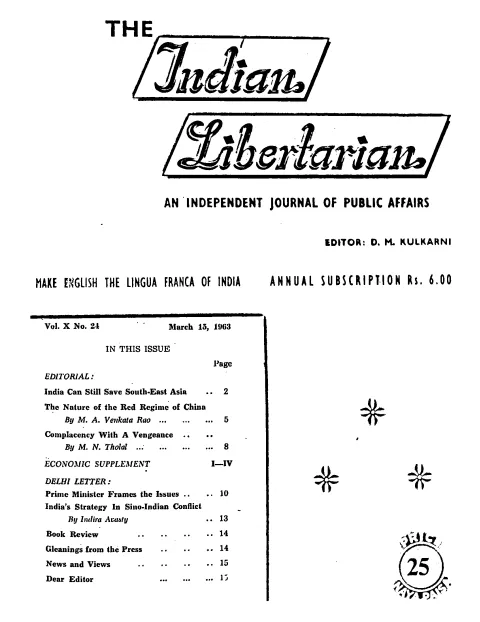
periodical issue
The Indian Libertarian
An Independent Journal of Public Affairs
By MA Venkata Rao, M. N. Tholal
Libertarian Publishers (Private) Ltd., 26, Durgadevi Road, Bombay-4 · Bombay · 1963
20 pages
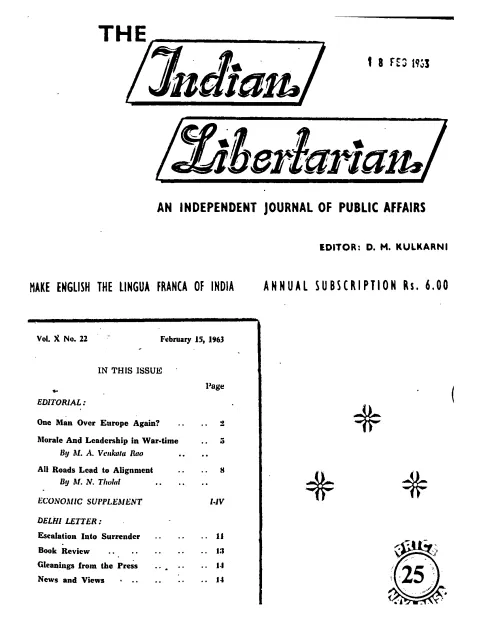
The Indian Libertarian
Summary
This February 15, 1963 issue (Vol. X No. 22) of The Indian Libertarian, the Bombay fortnightly edited by D. M. Kulkarni for the Libertarian Publishers, is preoccupied with international affairs in the immediate aftermath of the 1962 Sino-Indian war and de Gaulle’s reshaping of Europe. The editorial, ‘One Man Over Europe Again?’, reads de Gaulle’s veto of Britain’s entry into the Common Market as a single man once more bending Europe to his will and unsettling the Anglo-American alliance. M. A. Venkata Rao’s ‘Morale And Leadership in War-time’ reflects on national morale and leadership in the wake of the Chinese invasion, and M. N. Tholal’s ‘All Roads Lead to Alignment’ argues that the Chinese attack has exposed the bankruptcy of non-alignment. The issue also carries a four-page Economic Supplement, a ‘Delhi Letter’ titled ‘Escalation Into Surrender’, a book review, and the ‘Gleanings from the Press’ and ‘News and Views’ columns.
Key points
-
The editorial ‘One Man Over Europe Again?’ reads de Gaulle’s veto of Britain’s entry into the Common Market as one man again imposing his will on Europe and straining the Anglo-American alliance.
-
M. A. Venkata Rao’s ‘Morale And Leadership in War-time’ responds to the 1962 Chinese invasion, opening from the failed Colombo Proposals and the unresolved clearance of Chinese forces.
-
Venkata Rao argues that national morale and political leadership are the decisive factors shaping India’s military and diplomatic response to Chinese aggression.
-
M. N. Tholal’s ‘All Roads Lead to Alignment’ argues the 1962 war exposed the bankruptcy of non-alignment, since India turned to the U.S.A. and U.K. for arms and defence.
-
Tholal draws on General Thimayya’s assessment to contend that events are pushing India inexorably toward alignment with the Western powers.
-
The issue also carries a four-page Economic Supplement, a Delhi Letter titled ‘Escalation Into Surrender’, and a book review alongside the regular news columns.
Essays
Editorial: One Man Over Europe Again?
The editorial ‘One Man Over Europe Again?’ interprets de Gaulle’s veto of Britain’s application to the European Economic Community as a reassertion of one-man dominance over Europe. It weighs the consequences for the Anglo-American alliance and the Western bloc, framing de Gaulle’s move as a setback for a more integrated, Atlantic-oriented Europe.
- Reads de Gaulle’s EEC veto of Britain as one man again imposing his will on Europe.
- Assesses the strain placed on the Anglo-American alliance and Western unity.
- Frames the Common Market dispute as a test of Atlantic cohesion.
Morale And Leadership in War-time
By MA Venkata Rao
M. A. Venkata Rao’s ‘Morale And Leadership in War-time’ responds to the 1962 Chinese invasion, opening with the Colombo Proposals and the failure to secure a clearance of Chinese forces. He argues that national morale and leadership are decisive in war, examining India’s preparedness and political direction in the face of Chinese aggression.
- Written in the aftermath of the 1962 Chinese invasion of India.
- Opens with the Colombo Proposals and the unresolved clearance of Chinese forces.
- Argues morale and leadership are decisive factors in wartime.
All Roads Lead to Alignment
By M. N. Tholal
M. N. Tholal’s ‘All Roads Lead to Alignment’ argues that the Chinese attack has discredited India’s policy of non-alignment, since India turned to the U.S.A. and U.K. for military assistance and defence in the crisis. Drawing on General Thimayya’s views and the conduct of Prime Minister Nehru’s government, Tholal contends that events are pushing India inexorably toward alignment with the Western powers.
- Argues the 1962 war exposed the bankruptcy of non-alignment.
- Notes India’s appeal to the U.S.A. and U.K. for arms and defence.
- Draws on General Thimayya’s assessment of the situation.
Generated by the v1.5 extraction pipeline. Awaiting editorial review.
Metadata and summary are AI-extracted from the source PDF and reviewed for editorial accuracy. The original work is available via the Read PDF tab above (where present); paragraph-level citation inside the PDF is deferred to a future engagement.