periodical issue
The Indian Libertarian
An Independent Journal of Economic and Public Affair
By MA Venkata Rao, M. N. Tholal, A Ranganathan
The Indian Libertarian · Bombay · 1962
16 pages
The Indian Libertarian
Summary
This January 1, 1962 issue (Vol. IX No. 19) of The Indian Libertarian, the Bombay journal edited by D. M. Kulkarni that stands for ‘free economy and limited government,’ opens with an editorial on the liberation of Goa, arguing that India’s military action against Portuguese colonialism—though peaceful settlement had failed—was justified after years of Portuguese brutality against Goan Satyagrahis. The issue gathers commentary from several contributors: M. A. Venkata Rao on the libertarian conception of society against the Congress ‘socialistic pattern,’ M. N. Tholal’s polemic on Nehru and Krishna Menon’s defence handling, a reprinted C. L. Sulzberger piece on Khrushchev’s foreign policy, and A. Ranganathan on the individual under the Indian Constitution. Regular departments—Delhi Letter, Book Review, Gleanings from the Press, News & Views, and Dear Editor—round out the number.
Key points
-
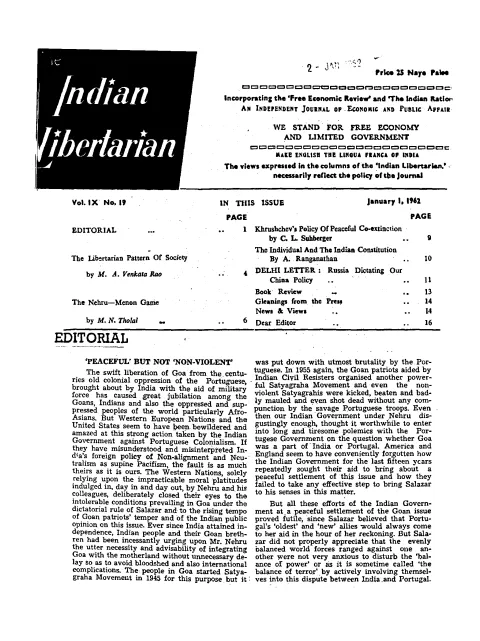
The 1 January 1962 issue of The Indian Libertarian (Vol. IX, No. 19), edited by D. M. Kulkarni under the banner ‘free economy and limited government’, opens with an editorial titled ‘Peaceful But Not Non-Violent’ defending India’s military liberation of Goa from Portuguese rule.
-
The editorial recounts Goan patriots mounting non-violent Satyagraha from 1945 only to be ‘kicked, beaten and badly mauled and even shot dead’ by Portuguese troops, arguing repeated attempts at peaceful settlement had proven futile against Salazar’s intransigence.
-
M. A. Venkata Rao’s ‘The Libertarian Pattern Of Society’ diagnoses an ‘alarming lack of intellectual integrity and conscience’ in Indian public life and attacks the ruling Congress party’s drift toward a ‘socialistic pattern of society’.
-
M. N. Tholal’s ‘The Nehru-Menon Game’ scrutinises a 4 December Rajya Sabha exchange in which the Prime Minister is accused of giving evasive replies on Chinese intrusions in Ladakh, framing the Nehru-Menon defence partnership as a game of evasions.
-
A reprinted New York Times piece by C. L. Sulzberger, ‘Khrushchev’s Policy Of Peaceful Co-extinction’, reads the Soviet leader’s coexistence rhetoric as a contest in which each superpower seeks to outlast the other.
-
A. Ranganathan’s ‘The Individual And The Indian Constitution’ draws on Sir Ivor Jennings’s description of the Constitution as ‘essentially an individualist document’, weighing amendments affecting the Right to Property against that individualist tradition.
Essays
Editorial
The unsigned editorial, ‘Peaceful But Not Non-Violent,’ defends India’s military liberation of Goa from Portuguese rule. It recounts how Goan patriots, aided by Indian Civil Resisters, mounted non-violent Satyagraha movements from 1945 onward only to be ‘kicked, beaten and badly mauled and even shot dead’ by Portuguese troops, and argues the world wrongly forgot that Goa was always part of India. The editorial holds that India’s repeated attempts at peaceful settlement proved futile against Salazar’s intransigence, leaving force as the only effective recourse.
- Frames Goa’s liberation as justified after peaceful Satyagraha was met with Portuguese brutality.
- Distinguishes a ‘peaceful’ settlement from a strictly ‘non-violent’ one.
- Criticizes Western nations for moral platitudes while ignoring Portuguese colonialism.
- Argues Salazar’s intransigence left India no effective alternative to force.
The Libertarian Pattern Of Society
By MA Venkata Rao
M. A. Venkata Rao’s ‘The Libertarian Pattern Of Society’ diagnoses an ‘alarming lack of intellectual integrity and conscience’ in Indian public life and attacks the ruling Congress party’s drift toward a ‘socialistic pattern of society.’ He argues that genuine social order rests on liberty rather than state-directed planning, defending the libertarian conception of society against the centralising and collectivist tendencies he sees dominating Indian political and economic thought.
- Opens by lamenting a decline of intellectual integrity in Indian public life.
- Targets the Congress ‘socialistic pattern of society’ as a central error.
- Defends liberty as the true basis of social order against state planning.
The Nehru—Menon Game
By M. N. Tholal
M. N. Tholal’s ‘The Nehru—Menon Game’ is a sharp political polemic, opening with an exchange in the Rajya Sabha on December 4 in which the Prime Minister is accused of giving evasive replies on Chinese intrusions in Ladakh. Tholal scrutinises Nehru’s defence and foreign-policy partnership with Krishna Menon, presenting their handling of the China question and the Defence Ministry as a ‘game’ of evasions.
- Centres on a Rajya Sabha exchange over Chinese intrusion in Ladakh.
- Criticizes Nehru’s evasive parliamentary replies.
- Frames Nehru and Menon’s conduct as a political ‘game’.
Khrushchev’s Policy Of Peaceful Co-extinction
By C. L. Subherger
A reprinted piece by C. L. Sulzberger (from The New York Times), ‘Khrushchev’s Policy Of Peaceful Co-extinction,’ analyses the Soviet leader’s superpower strategy. Sulzberger argues that two days before Khrushchev addressed the Soviet Party Congress, he had told the United States in effect that the world is large enough for two superpowers to coexist—but reads the subtext as a contest in which each side seeks to outlast the other, hence ‘co-extinction’ rather than co-existence.
- Reprinted from The New York Times.
- Reads Khrushchev’s ‘co-existence’ rhetoric as a strategy of mutual outlasting.
- Frames US-Soviet relations as a contest between two superpowers.
The Individual And The Indian Constitution
By A Ranganathan
A. Ranganathan’s ‘The Individual And The Indian Constitution’ examines the place of the individual in India’s constitutional order, drawing on Sir Ivor Jennings’s view of the Constitution as ‘essentially an individualist document.’ Ranganathan traces how the great experiments of the nineteenth century sought to limit state power, and weighs the Indian Constitution’s amendments—including those affecting the Right to Property—against that individualist tradition.
- Invokes Sir Ivor Jennings calling the Constitution ‘an individualist document.’
- Traces nineteenth-century efforts to limit state power.
- Weighs constitutional amendments, including the Right to Property, against individualism.
Generated by the v1.5 extraction pipeline. Awaiting editorial review.
Metadata and summary are AI-extracted from the source PDF and reviewed for editorial accuracy. The original work is available via the Read PDF tab above (where present); paragraph-level citation inside the PDF is deferred to a future engagement.