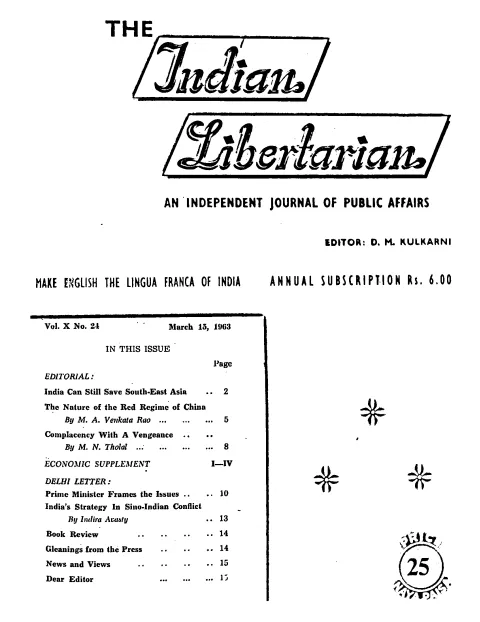
periodical issue
The Indian Libertarian
An Independent Journal of Public Affairs
By MA Venkata Rao, M. N. Tholal
The Indian Libertarian · Bombay · 1963
16 pages
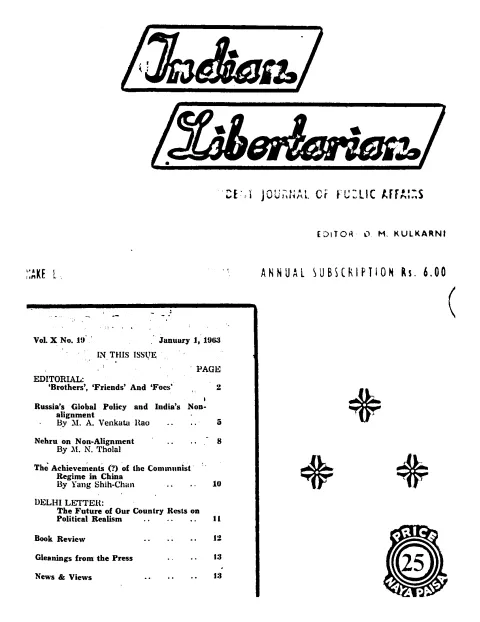
The Indian Libertarian
Summary
This January 1, 1963 issue (Vol. X No. 19) of The Indian Libertarian, edited by D. M. Kulkarni, is preoccupied with the geopolitical fallout of China’s 1962 aggression against India and the credibility of Indian non-alignment. The editorial ‘‘Brothers’, ‘Friends’ And ‘Foes’’ reflects on betrayed Sino-Indian friendship; M. A. Venkata Rao analyses Russia’s global policy and what it means for India’s non-alignment; M. N. Tholal scrutinises Nehru’s defence of non-alignment after the China war; and Yang Shih-Chan continues a critical assessment of the Communist regime in China. A Delhi Letter on political realism and the regular Book Review, Gleanings, and News & Views departments complete the number.
Key points
-
The unsigned editorial ‘Brothers’, ‘Friends’ And ‘Foes’ responds to China’s 1962 aggression against India, reflecting bitterly on the collapse of the Hindi-Chini-bhai-bhai sentiment of brotherhood.
-
The editorial goes on to reassess which nations count as India’s real friends and which as foes in the aftermath of the border war.
-
M. A. Venkata Rao’s Russia’s Global Policy and India’s Non-alignment argues that Khrushchev favours gradual infiltration over open revolution while still paying lip service to world Communist doctrine.
-
Venkata Rao questions whether India’s policy of non-alignment can hold its footing between the Soviet and Western blocs given this calculated Soviet strategy.
-
M. N. Tholal’s Nehru on Non-Alignment examines the Prime Minister’s continued defence of non-alignment after the China war, weighing his claim that the policy was disturbed but not invalidated.
-
Tholal probes whether India’s declared policy of non-alignment can remain credible once a professedly non-aligned nation has itself been militarily attacked.
-
Yang Shih-Chan’s The Achievements (?) of the Communist Regime in China, continued from the 15 December 1962 issue, offers a sceptical accounting of the Chinese Communist record.
-
Yang Shih-Chan weighs the regime’s methods of compulsion against its officially claimed economic and social achievements, casting doubt on their legitimacy.
Essays
Editorial: ‘Brothers’, ‘Friends’ And ‘Foes’
The unsigned editorial, ‘‘Brothers’, ‘Friends’ And ‘Foes’,’ responds to China’s ‘treacherous aggression on India’ and the collapse of the Hindi-Chini-bhai-bhai sentiment. It reflects bitterly on how a proclaimed brotherhood gave way to invasion, and weighs the resulting realignment of India’s friends and foes on the world stage in the war’s aftermath.
- Responds directly to China’s 1962 aggression against India.
- Reflects on the betrayal of the ‘brothers’ rhetoric of Sino-Indian friendship.
- Reassesses who India’s real friends and foes are after the war.
Russia’s Global Policy and India’s Non-alignment
By MA Venkata Rao
M. A. Venkata Rao’s ‘Russia’s Global Policy and India’s Nonalignment’ argues that Khrushchev prefers the method of slow infiltration to advance Marxist-Communist aims, even while paying lip service to the dogmas of world Communist revolution. Rao reads Soviet strategy as a patient, calculated drive to extend its sphere, and questions whether Indian non-alignment can hold its footing between the two power blocs in such a world.
- Reads Khrushchev as favouring gradual infiltration over open revolution.
- Treats Soviet global strategy as calculated and patient.
- Questions the viability of India’s non-alignment between the blocs.
Nehru on Non-Alignment
By M. N. Tholal
M. N. Tholal’s ‘Nehru on Non-Alignment’ examines the Prime Minister’s continued defence of non-alignment in the wake of the China war. Tholal weighs Nehru’s claim that non-alignment as a foreign policy stance was disturbed by the war but not invalidated by it, probing whether the policy can survive once a non-aligned nation has itself been attacked.
- Centres on Nehru’s post-war defence of non-alignment.
- Tests whether non-alignment is tenable after a non-aligned nation is invaded.
- Frames the debate as the credibility of Indian foreign policy.
The Achievements (?) of the Communist Regime in China
By Yang Shih-Chan
Yang Shih-Chan’s ‘The Achievements (?) of the Communist Regime in China,’ continued from the December 15, 1962 issue, offers a sceptical accounting of the Chinese Communist record. The author challenges official claims of progress, weighing the regime’s methods of compulsion against its purported gains and casting doubt on the legitimacy of its ‘achievements.’
- A continuation piece from the December 15, 1962 issue.
- Questions the Chinese Communist regime’s claimed achievements.
- Emphasizes coercion behind the regime’s reported progress.
Generated by the v1.5 extraction pipeline. Awaiting editorial review.
Metadata and summary are AI-extracted from the source PDF and reviewed for editorial accuracy. The original work is available via the Read PDF tab above (where present); paragraph-level citation inside the PDF is deferred to a future engagement.