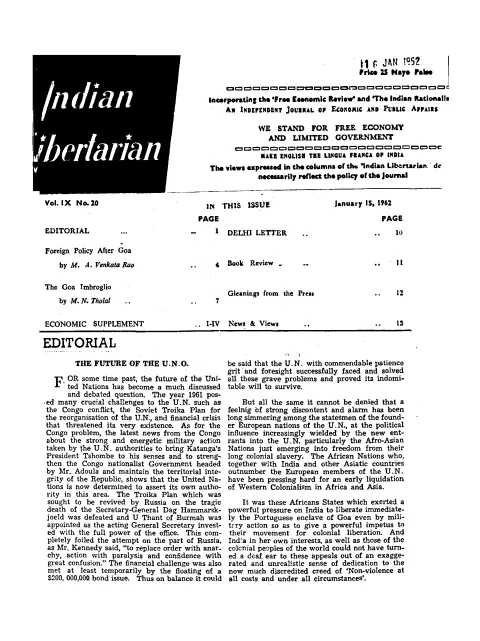
periodical issue
The Indian Libertarian
An Independent Journal of Public Affairs
By MA Venkata Rao, M. N. Tholal
The Indian Libertarian · Bombay · 1964
16 pages
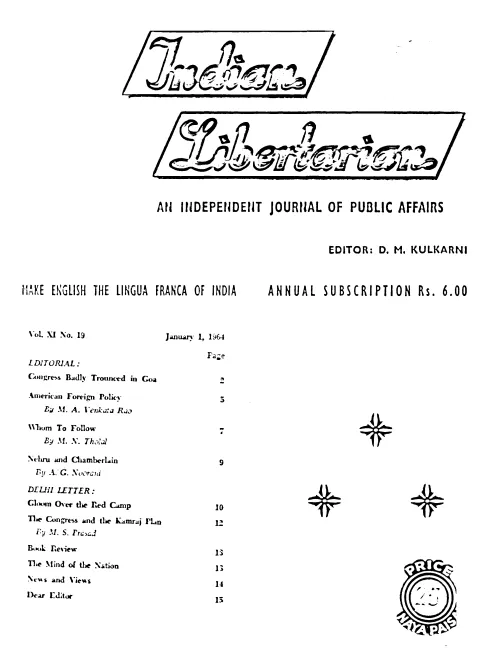
The Indian Libertarian
Summary
This January 1, 1964 issue (Vol. XI No. 19) of The Indian Libertarian, edited by D. M. Kulkarni, mixes Indian party politics with Cold War foreign affairs. The editorial celebrates the Congress party’s heavy electoral defeat in Goa; M. A. Venkata Rao surveys American foreign policy and its posture toward the Communist bloc; M. N. Tholal asks ‘Whom To Follow?’ in a meditation on political leadership and integrity; A. G. Noorani draws a pointed analogy between Nehru and Neville Chamberlain’s appeasement; and Prof. M. S. Prasad examines the Congress party’s internal Kamraj Plan. A Delhi Letter on disarray in the Communist ‘Red Camp,’ plus Book Review, The Mind of the Nation, News and Views, and Dear Editor departments complete the number.
Key points
-
The unsigned editorial ‘Congress Badly Trounced in Goa’ reads the Congress party’s decisive defeat in the Goa election as a considered popular verdict the ruling party would do well to accept rather than dismiss.
-
M. A. Venkata Rao’s ‘American Foreign Policy’ weighs the United States’ responsibilities as leader of the free world against the demands of Cold War rivalry with the Communist bloc, considering implications for India and other non-aligned states.
-
M. N. Tholal’s essay ‘Whom To Follow?’ argues that even great leaders cannot foresee precisely how events will unfold, and asks how the public should choose whom to follow when no leader’s judgement is infallible.
-
A. G. Noorani’s ‘Nehru and Chamberlain’ draws a pointed historical analogy between Jawaharlal Nehru and Neville Chamberlain, arguing that Nehru’s methods, like Chamberlain’s appeasement, were exposed as inadequate by events.
-
Prof. M. S. Prasad’s ‘The Congress and the Kamraj Plan’ examines the internal reorganisation scheme under which senior Congress leaders resigned government office to devote themselves to party work.
-
Prasad traces how the All-India Congress Committee handled the Kamraj Plan and reads its implementation as a revealing window onto power and discipline within the ruling party.
-
The issue includes a Delhi Letter reporting disarray within the Communist ‘Red Camp’, alongside regular Book Review, Mind of the Nation and Dear Editor departments.
Essays
Editorial: Congress Badly Trounced in Goa
The unsigned editorial, ‘Congress Badly Trounced In Goa,’ reads the Congress party’s decisive electoral defeat in Goa as a verdict by the people against the party. It argues the result is a rebuke the Congress would have done well to accept as a true expression of popular will, drawing broader lessons about the gap between the ruling party and the electorate.
- Treats the Goa election result as a heavy defeat for Congress.
- Frames the outcome as the considered verdict of the people.
- Draws a broader lesson about Congress’s distance from popular sentiment.
American Foreign Policy
By MA Venkata Rao
M. A. Venkata Rao’s ‘American Foreign Policy’ assesses the United States’ conduct on the world stage and its rivalry with the Communist powers. Rao weighs America’s responsibilities as a leading free-world power against the demands of the Cold War, considering how its foreign policy bears on India and the non-aligned nations.
- Surveys US foreign policy in the Cold War context.
- Weighs American leadership of the free world against Communist rivalry.
- Considers the implications for India and non-aligned states.
Whom To Follow
By M. N. Tholal
M. N. Tholal’s ‘Whom To Follow?’ is a reflective essay on leadership and the integrity of those who claim it. Tholal argues that great leaders cannot foretell the precise course events will take, and probes how a public ought to choose whom to follow when no leader’s judgement is infallible.
- Reflects on the nature of political leadership.
- Argues that even great leaders cannot foresee how events unfold.
- Questions how the public should choose whom to follow.
Nehru and Chamberlain
By A. G. Noorani
A. G. Noorani’s ‘Nehru and Chamberlain’ draws a sharp historical analogy between Jawaharlal Nehru and Neville Chamberlain, the British Prime Minister associated with appeasement. Noorani argues that Nehru, like Chamberlain, pursued a policy whose methods were ultimately exposed as inadequate by events, inviting the reader to weigh the comparison in light of India’s strategic setbacks.
- Draws an analogy between Nehru and Neville Chamberlain.
- Centres on the failure of appeasement-style policy.
- Invites reassessment of Nehru’s strategic judgement.
The Congress and the Kamraj Plan
By M. S. Prasad
Prof. M. S. Prasad’s ‘The Congress and the Kamraj Plan’ examines the Congress party’s internal reorganisation scheme, under which senior leaders resigned office to devote themselves to party work. Prasad traces how the All-India Congress Committee handled the plan and what it revealed about power and discipline within the ruling party.
- Analyses the Congress party’s Kamraj Plan reorganisation.
- Examines the A.I.C.C.’s handling of the scheme.
- Reads the plan as a window onto Congress internal politics.
Generated by the v1.5 extraction pipeline. Awaiting editorial review.
Metadata and summary are AI-extracted from the source PDF and reviewed for editorial accuracy. The original work is available via the Read PDF tab above (where present); paragraph-level citation inside the PDF is deferred to a future engagement.