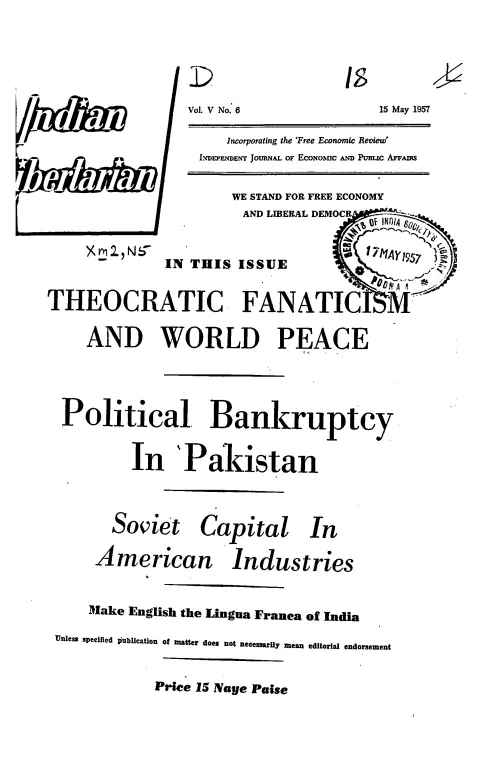
periodical issue
The Indian Libertarian
Independent Journal of Economic and Public Affairs (Incorporating the 'Free Economic Review')
By MA Venkata Rao, KD Valicha, A Ranganathan
R. L. Foundation, Arya Bhuvan, Sandhurst Road, Bombay 4 · Bombay · 1957
28 pages
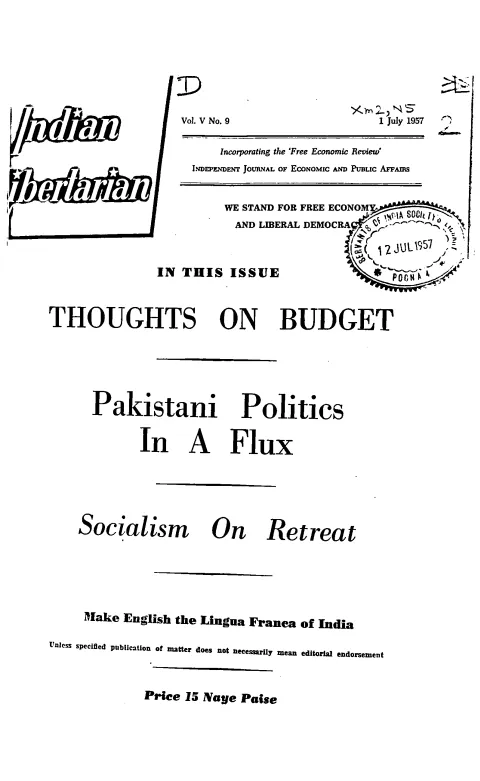
The Indian Libertarian
Summary
This 1 July 1957 issue (Vol. V No. 9) of The Indian Libertarian — the Bombay ‘Independent Journal of Economic and Public Affairs’ edited by Kusum Lotwala, published by the R. L. Foundation, and standing ‘for free economy and liberal democracy’ — leads with three banner themes: ‘Thoughts on Budget’, ‘Pakistani Politics in a Flux’, and ‘Socialism on Retreat’. Its editorial reports on a new party forming in Pakistan and the wider regional politics, while M. A. Venkata Rao dissects the Finance Minister’s budget and a lead article argues that socialism is in worldwide retreat. The number carries commentary on Pakistan (by ‘Vigilant’ and K. D. Valicha), on American aid to India, and a Research Department supplement of the R. L. Foundation whose contributions include M. V. Balakrishna Rao’s ‘The Socialist Regression’ and A. Ranganathan on the making of modern India, alongside anti-communist polemic and the journal’s regular news and review departments.
Key points
-
The 1 July 1957 issue (Vol. V, No. 9) of The Indian Libertarian, edited by Kusum Lotwala and published by the R. L. Foundation, leads with three themes: the Union budget, Pakistani political flux, and socialism’s worldwide retreat.
-
The editorial reports the formation of a new national party in Pakistan amid political flux and connects regional questions, including Kashmir, to the journal’s liberal-democratic outlook.
-
M. A. Venkata Rao’s ‘Thoughts on Budget’ examines the Finance Minister’s new tax proposals and criticises the budget’s expansion of state economic control as evidence of the government’s broader economic direction.
-
‘Socialism on the Retreat’ claims socialism is losing ground worldwide, citing the Mexican government’s turn away from doctrinaire collectivism as an example of a swing back toward free enterprise.
-
The Research Department supplement of the R. L. Foundation opens with M. V. Balakrishna Rao’s ‘The Socialist Regression,’ arguing Marx misread economic history and that socialism marks a regression rather than progress.
-
A. Ranganathan’s contribution to the same supplement, ‘The Making of Modern India,’ examines the intellectual and political formation of the modern Indian nation.
Essays
EDITORIAL
The editorial opens with ‘New Party in Pakistan’, tracking the formation of a fresh national party there and the fluid state of Pakistani politics, and ranges across regional questions including Kashmir and the budget debate. It frames these developments through the journal’s liberal-democratic and free-economy commitments, and turns to the role of the press and the conditions for democracy in the subcontinent.
- Reports the emergence of a new national party in Pakistan amid political flux.
- Connects regional politics, including Kashmir, to the journal’s liberal-democratic outlook.
- Discusses the press and the prospects for democracy in the region.
Thoughts On Budget
By MA Venkata Rao
In ‘Thoughts on Budget’, M. A. Venkata Rao examines the Finance Minister’s budget proposals, weighing their tax and expenditure measures against the journal’s free-economy principles. He is critical of fresh levies and the drift toward heavier state control of the economy, reading the budget as a barometer of the government’s economic philosophy.
- Analyses the Finance Minister’s budget and its new tax proposals.
- Criticises the budget’s expansion of state economic control.
- Treats the budget as evidence of the government’s broader economic direction.
Socialism on the Retreat
‘Socialism on the Retreat’ argues that socialism is losing ground worldwide and that even the Mexican government has moved away from doctrinaire collectivism. The article reviews the supposed failures of planned economies and contends that the tide of opinion is turning back toward private enterprise and limited government, an argument the issue presents as a vindication of the journal’s stance.
- Claims socialism is in retreat across several countries.
- Cites the Mexican government’s turn away from collectivism as an example.
- Reads the trend as a worldwide swing back toward free enterprise.
Supplement of Research Dept. of R. L. Foundation; The Making of Modern India
By A Ranganathan
The Research Department supplement of the R. L. Foundation, conducted under the journal’s Libertarian Social Institute auspices, opens with M. V. Balakrishna Rao’s ‘The Socialist Regression’, which argues that Marx misread economic history and that socialism marks a regression rather than progress. A. Ranganathan’s contribution on ‘The Making of Modern India’ continues the supplement, examining the intellectual and political formation of the modern nation.
- The R. L. Foundation supplement gathers longer analytical essays.
- Balakrishna Rao’s ‘The Socialist Regression’ attacks the Marxist reading of history.
- Ranganathan addresses the making of modern India.
Generated by the v1.5 extraction pipeline. Awaiting editorial review.
Metadata and summary are AI-extracted from the source PDF and reviewed for editorial accuracy. The original work is available via the Read PDF tab above (where present); paragraph-level citation inside the PDF is deferred to a future engagement.