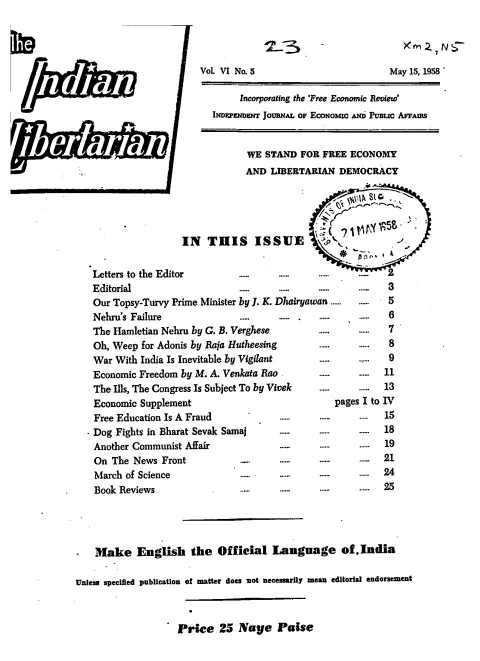
periodical issue
The Indian Libertarian
Independent Journal of Economic and Public Affairs
The Indian Libertarian, Edited by Miss Kusum Lotwala; published on the 1st and 15th of each month from Arya Bhuvan, Sandhurst Road, Bombay 4 · Bombay · 1958
31 pages
The Indian Libertarian
Summary
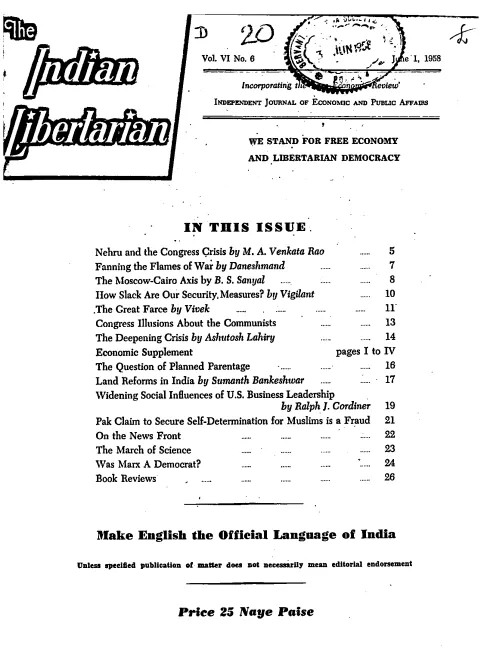
This June 1, 1958 issue (Vol. VI No. 6) of The Indian Libertarian, the Bombay ‘Independent Journal of Economic and Public Affairs’ edited by Kusum Lotwala, leads with M. A. Venkata Rao on the crisis convulsing the Congress and ranges across Cold War foreign policy, internal security, and anti-communist polemic under the banner ‘We stand for free economy and libertarian democracy.’ Pseudonymous columnists (‘Daneshmand’, ‘Vigilant’, ‘Vivek’) warn against war-mongering, lax security, and political farce, while B. S. Sanyal anatomises a ‘Moscow-Cairo Axis’ and Ashutosh Lahiry reads a deepening national crisis. A bound-in four-page Economic Supplement treats taxation, oil prices, and ‘The Question of Planned Parentage’. Articles from printed page 17 onward — Sumanth Bankeshwar on land reforms, Ralph J. Cordiner on U.S. business leadership, and the tail departments — fall beyond the rendered pages and are not summarised here.
Key points
-
M. A. Venkata Rao’s “Nehru and the Congress Crisis” reads the party’s internal feuds as a failure of Nehru-era leadership caught between socialist rhetoric and practical governance, weakening its response to communism.
-
Writing as ‘Daneshmand’ in the recurring column ‘This Is Pakistan’, one contributor charges Pakistani actors with deliberately fanning the flames of war over Kashmir and the border.
-
B. S. Sanyal’s “The Moscow-Cairo Axis” argues that an aligned Soviet-Egyptian bloc under Nasser is outmanoeuvring naive Indian non-alignment diplomacy.
-
Writing as ‘Vigilant’, a security column questions the adequacy of India’s internal security, alleging money and effort flow toward Pakistani espionage.
-
Writing as ‘Vivek’, a further column, “The Great Farce”, mocks a recent political episode as theatrical posturing divorced from actual conduct.
-
An unsigned piece, “Congress Illusions About the Communists”, argues the ruling party misreads the Communist Party as an ordinary rival rather than a disciplined movement bent on capturing the state.
-
Ashutosh Lahiry’s “The Deepening Crisis” blames socialist standardisation and regimentation for worsening India’s economic and political malaise over the preceding year.
-
The bound-in Economic Supplement argues current taxation policy penalises productive capital and welcomes a recent reduction in oil prices as a benefit to consumers.
-
“The Question of Planned Parentage” takes up family planning, weighing healthy families, food supply and education against population growth as an economic question.
Essays
Nehru and the Congress Crisis
By MA Venkata Rao
M. A. Venkata Rao examines the crisis inside the Congress, arguing that the party’s internal feuds and ideological drift reflect a deeper failure of leadership under Nehru. He contends that the Congress has lost its bearings between socialist rhetoric and practical governance, and that its inability to confront the communist challenge or set sound economic policy threatens India’s liberal-democratic prospects.
- Reads the Congress crisis as a failure of Nehru-era leadership.
- Sees the party caught between socialist rhetoric and governance.
- Links Congress disarray to its weakness against communism.
Fanning the Flames of War
By Daneshmand
Writing under the pseudonym ‘Daneshmand’ in a column headed ‘This Is Pakistan’, the author argues that elements in Pakistan are ‘fanning the flames of war’ over Kashmir and along the border, treating belligerence as a road to national suicide. The piece warns that war-mongering serves no rational end and reads the agitation as reckless rather than strategic.
- Charges Pakistani actors with deliberately stoking war.
- Frames border and Kashmir belligerence as self-destructive.
- Part of the journal’s recurring ‘This Is Pakistan’ commentary.
The Moscow-Cairo Axis
By B. S. Sanyal
B. S. Sanyal analyses what he calls the ‘Moscow-Cairo Axis’, arguing that Soviet and Egyptian (Nasserite) policy have aligned in ways that threaten the non-aligned world and India’s interests. He reads Nehru’s foreign policy as naive about this alignment, contending that Indian diplomacy has been outmanoeuvred by seasoned Soviet and Egyptian statecraft.
- Posits an aligned Moscow-Cairo bloc in world affairs.
- Argues Indian non-alignment is naive about this axis.
- Casts Nasser and Soviet diplomacy as outmanoeuvring Nehru.
How Slack Are Our Security Measures?
By Vigilant
In a security column written as ‘Vigilant’, the author asks how slack India’s internal security measures have become, pointing to money flowing to Pakistan for spies and to lax counter-intelligence. The piece argues that complacency about subversion and espionage leaves the country dangerously exposed.
- Questions the adequacy of India’s internal security.
- Alleges money and effort flow to Pakistani espionage.
- Warns that complacency invites subversion.
The Great Farce
By Vivek
Writing as ‘Vivek’, the columnist derides a recent political episode as ‘The Great Farce’, using the performance metaphor to mock the gap between official posturing and real conduct. The piece treats the spectacle as evidence of unseriousness in public life and the hollowness of vulgar political theatre.
- Mocks a political episode as theatrical farce.
- Contrasts official posturing with actual conduct.
- Reads the spectacle as a symptom of unserious public life.
Congress Illusions About the Communists
An unsigned piece, ‘Congress Illusions About the Communists’, argues that the ruling Congress fundamentally misunderstands the Communist Party, treating it as a normal political rival rather than a disciplined movement bent on capturing the state. It warns that Congress tactics and complacency play into communist hands.
- Charges Congress with misreading the communist threat.
- Argues communists are treated as ordinary rivals, not subversives.
- Warns Congress complacency aids communist advance.
The Deepening Crisis
By Ashutosh Lahiry
Ashutosh Lahiry surveys ‘The Deepening Crisis’, arguing that developments of the past year have intensified India’s economic and political difficulties. He reads standardised socialist patterns and regimentation as worsening the malaise and calls for a candid stock-taking of the country’s direction.
- Argues India’s crisis has deepened over the past year.
- Blames socialist standardisation and regimentation.
- Calls for honest stock-taking of national direction.
Economic Supplement
The bound-in Economic Supplement (pages I-IV) carries unsigned commentary arguing that present taxation policy must change to stop penalising productive capital, alongside a piece welcoming a reduction in oil prices as a benefit to consumers. The supplement presses the journal’s free-economy line that lighter taxes and freer prices serve growth and the public.
- Argues current taxation policy must be reformed to spare capital.
- Welcomes an oil-price reduction as benefiting consumers.
- Reiterates the journal’s free-economy economics.
The Question of Planned Parentage
An unsigned article, ‘The Question of Planned Parentage’, takes up family planning, weighing healthy families, food supply, and education against population growth. It frames responsible parenthood and population policy as bearing directly on India’s economic prospects.
- Takes up family planning and population policy.
- Connects population growth to food and education burdens.
- Frames responsible parenthood as an economic question.
Generated by the v1.5 extraction pipeline. Awaiting editorial review.
Metadata and summary are AI-extracted from the source PDF and reviewed for editorial accuracy. The original work is available via the Read PDF tab above (where present); paragraph-level citation inside the PDF is deferred to a future engagement.