periodical issue
The Indian Libertarian
An Independent Journal of Economic and Public Affairs
Edited by D. M. Kulkarni, B.A., LL.B., for the Libertarian Publishers Private Ltd., Printed by G. N. Lawande at G. N. Printers (Soham Prakashan Press), Nariman Bldg.-5, R. Dadaji Street, Fort, Bombay 1, and published by him at the office of the Libertarian Publishers (Private) Ltd., 26, Durgadevi Road, Bombay 4 · Bombay · 1961
20 pages
The Indian Libertarian
Summary
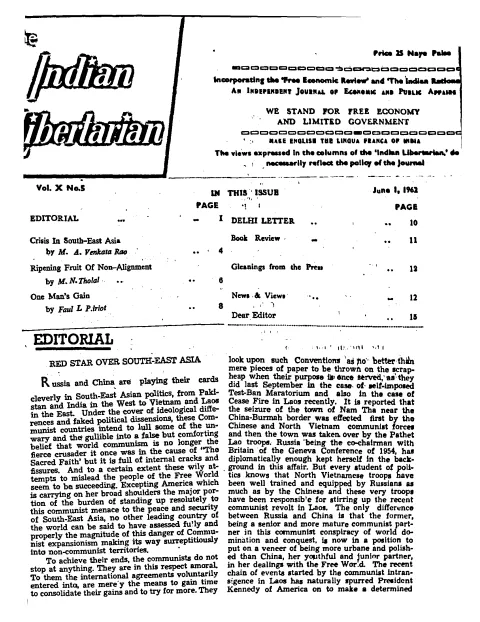
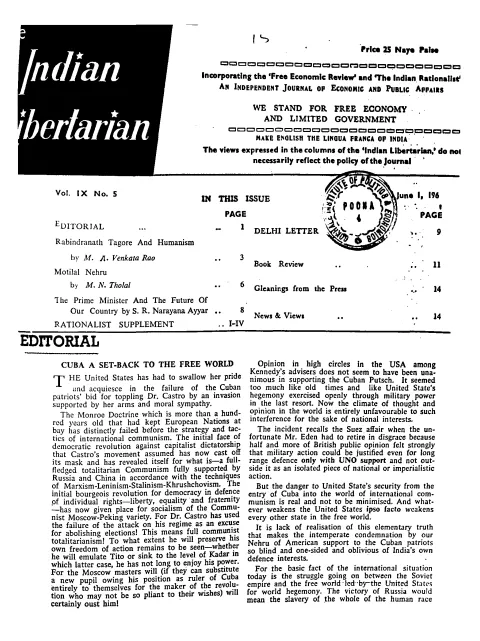
This June 1, 1961 issue (Vol. IX No. 5) of The Indian Libertarian, the Bombay fortnightly edited by D. M. Kulkarni whose masthead now stands ‘for free economy and limited government,’ opens with an editorial reading the failed Bay of Pigs landing as ‘Cuba: A Set-back to the Free World’ and moves through Cold War commentary on Laos, South Vietnam, and the contest with communism. The literary and biographical heart of the issue comprises M. A. Venkata Rao’s appreciation ‘Rabindranath Tagore And Humanism,’ M. N. Tholal’s affectionate portrait of ‘Motilal Nehru’ as ‘a true democrat,’ and S. R. Narayana Ayyar’s critical reflection ‘The Prime Minister And The Future Of Our Country.’ The issue also carries an interleaved four-page Rationalist Supplement (I-IV), a Delhi Letter, a book review, a ‘Gleanings from the Press’ column, and news and views. Its argumentative centre is the journal’s classical-liberal, anti-communist defence of economic freedom and limited government against state planning and Soviet expansion.
Key points
-
This 1 June 1961 issue, Vol. IX No. 5, edited by D. M. Kulkarni, opens with the editorial Cuba: A Set-back to the Free World, reading the failed Bay of Pigs landing as a propaganda victory for Castro and Moscow.
-
The editorial surveys the communist advance in Laos and South Vietnam and doubts the durability of an Austrian type of neutrality for Laos.
-
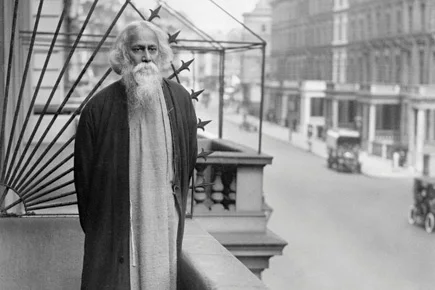
M. A. Venkata Rao’s Rabindranath Tagore And Humanism, written for the poet’s birth centenary, reads Tagore’s universalism and faith in the individual as a counter to collectivist currents.
-
M. N. Tholal’s Motilal Nehru is a personal recollection portraying the Congress leader as a true democrat who met others as equals despite his wealth, implicitly contrasting his temperament with later Congress politics.
-
S. R. Narayana Ayyar’s The Prime Minister And The Future Of Our Country questions the personalised concentration of authority around Nehru and its implications for accountable government.
-
The issue also carries a four-page Rationalist Supplement, a Delhi Letter, a book review, and a Gleanings from the Press column.
Essays
Editorial (Queen Elizabeth in India; Conspiracy to Murder Leaders; etc.)
The lead editorial, ‘Cuba: A Set-back to the Free World,’ reads the failure of the U.S.-backed landing in Cuba as a defeat for the free world and a propaganda gain for the Castro regime and its Soviet patrons. It then widens into a survey of the communist advance in Laos and South Vietnam, questioning the ‘precarious hope’ of neutralisation and warning that the West must set a higher value on freedom if it is to hold the line in Asia.
- Treats the failed Cuban landing as a set-back for the free world.
- Reads the episode as a propaganda victory for Castro and Moscow.
- Surveys the communist threat in Laos and South Vietnam.
- Doubts the durability of an ‘Austrian type of neutrality’ for Laos.
- Argues the West undervalues freedom in the Cold War contest.
President Kennedy’s “New Frontiers”
By MA Venkata Rao
M. A. Venkata Rao’s ‘Rabindranath Tagore And Humanism’ is an appreciation of the poet’s humanist vision, written in the centenary of his birth. It places Tagore’s universalism and faith in the creative individual against the collectivist currents of the age, treating his humanism as a living resource for a liberal, anti-totalitarian outlook rather than a merely literary inheritance.
- An appreciation of Rabindranath Tagore’s humanism in his birth centenary.
- Reads Tagore’s universalism as a counter to collectivism.
- Connects the poet’s faith in the individual to a liberal outlook.
- Written by M. A. Venkata Rao, a regular contributor.
Psychology of Non-Alignment
By M. N. Thoial
M. N. Tholal’s ‘Motilal Nehru’ is a personal recollection of the Congress leader, recalling their first meeting and casting Motilal as ‘a true democrat’ who, despite his wealth and grandeur, met others as equals. The piece sets Motilal’s temperament against the politics of his son and the later drift of the movement, using the portrait to make a quiet argument about democratic character.
- A personal recollection of Motilal Nehru by M. N. Tholal.
- Portrays Motilal as ‘a true democrat’ unspoiled by wealth.
- Draws on the author’s first meeting with him.
- Implicitly contrasts his temperament with later Congress politics.
Lokayata: Indian Materialism
By S. Ramanathan
S. R. Narayana Ayyar’s ‘The Prime Minister And The Future Of Our Country’ is a critical reflection on Nehru’s leadership and its consequences for India’s direction. In the rendered opening, Ayyar questions the personalised concentration of authority around the Prime Minister and the implications of that dominance for the country’s future, framing it as a problem for liberal, accountable government.
- A critical reflection on Nehru’s leadership of India.
- Questions the concentration of authority around the Prime Minister.
- Frames the issue as a concern for the country’s future.
- Continues the issue’s scrutiny of Congress dominance.
Generated by the v1.5 extraction pipeline. Awaiting editorial review.
Metadata and summary are AI-extracted from the source PDF and reviewed for editorial accuracy. The original work is available via the Read PDF tab above (where present); paragraph-level citation inside the PDF is deferred to a future engagement.