periodical issue
The Indian Libertarian
An Independent Journal of Public Affairs
By MA Venkata Rao, M. N. Tholal
The Indian Libertarian, An Independent Journal of Public Affairs · Bombay · 1963
16 pages
The Indian Libertarian
Summary
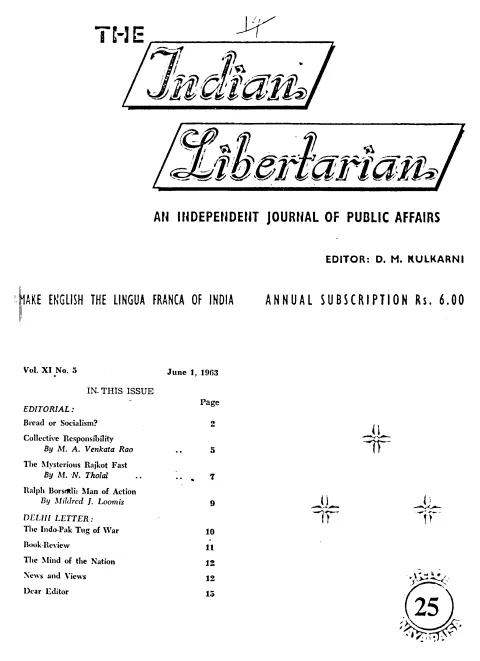
This June 1, 1963 issue (Vol. XI No. 5) of The Indian Libertarian, the Bombay fortnightly edited by D. M. Kulkarni and here carrying a redesigned cover as ‘An Independent Journal of Public Affairs,’ opens with an editorial, ‘Bread or Socialism?’, that pits the productive promise of free enterprise against the claims of socialist planning in a hungry India. M. A. Venkata Rao’s ‘Collective Responsibility’ is a work of political theory weighing collective against individual responsibility and drawing on Indian sources; M. N. Tholal continues his serial ‘The Mysterious Rajkot Fast’ (part II), re-examining Gandhi’s 1939 fast at Rajkot; and Mildred J. Loomis contributes ‘Ralph Borsodi: Man of Action,’ a profile of the American decentralist and homesteading reformer behind the School of Living and the ‘Green Revolution’ of self-sufficient living. The issue rounds out with a Delhi Letter on ‘The Indo-Pak Tug of War,’ a book review, ‘The Mind of the Nation,’ news and views, and a ‘Dear Editor’ section. Its argumentative centre is the journal’s defence of economic freedom and individual responsibility against socialism and collectivism.
Key points
-
The editorial ‘Bread or Socialism?’ frames India’s development choice as one between the material abundance a free, productive economy can deliver and doctrinaire socialist planning.
-
M. A. Venkata Rao’s ‘Collective Responsibility’ is a political-theory essay arguing, from a British rule-book maxim and Indian sources, that collective responsibility must rest on and not dissolve individual conscience.
-
M. N. Tholal’s serial ‘The Mysterious Rajkot Fast’ (part II) re-examines Gandhi’s controversial 1939 fast at Rajkot, which Gandhi himself later admitted had been a mistake.
-
Tholal probes the political bargaining and contradictions surrounding the Rajkot fast to scrutinise Gandhi’s use of fasting as a political instrument.
-
Mildred J. Loomis’s ‘Ralph Borsodi: Man of Action’ profiles the American decentralist Ralph Borsodi, resisting the label of mere ‘visionary’ by stressing that he put his ideas into practice.
-
Loomis traces Borsodi’s founding of the School of Living and his ‘Green Revolution’ of decentralised, family-scale, self-sufficient production as a practical alternative to industrial dependence.
-
The issue closes with a Delhi Letter on ‘The Indo-Pak Tug of War’, a book review, and the standing ‘Mind of the Nation’ and ‘Dear Editor’ sections.
Essays
Editorial: Bread or Socialism?
The editorial ‘Bread or Socialism?’ frames India’s choice as one between the material abundance (‘bread’) that a free, productive economy can deliver and the doctrinaire pursuit of socialism. It argues that British rulers once confronted a similar question and that the experience of socialist planning warns against sacrificing prosperity to ideology, pressing the case that economic freedom, not state direction, is the surer route to feeding the nation.
- Poses India’s development choice as ‘bread’ (prosperity) versus socialism.
- Reads socialist planning as a threat to material abundance.
- Draws on historical and comparative experience of state control.
- Defends economic freedom as the surer path to prosperity.
Collective Responsibility
By MA Venkata Rao
M. A. Venkata Rao’s ‘Collective Responsibility’ is a reflective essay in political theory examining how responsibility is distributed between the group and the individual. Beginning from a British rule-book maxim, it argues that collective responsibility must rest on, and not dissolve, individual conscience, and it draws on Indian sources to test how far a community can be held answerable for the acts of its members.
- Examines the relation between collective and individual responsibility.
- Argues collective responsibility must not erase individual conscience.
- Draws on Indian moral and religious sources.
- A work of political-philosophical reflection rather than topical commentary.
The Mysterious Rajkot Fast
By M. N. Tholal
M. N. Tholal’s ‘The Mysterious Rajkot Fast’ (part II) re-examines Gandhi’s controversial 1939 fast at Rajkot, which Tholal recalls Gandhi undertook ‘to the consternation of his admirers’ and later admitted had been a mistake. The piece probes the motives, the political bargaining, and the contradictions surrounding the episode, using it to scrutinise Gandhi’s method of the fast as a political instrument.
- Second instalment re-examining Gandhi’s 1939 Rajkot fast.
- Treats the fast as a puzzling and contested episode.
- Probes the politics and bargaining behind it.
- Questions the fast as a political instrument.
Ralph Borsodi: Man of Action
By Mildred J. Loomis
Mildred J. Loomis’s ‘Ralph Borsodi: Man of Action’ profiles the American decentralist and homesteading reformer, resisting the label of mere ‘visionary’ by stressing how Borsodi put his ideas into practice. The piece traces his experiments in self-sufficient living, his founding of the School of Living, and his ‘Green Revolution’ of decentralised, family-scale production as a practical alternative to industrial dependence.
- Profiles the American decentralist Ralph Borsodi.
- Emphasises practice over theory (‘Man of Action’).
- Covers homesteading, the School of Living, and the ‘Green Revolution.’
- Presents decentralised self-sufficiency as a constructive alternative.
Generated by the v1.5 extraction pipeline. Awaiting editorial review.
Metadata and summary are AI-extracted from the source PDF and reviewed for editorial accuracy. The original work is available via the Read PDF tab above (where present); paragraph-level citation inside the PDF is deferred to a future engagement.