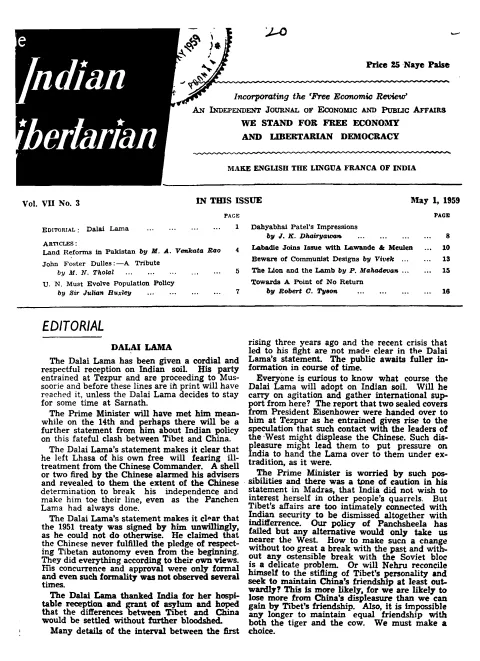
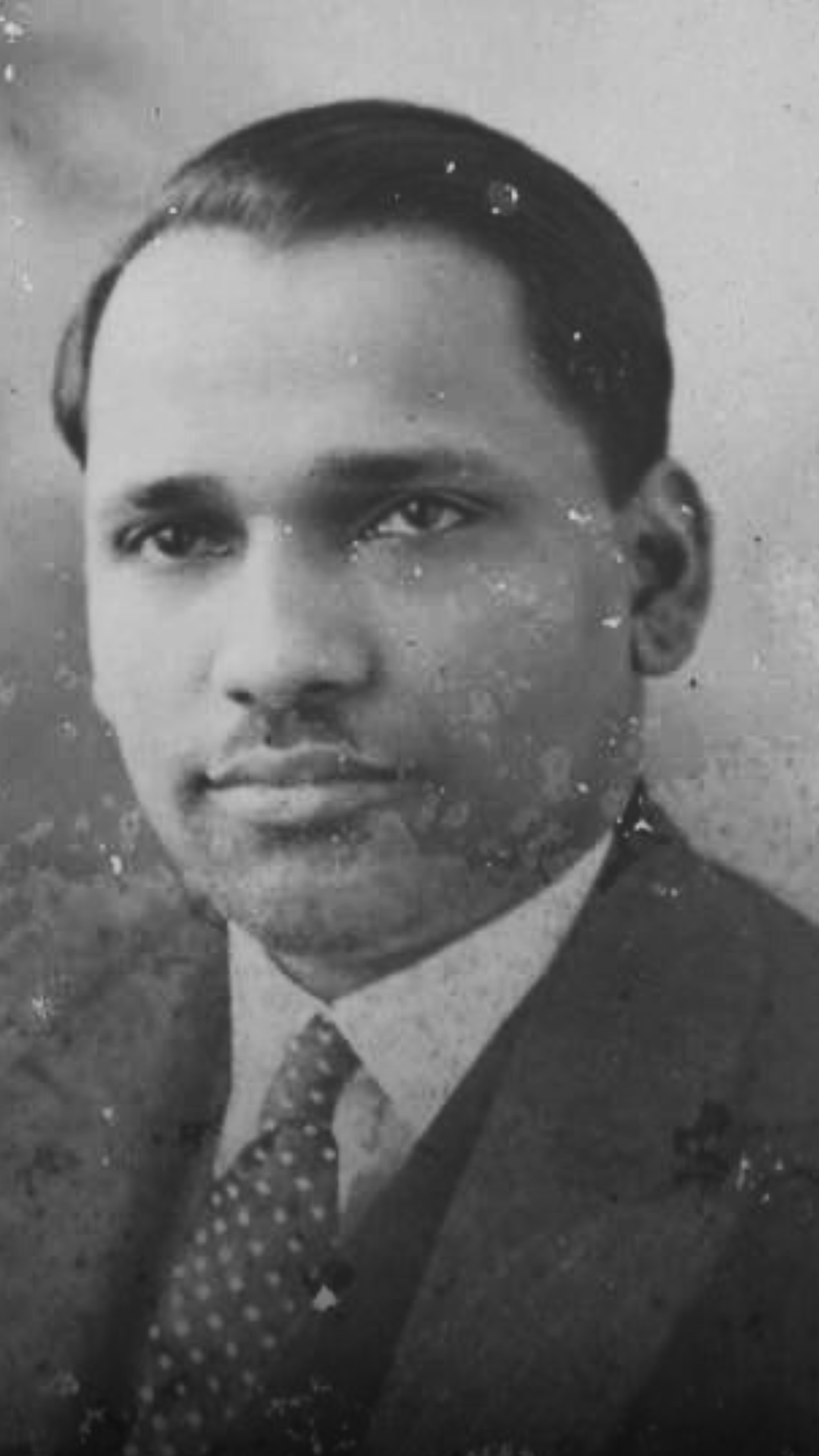
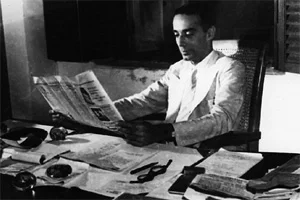
periodical issue
The Indian Libertarian
Independent Journal of Economic and Public Affairs (Incorporating the 'Free Economic Review')
By M. N. Tholal, MA Venkata Rao, A Ranganathan, Acharya J. B. Kripalani
Edited and Published by Miss Kusum Lotwala for the Libertarian Publishers (Private) Ltd., Arya Bhavan, Sandhurst Road, Bombay 4. · Bombay · 1959
20 pages
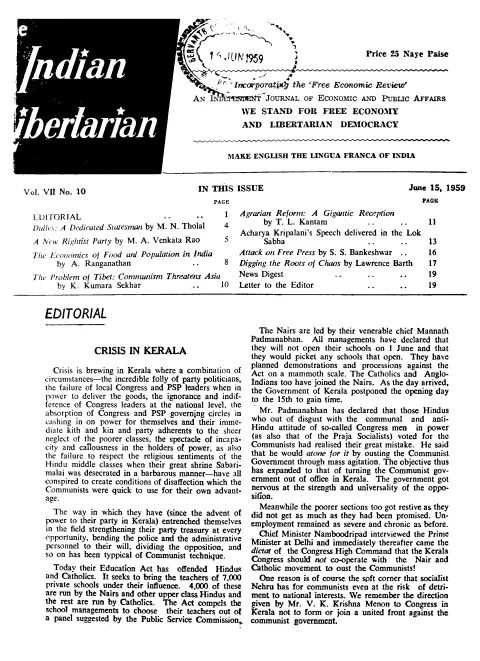
The Indian Libertarian
Summary
The June 15, 1959 issue (Vol. VII No. 10) of The Indian Libertarian, Bombay’s classical-liberal ‘Independent Journal of Economic and Public Affairs,’ leads with an editorial on the constitutional crisis in Communist-governed Kerala and gathers commentary on the Cold War, food and population, Tibet, agrarian collectivisation, and press freedom. Contributors include M. N. Tholal on John Foster Dulles, M. A. Venkata Rao on the case for a new rightist party, A. Ranganathan on the economics of food and population, K. Kumara Sekhar on the Communist threat to Tibet and Asia, T. L. Kantam on agrarian reform as deception, S. S. Bankeshwar on attacks on the free press, and Lawrence Barth on the roots of disorder, plus a reprint of Acharya Kripalani’s Lok Sabha speech. The issue’s center of gravity is anti-Communist and pro-free-enterprise, defending private property and a free press against socialist planning.
Key points
-
The editorial Crisis in Kerala analyses the confrontation triggered by the Communist state government’s Education Act, which antagonised Catholic and Nair school managements under the leadership of Mannath Padmanabhan.
-
The editorial blames a combination of Congress and PSP political missteps and Communist consolidation of power for deepening the Kerala crisis.
-
M. N. Tholal’s Dulles: A Dedicated Statesman defends US Secretary of State John Foster Dulles’s anti-communist brinkmanship as principled statesmanship, against the grain of prevailing Indian opinion.
-
M. A. Venkata Rao’s A New Rightist Party argues that India’s existing party system leaves liberal and free-enterprise opinion unrepresented, criticising socialistic drift and cooperative-farming schemes.
-
A. Ranganathan’s The Economics of Food and Population in India weighs food supply against population growth, invoking Malthus and the memory of the 1943 Bengal famine.
-
K. Kumara Sekhar’s The Problem of Tibet treats the Tibetan crisis as evidence that Chinese communism endangers the whole of Asia and criticises Nehru’s policy toward China.
-
T. L. Kantam’s Agrarian Reform: A Gigantic Deception, the second installment of a Whither China series, attacks planned-economy agrarian reform and collective farming as a deception of the peasantry.
-
S. S. Bankeshwar’s Attack on Free Press argues that press freedom is inseparable from the freedom of the citizen, warning that totalitarian governments invariably move to capture the press.
-
Lawrence Barth’s Digging the Roots of Chaos traces contemporary social disorder to mistaken underlying ideas about man and society rather than to surface politics.
Essays
Editorial
The editorial ‘Crisis in Kerala’ analyses the brewing confrontation in Communist-ruled Kerala, where the government’s Education Act has antagonised Catholic and Nair school managements and triggered agitation. It blames a combination of party politics, Congress and PSP folly, and Communist consolidation of power for the unrest, and frames the crisis as a test of liberal opposition to one-party Communist rule.
- Frames Kerala as a constitutional crisis under Communist government
- Identifies the Education Act and school-management dispute as the flashpoint
- Faults Congress and PSP for enabling the situation
- Notes the Nair leadership under Mannath Padmanabhan and Catholic opposition
Dulles: A Dedicated Statesman
By M. N. Tholal
M. N. Tholal’s ‘Dulles: A Dedicated Statesman’ offers a sympathetic assessment of US Secretary of State John Foster Dulles, presenting his anti-Communist firmness and ‘brinkmanship’ as principled statesmanship rather than warmongering, against the grain of much Indian opinion.
- Defends John Foster Dulles as a principled anti-Communist statesman
- Reads his brinkmanship as dedication rather than belligerence
- Positions the assessment against prevailing Indian neutralist opinion
A New Rightist Party
By MA Venkata Rao
M. A. Venkata Rao argues the case for a new rightist party in India, contending that the existing party system leaves liberal and free-enterprise opinion unrepresented. He criticises socialistic drift and cooperative-farming schemes and makes the case for an organised conservative-liberal alternative to Congress.
- Argues India needs an organised new rightist/liberal party
- Critiques socialistic drift and cooperative farming
- Holds that free-enterprise opinion lacks political representation
The Economics of Food and Population in India
By A Ranganathan
A. Ranganathan’s ‘The Economics of Food and Population in India’ examines the relationship between food supply and population growth, drawing on Malthus and the memory of the Bengal famine. It weighs planning and agricultural policy against population pressure and argues for a realistic economic approach to food security.
- Examines food supply against population growth in India
- Invokes Malthus and the 1943 Bengal famine
- Weighs agricultural and planning policy on food security
The Problem of Tibet: Communism Threatens Asia
By K. Kumara Sekhar
K. Kumara Sekhar’s ‘The Problem of Tibet: Communism Threatens Asia’ treats the Tibetan crisis as evidence that Chinese Communism endangers the whole of Asia. It is critical of Indian policy toward China and warns that Nehru’s accommodation underestimates the threat on India’s frontier.
- Treats the Tibet crisis as a Communist threat to all Asia
- Critiques Indian (Nehruvian) policy toward China
- Warns of danger on India’s northern frontier
Agrarian Reform: A Gigantic Reception
By T. L. Kantam
T. L. Kantam’s piece — printed under the running head ‘Agrarian Reform: a Gigantic Deception’ (the table of contents reads ‘Reception’) and described as the second part of a ‘Whither China?’ series — attacks planned-economy agrarian reform and collective farming. It surveys the costs of administration and argues that socialist land reform deceives the peasantry while concentrating control in the state.
- Attacks agrarian reform and collective farming as a ‘gigantic deception’
- Critiques the administrative cost of planned-economy land reform
- Runs as the second installment of a ‘Whither China?’ series
Attack on Free Press
By S. S. Bankeshwar
S. S. Bankeshwar’s ‘Attack On Free Press’ defends press freedom against state pressure, arguing that the freedom of the press is inseparable from the freedom of the citizen and that totalitarian governments invariably move to control or capture the press.
- Defends freedom of the press as inseparable from individual liberty
- Warns that totalitarian states seek to control the press
- Frames press freedom as a democratic safeguard
Digging the Roots of Chaos
By Lawrence Barth
Lawrence Barth’s ‘Digging the Roots of Chaos’ traces contemporary disorder to deeper intellectual and moral causes, arguing that the roots of social chaos lie in mistaken ideas about man and society rather than in surface politics alone.
- Locates the roots of chaos in mistaken ideas, not surface politics
- Connects intellectual error to social disorder
Generated by the v1.5 extraction pipeline. Awaiting editorial review.
Metadata and summary are AI-extracted from the source PDF and reviewed for editorial accuracy. The original work is available via the Read PDF tab above (where present); paragraph-level citation inside the PDF is deferred to a future engagement.