periodical issue
The Indian Libertarian
An Independent Journal of Economic and Public Affairs
By MA Venkata Rao, M. N. Tholal, G N Lawande, MA Sreenivasan, A Ranganathan
The Indian Libertarian, Independent Journal of Economic and Public Affairs. Published on the 1st and 15th of Each Month. Arya Bhuvan, Sandhurst Road, Bombay 4. · Bombay · 1959
28 pages
The Indian Libertarian
Summary
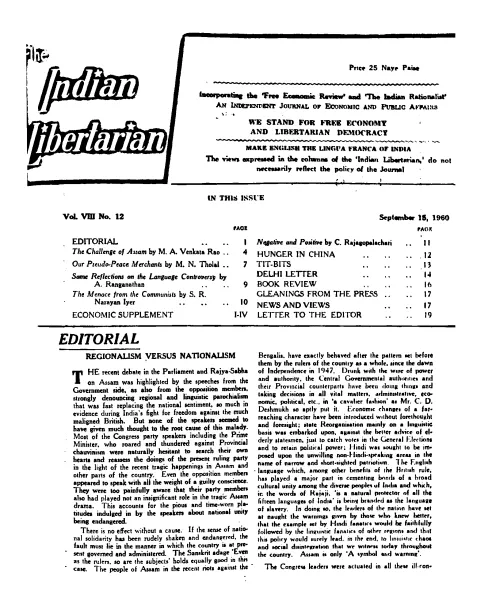
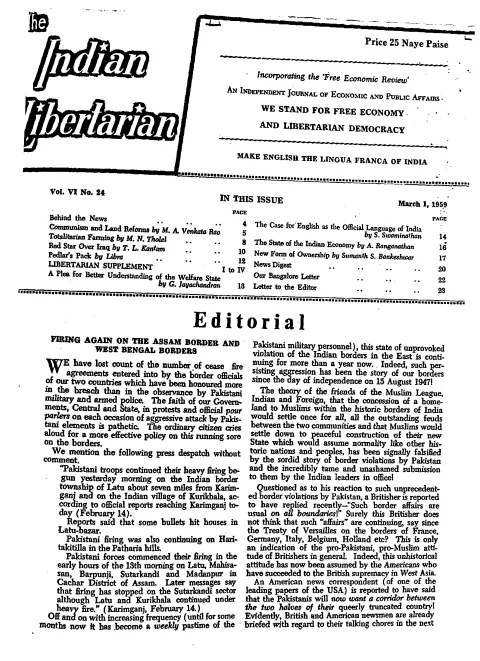
This March 1, 1959 issue (Vol. VI No. 24) of The Indian Libertarian opens with an editorial on renewed firing along the Assam and West Bengal borders with East Pakistan, reading the incidents as a test of Indian resolve and a warning against complacency toward Pakistan and the spread of communism in the region. The issue’s bylined articles run from M. A. Venkata Rao on communism and land reforms, through a Libertarian Supplement by Prof. G. N. Lawande on fiscal policy and economic development, M. A. Sreenivasan’s ‘Pancha Stotra’ (drawn from a Forum of Free Enterprise presidential address), G. Jayachandran’s defence of a limited reading of the welfare state, and A. Ranganathan’s survey of the state of the Indian economy. Across the rendered pages the unifying note is the journal’s classical-liberal suspicion of socialist planning, collectivised land reform, and the unbounded welfare state.
Key points
-
The editorial on renewed firing along the Assam and West Bengal borders with East Pakistan reads the incidents as a test of Indian resolve and warns against complacency toward Pakistan and the spread of communism in the region.
-
M. A. Venkata Rao’s “Communism and Land Reforms” argues that communist-style land redistribution delivers the peasant to the state rather than liberating him, and defends private property in land as a bulwark of freedom.
-
Prof. G. N. Lawande’s Libertarian Supplement essay, “Fiscal Policy & Economic Development”, sets out principles of sound public finance and argues that tax policy should be designed to encourage enterprise and capital formation rather than penalise it.
-
M. A. Sreenivasan’s “Pancha Stotra”, adapted from a Forum of Free Enterprise presidential address at Bangalore, offers a five-fold tribute to economic freedom and defends the productive private citizen against official suspicion.
-
G. Jayachandran’s “A Plea for a Better Understanding of the Welfare State” concedes that society owes members a baseline of security but warns that an open-ended welfare state erodes self-reliance and individual freedom.
-
Jayachandran pleads for a clearly bounded conception of the welfare state rather than the unlimited collectivism the term has come to license.
-
A. Ranganathan’s “The State of the Indian Economy” opens with N. G. Ranga’s criticism of the Nagpur land-reform approach as luring the country toward Marxism, before surveying the economy’s condition under planning.
Essays
Communism and Land Reforms
By MA Venkata Rao
M. A. Venkata Rao’s ‘Communism and Land Reforms’ argues that communist-style land redistribution, far from liberating the peasant, delivers him to the state. He contrasts the rhetoric of land reform with its outcome under collectivisation, warning that abolishing private property in land concentrates power and destroys the independent cultivator that a free society depends on.
- Distinguishes the rhetoric of land reform from its collectivist outcome.
- Warns that communist land policy subordinates the peasant to the state.
- Defends private property in land as a bulwark of freedom.
- Reads land reform as a vector for extending state power.
Libertarian Supplement: Fiscal Policy & Economic Development
By G N Lawande
In the Libertarian Supplement, Prof. G. N. Lawande’s ‘Fiscal Policy & Economic Development’ lays out principles of sound public finance for a developing economy. Beginning from ‘proper fiscal policy’ and the politics of planning, he assesses planned expenditure, the objects of tax policy, and how taxation should be designed to encourage rather than penalise productive enterprise and capital formation.
- Sets out principles of sound fiscal policy for a developing economy.
- Critiques the politics and economics of planned expenditure.
- Examines the proper objects of tax policy.
- Argues tax design should encourage enterprise and capital formation.
Pancha Stotra
By MA Sreenivasan
M. A. Sreenivasan’s ‘Pancha Stotra’, following a presidential speech delivered at Bangalore under the auspices of the Forum of Free Enterprise, offers a five-fold appreciation of economic freedom and enterprise. The piece praises the citizen who builds and produces and gently rebukes the climate of suspicion that planning casts over private initiative.
- Adapted from a Forum of Free Enterprise presidential address at Bangalore.
- Frames a five-fold (‘Pancha’) tribute to enterprise and freedom.
- Defends the productive private citizen against official suspicion.
A Plea for a Better Understanding of the Welfare State
By G. Jayachandran
G. Jayachandran’s ‘A Plea for a Better Understanding of the Welfare State’ tries to separate a defensible idea of the welfare state from the open-ended collectivism the term has come to license. Conceding that a society owes its members a baseline of security, he argues that an unbounded welfare state erodes self-reliance and individual freedom, and pleads for a limited, carefully bounded conception.
- Seeks a defensible, limited conception of the welfare state.
- Concedes a baseline of social security as legitimate.
- Warns that an open-ended welfare state erodes self-reliance.
- Pleads for clear boundaries on state welfare provision.
The State of the Indian Economy
By A Ranganathan
A. Ranganathan’s ‘The State of the Indian Economy’ opens by noting that ‘Mr. N. G. Ranga, M.P.’ has recently attacked the Nagpur approach to the land problem as ‘luring the country to the fundamental concepts of democracy and Marxism’. In the rendered pages Ranganathan begins surveying the condition of the Indian economy under planning; the essay continues past page 20.
- Opens with N. G. Ranga’s critique of the Nagpur land-reform line.
- Frames the assessment around planning’s economic record.
- Article continues beyond the rendered pages.
Generated by the v1.5 extraction pipeline. Awaiting editorial review.
Metadata and summary are AI-extracted from the source PDF and reviewed for editorial accuracy. The original work is available via the Read PDF tab above (where present); paragraph-level citation inside the PDF is deferred to a future engagement.