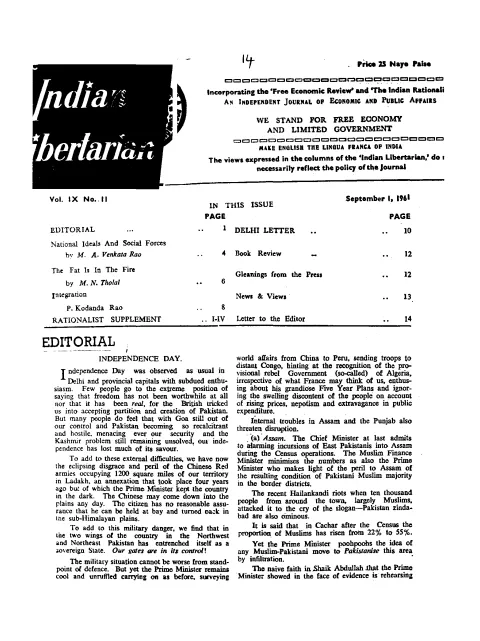
periodical issue
The Indian Libertarian
An Independent Journal of Public Affairs
By MA Venkata Rao, M. N. Tholal
The Indian Libertarian, Arya Bhuvan, Sandhurst Road, Bombay 4 · Bombay · 1963
16 pages
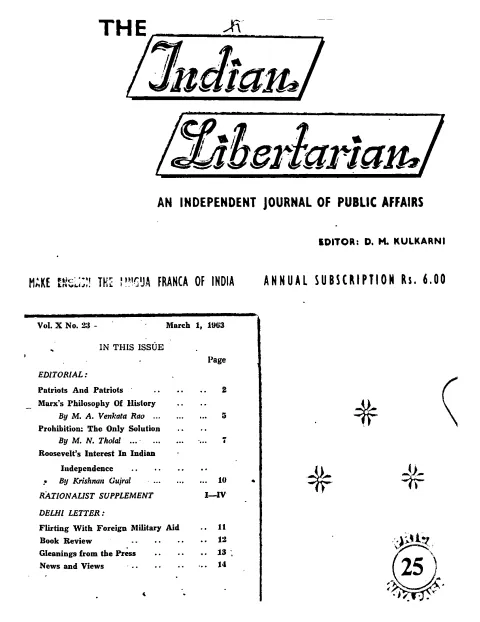
The Indian Libertarian
Summary
This March 1, 1963 issue (Vol. X No. 23) of The Indian Libertarian, now subtitled ‘An Independent Journal of Public Affairs’ and edited by D. M. Kulkarni, leads with an editorial, ‘Patriots and Patriots,’ distinguishing genuine patriotism from its hollow or self-serving imitations amid the post-1962 mood of national emergency. The signed articles span the journal’s recurring concerns: M. A. Venkata Rao’s ‘Marx’s Philosophy of History’ is a critical exposition (drawing on Karl Popper) of historical materialism; M. N. Tholal’s ‘Prohibition: The Only Solution’ argues the social case for prohibition; and Krishnan Gujral’s ‘Roosevelt’s Interest in Indian Independence,’ timed to the anniversary of F. D. Roosevelt’s birth, reconstructs American pressure on Britain over Indian freedom. A Rationalist Supplement and a ‘Delhi Letter’ on foreign military aid complete the issue.
Key points
-
The editorial Patriots and Patriots, written amid the post-1962-emergency mood, distinguishes opportunist copper patriots from disinterested twenty-four-carat and pure gold patriots serving the nation.
-
M. A. Venkata Rao’s Marx’s Philosophy of History concedes Marxism is among the precious heritages of freedom before faulting it for reducing democracy and religion to economic forces.
-
Venkata Rao draws explicitly on Karl Popper’s critique of historicism to challenge the claim that historical development follows knowable, inevitable stages toward a predetermined end.
-
M. N. Tholal’s Prohibition: The Only Solution, prompted by a Government of Bombay committee studying prohibition, marshals case material on liquor’s toll on labouring households.
-
Tholal presses the moral and social case for a total ban on liquor over mere regulation or temperance, while conceding the practical difficulties of enforcement.
-
Krishnan Gujral’s essay, reprinted from the U.S.A. Information Service to mark Franklin D. Roosevelt’s birth anniversary, reconstructs Roosevelt’s wartime pressure on Britain over Indian freedom.
Essays
Editorial: Patriots And Patriots
The editorial ‘Patriots and Patriots’ draws a sharp line between kinds of patriotism in the wake of the 1962 emergency. It distinguishes ‘copper’ patriots — opportunists who wrap private and partisan interest in the flag — from ‘24-carat’ and ‘pure gold’ patriots whose devotion to the country is disinterested. Surveying the conduct of parties and leaders during the crisis, the editor warns that loud professions of patriotism are no test of the real thing, and that the nation’s safety depends on telling the genuine article from its base imitations.
- Written in the post-1962-emergency mood of national danger
- Separates ‘copper’ patriots (opportunists) from ‘24-carat’ and ‘pure gold’ patriots
- Warns that loud professions of patriotism are no proof of the genuine article
- Tests parties and leaders by their disinterested service to the country
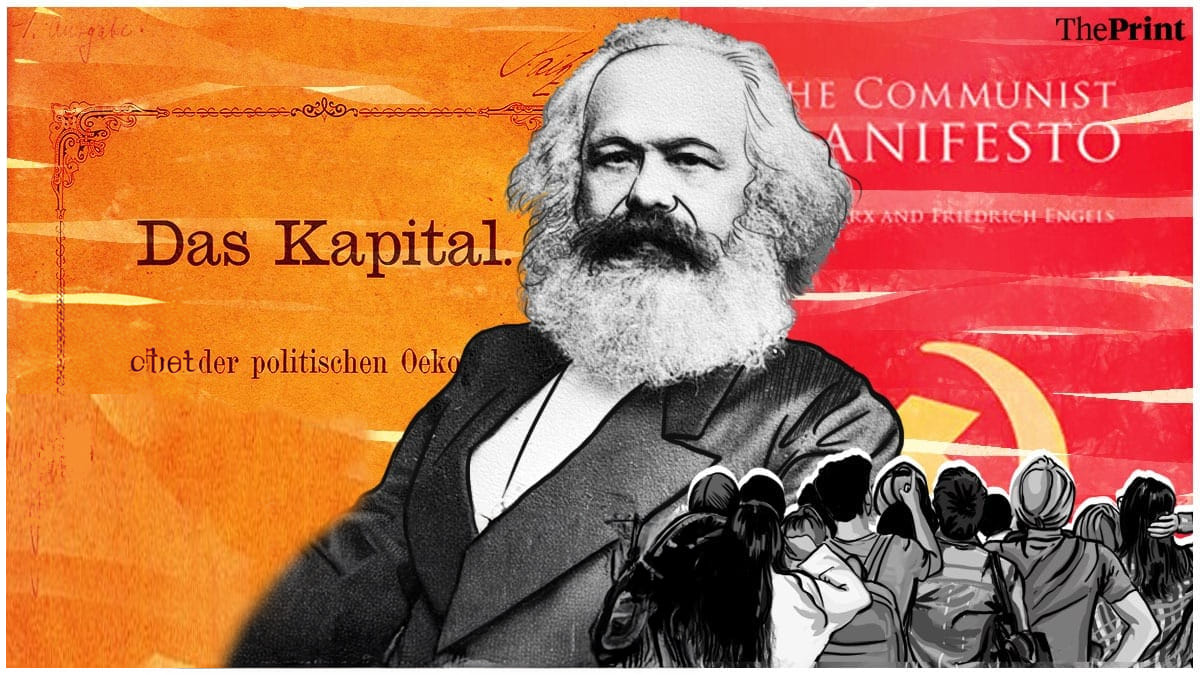
Marx’s Philosophy Of History
By MA Venkata Rao
M. A. Venkata Rao’s ‘Marx’s Philosophy of History’ is a critical exposition of historical materialism. He grants that Marxism is one of the great precious heritages of freedom, but argues it makes democracy, religion and freedom of the spirit the mere reflection of an underlying economic set-up of forces. Drawing explicitly on Karl Popper’s critique of historicism, Venkata Rao challenges the claim that the laws of historical development can be known with prophetic certainty, and defends the openness of history against the Marxist scheme of inevitable stages.
- Expounds and criticises Marx’s materialist conception of history
- Concedes Marxism is among the ‘precious heritages of freedom’ before dissenting
- Faults Marxism for reducing freedom, religion and democracy to economic forces
- Invokes Karl Popper’s critique of historicism against historical inevitability
Prohibition: The Only Solution
By M. N. Tholal
M. N. Tholal’s ‘Prohibition: The Only Solution’ argues that the Government of Bombay had appointed a committee to study the working of prohibition, and that, whatever its findings, prohibition remains for him the only real remedy for the social havoc of drink. He marshals case material on the misery liquor brings to homes — particularly among the labouring poor — and presses the moral and social case for a total ban over mere regulation or temperance, conceding the difficulties of enforcement while insisting the alternative is worse.
- Prompted by a Government of Bombay committee on the working of prohibition
- Argues prohibition is ‘the only solution’ to the social damage of drink
- Uses case material on the toll of liquor on poor and labouring households
- Presses the moral/social case for a total ban over regulation or temperance
Roosevelt’s Interest In Indian Independence
By Krishnan Gujral
Krishnan Gujral’s ‘Roosevelt’s Interest in Indian Independence,’ reprinted from the U.S.A. Information Service to mark the anniversary of Franklin D. Roosevelt’s birth, reconstructs the wartime pressure the American President brought to bear on Britain over Indian freedom. Drawing on the published record, Gujral recounts Roosevelt’s repeated ‘subsequent’ interventions and his exchanges with Churchill on the subject, presenting the United States as a sympathetic external advocate for India’s independence during the Second World War.
- Reprinted from the U.S.A. Information Service for the Roosevelt birth anniversary
- Reconstructs Roosevelt’s wartime pressure on Britain over Indian freedom
- Draws on the documentary record of Roosevelt-Churchill exchanges
- Casts the U.S. as a sympathetic external advocate of Indian independence
Generated by the v1.5 extraction pipeline. Awaiting editorial review.
Metadata and summary are AI-extracted from the source PDF and reviewed for editorial accuracy. The original work is available via the Read PDF tab above (where present); paragraph-level citation inside the PDF is deferred to a future engagement.