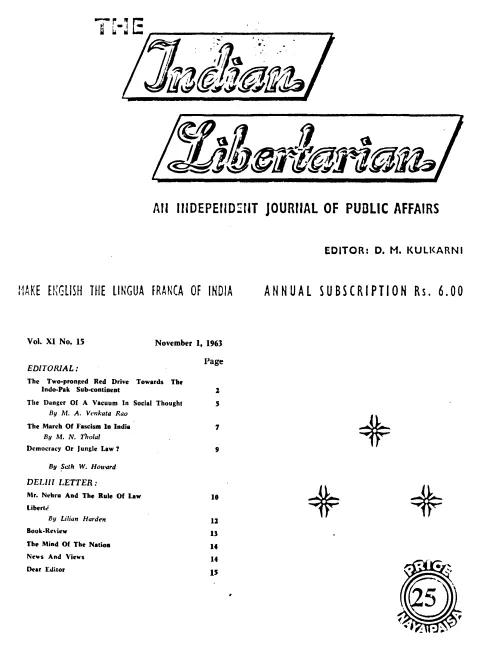
periodical issue
The Indian Libertarian
An Independent Journal of Public Affairs
By MA Venkata Rao, M. N. Tholal
The Indian Libertarian, Arya Bhuvan, Sandhurst Road, Bombay 4 · Bombay · 1964
16 pages
The Indian Libertarian
Summary
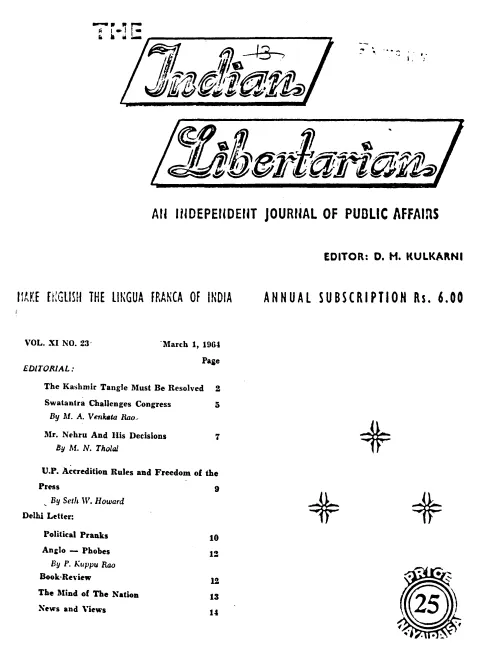
This March 1, 1964 issue (Vol. XI No. 23) of The Indian Libertarian, edited by D. M. Kulkarni, opens with an editorial, ‘The Kashmir Tangle Must Be Resolved,’ written as the UN Security Council again takes up Kashmir, urging a firm but conciliatory settlement. The signed articles carry the journal’s classical-liberal politics: M. A. Venkata Rao’s ‘Swatantra Challenges Congress’ reports the Swatantra Party’s Bangalore convention as a constitutionalist challenge to Congress’s socialist drift; M. N. Tholal’s ‘Mr. Nehru and His Decisions’ is a critical assessment of the ageing Prime Minister’s record of choices; and Seth W. Howard’s ‘U.P. Accreditation Rules and the Freedom of the Press’ attacks new state rules as a threat to press freedom. A Delhi Letter and shorter pieces, including P. Kuppu Rao’s ‘Anglo — Phobes,’ complete the issue.
Key points
-
The 1 March 1964 issue, Vol. XI No. 23, of The Indian Libertarian, edited by D. M. Kulkarni, opens with the editorial “The Kashmir Tangle Must Be Resolved,” prompted by the UN Security Council again taking up the dispute.
-
The editorial weighs the “gains and losses” of India’s diplomatic position and calls for a firm national and foreign policy to end the deadlock rather than let it fester before international opinion.
-
M. A. Venkata Rao’s “Swatantra Challenges Congress” reports the Swatantra Party’s Bangalore convention as marked progress for a constitutionalist, free-enterprise opposition to Congress’s socialist economic policy.
-
M. N. Tholal’s “Mr. Nehru and His Decisions” argues that many of the ageing Prime Minister’s major decisions have plainly miscarried, indicting his personal dominance over national policy.
-
Seth W. Howard’s “U.P. Accreditation Rules and the Freedom of the Press” attacks new Uttar Pradesh rules giving officials discretionary power to reward compliant journalists and punish critics.
-
Howard contrasts the accreditation measure with democratic norms of a free press, calling it a “very surprising” encroachment the United States and other democracies would not countenance.
-
A Delhi Letter and shorter pieces, including P. Kuppu Rao’s “Anglo — Phobes,” complete the issue alongside the editorial and the three signed essays.
Essays
Editorial: The Kashmir Tangle Must Be Resolved
The editorial ‘The Kashmir Tangle Must Be Resolved’ is prompted by the U.N. Security Council again taking up Kashmir. It surveys the gains and losses of India’s position in the long dispute, criticising drift and indecision, and argues that a firm national and foreign policy is needed to resolve the tangle rather than let it fester before international opinion. While insisting on India’s case, the editorial presses for a settlement that secures the country’s interests without endless deadlock.
- Occasioned by the U.N. Security Council again taking up Kashmir
- Weighs the ‘gains and losses’ of India’s diplomatic position
- Calls for a firm national and foreign policy to end the deadlock
- Presses for resolution rather than indefinite festering of the dispute
Swatantra Challenges Congress
By MA Venkata Rao
M. A. Venkata Rao’s ‘Swatantra Challenges Congress’ reports the Swatantra Party’s convention at Bangalore as a marked-progress moment in the party’s life and in the larger fight against the socialist economic policy that, in the journal’s view, the Congress and the planners have fastened on India. He reads the convention as evidence that a constitutionalist, free-enterprise opposition can mount a real challenge to one-party Congress dominance, and frames Swatantra as the political vehicle for the dispersion of economic power against state-directed planning.
- Reports the Swatantra Party convention at Bangalore
- Reads it as marked progress for the free-enterprise opposition
- Frames Swatantra as a constitutionalist challenge to Congress dominance
- Opposes the socialist economic policy of Congress and the planners
Mr. Nehru And His Decisions
By M. N. Tholal
M. N. Tholal’s ‘Mr. Nehru and His Decisions’ is a critical assessment of the Prime Minister’s pattern of decision-making. Tholal argues that one would have to be exceptionally muddle-headed not to see that many of Nehru’s major decisions have miscarried, and reviews the record — domestic and foreign — to argue that the ageing Nehru’s choices have repeatedly damaged the country. The piece is a pointed indictment of the cult around Nehru and of the consequences of his personal dominance over policy.
- A critical review of Nehru’s record of major decisions
- Argues many of those decisions have plainly miscarried
- Indicts the personal dominance of Nehru over national policy
- Reads the consequences as damaging to the country
U.P. Accreditation Rules and Freedom of the Press
By Seth W. Howard
Seth W. Howard’s ‘U.P. Accreditation Rules and the Freedom of the Press’ attacks new accreditation rules framed by the Uttar Pradesh government as a backdoor threat to press freedom. Howard argues the rules give officials discretionary power to grant or withhold accreditation, and so to reward compliant journalists and punish critics, substituting administrative control for the free working of the press. He reads the measure as a ‘very surprising’ encroachment that the U.S. and other democratic governments would never countenance.
- Attacks new U.P. press-accreditation rules as a threat to press freedom
- Argues the rules give officials discretionary power over journalists
- Warns they let the state reward compliance and punish criticism
- Contrasts the measure with democratic norms of a free press
Generated by the v1.5 extraction pipeline. Awaiting editorial review.
Metadata and summary are AI-extracted from the source PDF and reviewed for editorial accuracy. The original work is available via the Read PDF tab above (where present); paragraph-level citation inside the PDF is deferred to a future engagement.