periodical issue
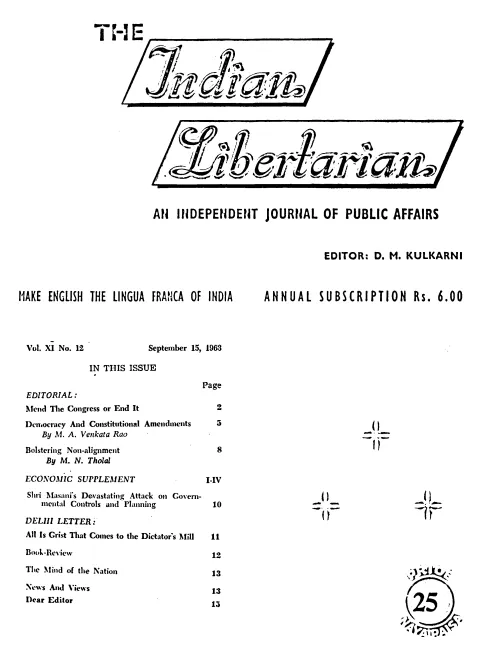
The Indian Libertarian
Independent Journal of Economic and Public Affairs
By MA Venkata Rao, M. N. Tholal, J. M. Lobo Prabhu
The Indian Libertarian, Arya Bhuvan, Sandhurst Road, Bombay 4 · Bombay · 1961
20 pages
The Indian Libertarian
Summary
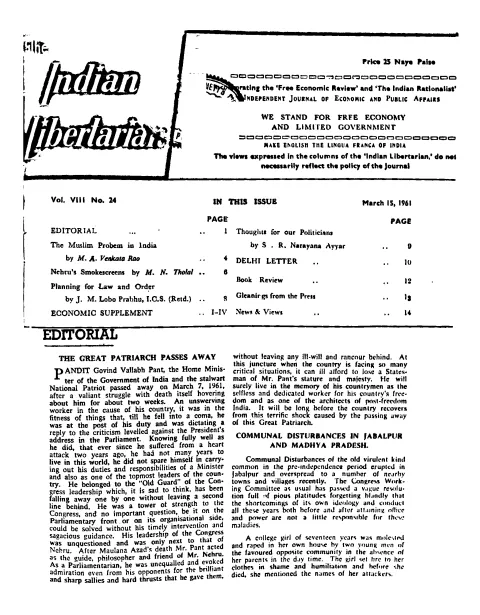
The Indian Libertarian, Vol. VIII No. 24 (15 March 1961), is an issue of the Bombay fortnightly now edited by D. M. Kulkarni and flying the banner ‘We Stand for Free Economy and Limited Government.’ The editorial opens with the death of Home Minister Govind Vallabh Pant (‘The Great Patriarch Passes Away’) on 7 March 1961 and turns to communal disturbances in Jabalpur and Madhya Pradesh, Indian troops in the Congo, and the case for the private sector. The issue’s analytical core is M. A. Venkata Rao’s essay on ‘The Muslim Problem in India’ and M. N. Tholal’s polemic against ‘Nehru’s Smokescreens’, joined by J. M. Lobo Prabhu on planning for law and order and S. R. Narayana Ayyar’s ‘Thoughts for our Politicians.’ A separately paginated Economic Supplement carries B. Ramakrishnan’s critique of the 1961-62 Central Budget as ‘soaking the rich and fleecing the poor’, alongside a Delhi Letter, book review, press gleanings and news departments.
Key points
-
The 15 March 1961 issue of The Indian Libertarian (Vol. VIII, No. 24), edited by D. M. Kulkarni, opens with an editorial marking the death of Home Minister Govind Vallabh Pant on 7 March 1961 alongside coverage of communal disturbances in Jabalpur and Madhya Pradesh.
-
The same editorial addresses Indian troops serving in the Congo and restates the journal’s case for the private sector against continued state economic control.
-
M. A. Venkata Rao’s ‘The Muslim Problem in India’ examines the position of Muslims within the Indian polity after Partition, arguing for equal citizenship grounded in secular and constitutional principles rather than communal appeasement.
-
M. N. Tholal’s ‘Nehru’s Smokescreens’ accuses the Prime Minister of using rhetoric to mask policy failures, building its case around a Rajagopalachari speech in Delhi and diagnosing a governmental ‘fear complex’.
-
J. M. Lobo Prabhu, writing as a retired I.C.S. officer, argues in ‘Planning for Law and Order’ that maintaining order is government’s first duty and has been neglected amid the emphasis on economic planning.
-
In the Economic Supplement, B. Ramakrishnan’s ‘Soaking the Rich and Fleecing the Poor’ critiques the 1961-62 Central Budget for failing to hold the price line while shifting fiscal burdens onto ordinary people despite its redistributive claims.
Essays
The Muslim Problem in India
By MA Venkata Rao
M. A. Venkata Rao examines ‘The Muslim Problem in India’ in the wake of Partition, weighing the position of the Muslim community within the Indian polity and the failures of policy toward integration. He situates the question within secular and constitutional principles, arguing for an approach grounded in equal citizenship rather than communal appeasement.
- Addresses the position of Muslims in post-Partition India.
- Frames the issue around secular and constitutional principles.
- Critiques communal appeasement in favour of equal citizenship.
Nehru’s Smokescreens
By M. N. Tholal
M. N. Tholal’s ‘Nehru’s Smokescreens’ is a polemic accusing Prime Minister Nehru of obscuring policy failures behind rhetoric. Built around an extended example of a Rajagopalachari speech in Delhi, the essay charges that Nehru deflects criticism and masks the shortcomings of his government with a ‘fear complex’ and verbal screens.
- Accuses Nehru of using rhetoric to mask policy failures.
- Opens from a Rajagopalachari speech in Delhi.
- Diagnoses a ‘fear complex’ in the government’s posture.
Planning for Law and Order
By J. M. Lobo Prabhu, I.C.S. (Retd.)
J. M. Lobo Prabhu, I.C.S. (Retd.), writes on ‘Planning for Law and Order’, arguing that the maintenance of order is the first duty and difficulty of government. Drawing on administrative experience, he discusses how the machinery of law and order has been neglected amid the emphasis on economic planning.
- Argues law and order is government’s primary responsibility.
- Written from the standpoint of a retired I.C.S. administrator.
- Contends the order-keeping machinery has been neglected under economic planning.
Economic Supplement
The Economic Supplement carries B. Ramakrishnan’s analysis of the 1961-62 Central Budget under the title ‘Soaking the Rich and Fleecing the Poor.’ He argues that the budget’s tax measures fail to hold the price line and shift burdens onto ordinary people while claiming to redistribute, criticising the fiscal logic of the Plan-era budget.
- Critiques the 1961-62 Central Budget.
- Argues the budget ‘fleeces the poor’ while professing redistribution.
- Questions the budget’s capacity to hold the price line.
Generated by the v1.5 extraction pipeline. Awaiting editorial review.
Metadata and summary are AI-extracted from the source PDF and reviewed for editorial accuracy. The original work is available via the Read PDF tab above (where present); paragraph-level citation inside the PDF is deferred to a future engagement.