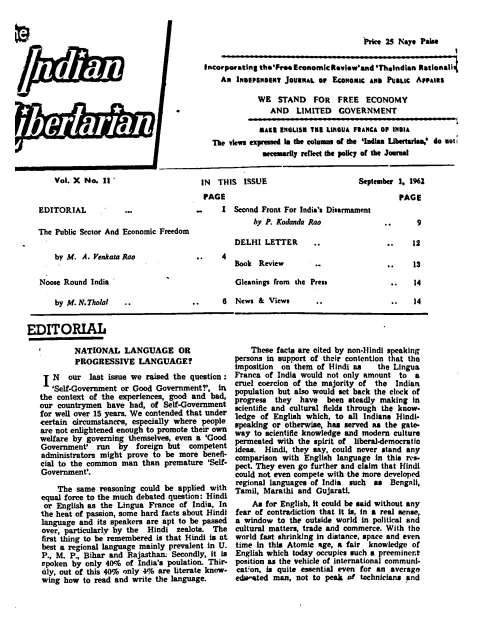
periodical issue
The Indian Libertarian
An Independent Journal of Public Affairs
By MA Venkata Rao, M. N. Tholal
The Indian Libertarian — Independent Journal of Free Economy and Public Affairs. Edited by D. M. Kulkarni, B.A. (S.E.) ... Single Copy 25 Naye Paise · Bombay · 1963
20 pages
The Indian Libertarian
Summary
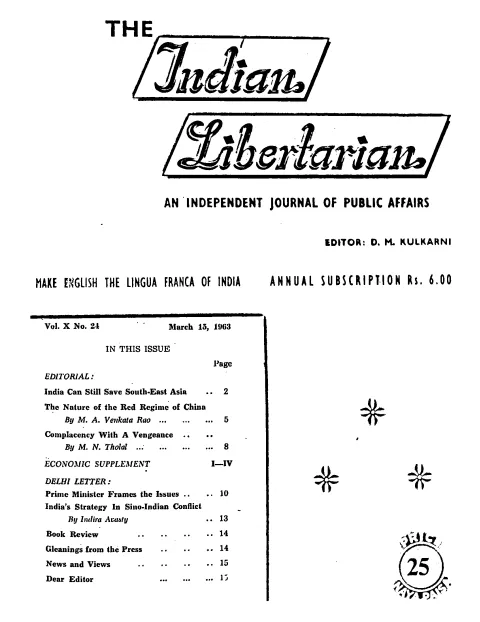
This March 15, 1963 issue of The Indian Libertarian (Vol. X No. 24), a Bombay fortnightly edited by D. M. Kulkarni, is dominated by the aftermath of the 1962 Sino-Indian war and India’s place in the Cold War. The lead editorial argues India can still rally South-East Asia against Chinese expansion if it sheds non-alignment; M. A. Venkata Rao anatomises the nature of Communist China’s regime; M. N. Tholal attacks Indian ‘complacency’ in defence and foreign policy; and a Delhi Letter reports on the Prime Minister’s framing of the issues before Parliament. The issue also carries an Economic Supplement, a section on press freedom (Nehru on freedom of the press), book reviews, ‘Gleanings from the Press’, ‘News and Views’, and a letters column. Throughout, the journal presses a classical-liberal, anti-Communist line and its standing slogan, ‘Make English the lingua franca of India.‘
Key points
-
The unsigned lead editorial argues that despite the 1962 reverses, India retains the moral and strategic standing to lead South-East Asia against Chinese expansion, provided it abandons the illusions of non-alignment.
-
The editorial casts the China threat as both military and ideological, urging a clear Western-aligned posture toward the Communist regime in Peking.
-
M. A. Venkata Rao’s ‘The Nature of the Red Regime of China’ traces how the Communist Party consolidated totalitarian power and argues its expansionist doctrine precludes genuine accommodation with its neighbours.
-
M. N. Tholal’s ‘Complacency With A Vengeance’ attacks Indian leaders, including Nehru, for substituting official self-assurance and slogans for serious defence preparedness in the shadow of the China debacle.
-
A Delhi Letter reports the Prime Minister’s framing of defence, economic and foreign-policy issues before Parliament in the aftermath of the border conflict, touching on personal taxation and fiscal questions.
-
Indira Avasty’s piece weighs India’s strategic options in the Sino-Indian conflict, considering the choice between non-alignment and Western military aid.
-
The issue’s Economic Supplement and a section on press freedom cite Nehru’s own past statements on freedom of the press.
-
Regular departments including book reviews, ‘Gleanings from the Press’, ‘News and Views’ and a letters column round out the issue’s classical-liberal, anti-Communist line.
Essays
India Can Still Save South-East Asia
The unsigned lead editorial argues that despite the 1962 reverses, India retains the moral and strategic standing to lead South-East Asia in resisting Chinese Communist expansion, provided it abandons the illusions of non-alignment and confronts the nature of the Peking regime directly. It frames the China threat as ideological as well as military and urges a clear Western-aligned posture.
- India can still rally South-East Asian states against Chinese expansion if it acts decisively
- Non-alignment is treated as a liability after the 1962 border war
- The threat from China is cast as both military and ideological
- Calls for clarity about the character of the Communist regime in Peking
The Nature of the Red Regime of China
By MA Venkata Rao
M. A. Venkata Rao examines the character of the ‘Red Regime’ in China, tracing how the Communist Party consolidated power and arguing that its totalitarian methods and expansionist aims make accommodation impossible. He reads the regime through its own doctrine and contrasts it with liberal and democratic alternatives.
- Analyses the consolidation and methods of Communist rule in China
- Treats the regime as totalitarian and expansionist by design
- Argues its doctrine precludes genuine accommodation with neighbours
- Positions liberal democracy as the contrasting alternative
Complacency With A Vengeance
By M. N. Tholal
M. N. Tholal’s ‘Complacency With A Vengeance’ is a polemic against what he sees as Indian leaders’ — and Nehru’s — complacency in defence and foreign affairs, written in the shadow of the China debacle. He charges that official self-assurance and slogans have substituted for serious preparedness.
- Attacks official complacency in defence and foreign policy
- Written against the backdrop of the 1962 Chinese attack
- Criticises reliance on slogans over substantive preparedness
- Implicates the political leadership, including Nehru
Delhi Letter: Prime Minister Frames the Issues
The Delhi Letter reports on the Prime Minister framing the issues before Parliament in the wake of the border conflict, covering parliamentary debate on defence, the economy and foreign policy. It includes discussion of personal taxation and budgetary matters under an economic-supplement heading.
- Reports the Prime Minister’s framing of national issues in Parliament
- Covers post-war defence and economic debate in Delhi
- Touches on personal taxation and fiscal questions
India’s Strategy In Sino-Indian Conflict
By Indira Avasty
Indira Avasty’s short piece sets out a strategy for India in the Sino-Indian conflict, weighing alliances, non-alignment and the question of foreign military aid in defending against further Chinese pressure.
- Proposes a strategic posture for India in the Sino-Indian conflict
- Engages the choice between non-alignment and Western support
- Frames defence against China as the immediate priority
Generated by the v1.5 extraction pipeline. Awaiting editorial review.
Metadata and summary are AI-extracted from the source PDF and reviewed for editorial accuracy. The original work is available via the Read PDF tab above (where present); paragraph-level citation inside the PDF is deferred to a future engagement.