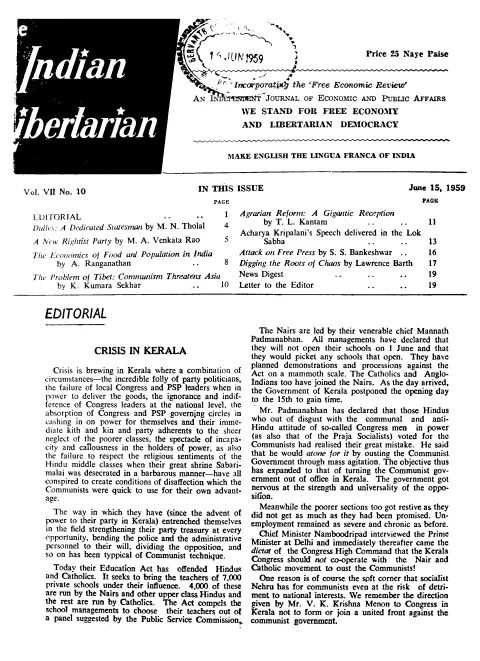
periodical issue
The Indian Libertarian
An Independent Journal of Economic and Public Affairs
The Indian Libertarian, Independent Journal of Economic and Public Affairs. Published on the 1st and 15th of Each month. Price 25 Naye Paise. · Bombay · 1959
20 pages
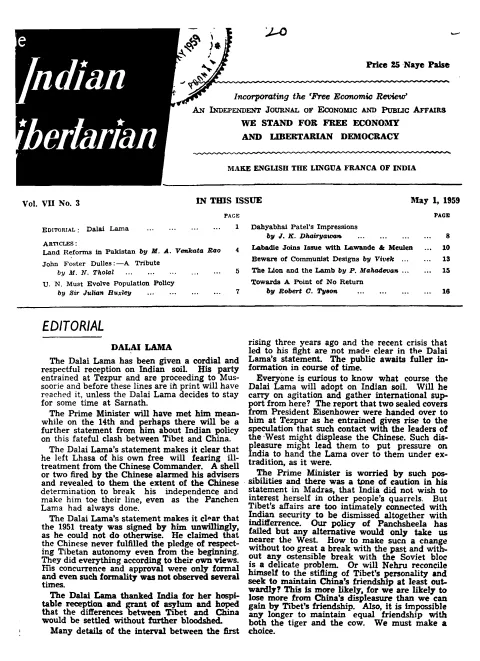
The Indian Libertarian
Summary
This May 1, 1959 issue of The Indian Libertarian (Vol. VII No. 3), the Bombay free-economy fortnightly, is dominated by the Dalai Lama’s flight into Indian asylum and the deepening Tibet–China crisis. The lengthy editorial weighs how Nehru should handle Chinese displeasure over India’s reception of the Dalai Lama, framing it as a forced ‘choice’ between China and the West. M. A. Venkata Rao reviews land reforms in Pakistan; M. N. Tholal offers a tribute to the recently retired U.S. Secretary of State John Foster Dulles; Sir Julian Huxley’s piece urges the U.N. to evolve a world population policy; and further articles cover Dahyabhai Patel’s impressions, a debate among libertarians (Labadie, Lawande and Meulen), Communist designs, and Cold War prospects. The masthead retains the slogan ‘Make English the Lingua Franca of India.‘
Key points
-
The editorial on the Dalai Lama’s asylum reviews the 1951 treaty and China’s erosion of Tibetan autonomy, arguing Nehru’s cautious Madras statement can no longer sustain “equal friendship with both the tiger and the cow.”
-
The editorial concludes that India must now choose between China and the West rather than continue its studied neutrality on the Tibet question.
-
M. A. Venkata Rao’s essay on land reforms in Pakistan reads the measures against Islam’s egalitarian tradition, treating them as a realisable contrast to Indian land policy rather than mere rhetoric.
-
M. N. Tholal’s tribute to the retiring U.S. Secretary of State John Foster Dulles defends his Cold War record of containment and firmness toward Soviet expansion.
-
Sir Julian Huxley’s contribution declares a world population crisis and calls on the United Nations to evolve a deliberate international population policy rather than allow drift.
-
Huxley links human ecology to finite earth resources, warning that unchecked population growth threatens to outstrip food supply and other resources unless nations act through reasoned international coordination.
-
Further articles cover Dahyabhai Patel’s impressions, a debate among libertarians Labadie, Lawande and Meulen, Communist designs and Cold War prospects, while the masthead retains the slogan “Make English the Lingua Franca of India.”
Essays
Editorial: Dalai Lama
The editorial centres on the Dalai Lama’s reception on Indian soil and the diplomatic crisis it has provoked with Communist China. It reports the Prime Minister’s anxiety about the ‘tone of caution’ in his Madras statement, recounts the 1951 treaty and China’s suppression of Tibetan autonomy, and argues that India can no longer maintain ‘equal friendship with both the tiger and the cow’ — it must make a choice between China and the West.
- Frames the Dalai Lama’s asylum as a turning point in India–China relations
- Reviews the 1951 treaty and China’s erosion of Tibetan autonomy
- Criticises Nehru’s reluctance to break openly with Peking
- Argues India must choose between China and the West
Land Reforms in Pakistan
By MA Venkata Rao
M. A. Venkata Rao examines land reforms in Pakistan, treating them as a positive and realisable point of contrast with Indian practice. He reads the Pakistani measures against the background of Islam’s egalitarian tradition and the country’s agrarian structure, weighing how reform is being pursued there.
- Surveys Pakistan’s land reform measures
- Reads them against Islamic egalitarian tradition
- Implicitly contrasts them with Indian land policy
- Treats reform as realisable rather than merely rhetorical
John Foster Dulles:—A Tribute
By M. N. Tholal
M. N. Tholal’s tribute to John Foster Dulles, written on his resignation as U.S. Secretary of State, defends Dulles’s record as an architect of containment and Cold War firmness against Communist expansion. Tholal reviews how Dulles fulfilled the pledge of resisting Soviet advances and assesses his place in the contest with the Communist powers.
- A tribute occasioned by Dulles’s resignation as Secretary of State
- Defends his Cold War policy of firmness toward the Soviet bloc
- Credits him with resisting Communist expansion
- Assesses his historical standing in the Cold War
U. N. Must Evolve Population Policy
By Sir Julian Huxley
Sir Julian Huxley argues that the world is passing through a population crisis and that the U.N. must evolve a deliberate population policy. Linking human ecology to earth resources, he warns that unchecked numbers will outstrip food and resources, and calls for regimentation of population growth through reasoned international action rather than drift.
- Declares a world population crisis requiring U.N. action
- Links population to human ecology and finite earth resources
- Warns growth will outpace food and resources
- Calls for a deliberate international population policy
Generated by the v1.5 extraction pipeline. Awaiting editorial review.
Metadata and summary are AI-extracted from the source PDF and reviewed for editorial accuracy. The original work is available via the Read PDF tab above (where present); paragraph-level citation inside the PDF is deferred to a future engagement.