periodical issue
The Indian Libertarian
Independent Journal of Economic and Public Affairs
By MA Venkata Rao, M. N. Tholal, J. K. Dhairyawan
The Indian Libertarian, Libertarian Publishers (Private) Ltd. · Bombay · 1960
24 pages
The Indian Libertarian
Summary
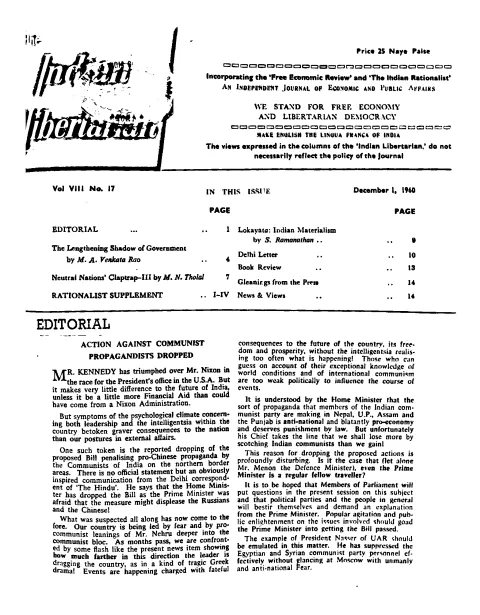
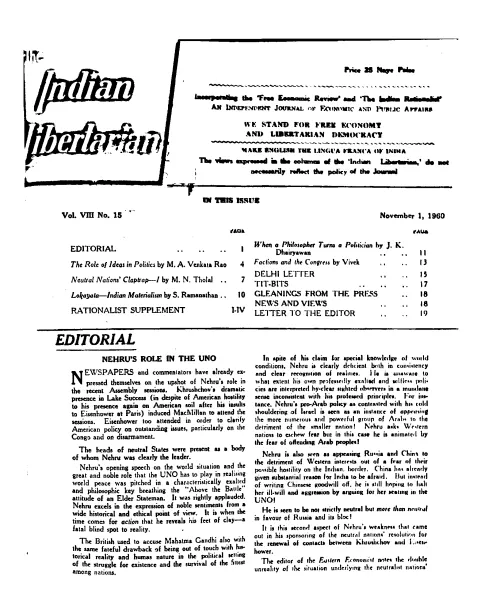
This November 1, 1960 issue of The Indian Libertarian (Vol. VIII No. 15), the Bombay fortnightly edited by Miss Kusum Lotwala for Libertarian Publishers, opens with an unsigned editorial, ‘Nehru’s Role in the UNO’, that scrutinises Nehru’s conduct at the UN General Assembly—his neutralist resolution on contacts between Khrushchev and Eisenhower, his pro-Arab tilt, and his certification of Soviet satellites as non-colonial—judging his neutralism to be ‘more than neutral in favour of Russia and its bloc’. The bylined essays in the rendered pages turn on the power of ideas in politics, the rhetoric of the neutral nations, and Indian intellectual history: M. A. Venkata Rao on ‘The Role of Ideas in Politics’, M. N. Tholal on ‘Neutral Nations’ Claptrap’, and S. Ramanathan on ‘Lokayata—Indian Materialism’ and (in the Rationalist Supplement) the ‘Spiritual Glory of India’. A separately paginated Rationalist Supplement (pp. I–IV) carries the journal’s standing rationalist content. Essays on Dhairyawan’s ‘When a Philosopher Turns a Politician’ and Vivek’s ‘Factions and the Congress’ are listed in the contents but fall outside the rendered pages.
Key points
-
The 1 November 1960 issue, Vol. VIII No. 15, opens with an editorial, ‘Nehru’s Role in the UNO’, judging Nehru’s neutralism at the UN General Assembly to be more than neutral in favour of Russia and its bloc.
-
The editorial cites Nehru’s resolution urging Khrushchev-Eisenhower contacts, his pro-Arab tilt, and his certification of Soviet satellites as non-colonial as evidence of this pro-Soviet lean.
-
M. A. Venkata Rao’s ‘The Role of Ideas in Politics’ argues intellectual authority has been captured by Marxist ideas and by Planning Commission reports that embody socialist dogma unconfronted by independent thought.
-
Venkata Rao praises the Libertarian Social Institute under M. R. Lotvala of Bombay for evaluating current political and economic ideas from first principles.
-
M. N. Tholal’s ‘Neutral Nations’ Claptrap’ questions whether the neutral-nations bloc deserves respect, using Nasser’s Arab nationalism as the exemplary case of false neutrality masking expansionism.
-
S. Ramanathan’s ‘Lokayata—Indian Materialism’ recovers the ancient Charvaka materialist tradition and its rejection of the Vedas, using the parable of the chanting dogs to satirise Brahminical ritual authority.
-
A companion Rationalist Supplement piece by Ramanathan, ‘Spiritual Glory of India’, extends the argument into a critique of India’s reputation for otherworldly spirituality.
Essays
The Role of Ideas in Politics
By MA Venkata Rao
Venkata Rao argues that ideas, not merely material forces, decide the direction of politics, and that the intellectual class bears responsibility for a society’s fate. Tracing the historical prestige of intellectuals—the medieval priest in the West, the Brahmin savant and mandarin in the East—he laments that under socialism this authority has been captured by Marxist ideas and by the Planning Commission’s reports, which ‘embody socialist ideas authoritatively’ without being confronted by independent thought. He calls for thinkers grounded in first principles to evaluate current ideas and reform, and praises the Libertarian Social Institute under M. R. Lotvala of Bombay for undertaking exactly this work.
- Ideas, not material forces alone, determine political outcomes.
- The intellectual class historically held social and spiritual authority.
- Under socialism that authority has been captured by Marxist ideas.
- Planning Commission reports embody socialist dogma unconfronted by independent thought.
- Praises the Libertarian Social Institute under M. R. Lotvala for evaluating ideas from first principles.
Neutral Nations’ Claptrap—I
By M. N. Tholal
Tholal attacks the moral pretensions of the ‘neutral nations’ bloc and their UN resolution urging renewed contact between Khrushchev and Eisenhower, asking whether such neutrality deserves respect or confidence. He singles out Egypt’s President Nasser as a case study, arguing that Nasser’s Arab nationalism—demanding the merger of all Arab states under his leadership while talking of a ‘philosophy of the revolution’ and consolidating Muslims worldwide—exposes the emptiness of his claims to peace and self-determination. The essay reads as a sustained critique of charismatic strongmen who pose as peacemakers while pursuing expansionist aims.
- Questions whether the neutral nations’ bloc deserves respect or confidence.
- Treats their UN resolution on Khrushchev-Eisenhower contacts as posturing.
- Uses Nasser as the exemplary case of false neutrality.
- Charges Nasser’s Arab nationalism with expansionism dressed as peace and self-determination.
Lokayata—Indian Materialism
By S. Ramanathan
Ramanathan’s ‘Lokayata—Indian Materialism’, the first article in a series, recovers the ancient Indian materialist (Charvaka/Lokayata) tradition and its rejection of the Vedas and Vedic priestcraft. Through the parable of ‘the chanting dogs’ he satirises Brahminical ritual authority, presenting Lokayata as an indigenous current of free, sceptical thought that the orthodox tradition sought to suppress. In the accompanying Rationalist Supplement piece, ‘Spiritual Glory of India’, he extends the argument into a broader critique of India’s reputation for otherworldly spirituality.
- Recovers the Lokayata/Charvaka materialist tradition of ancient India.
- Presents it as a rejection of the Vedas and Vedic priestcraft.
- Uses the parable of ‘the chanting dogs’ to satirise Brahminical authority.
- Frames Indian materialism as an indigenous current of free, sceptical thought.
- Companion supplement piece critiques the cliché of India’s ‘spiritual glory’.
Generated by the v1.5 extraction pipeline. Awaiting editorial review.
Metadata and summary are AI-extracted from the source PDF and reviewed for editorial accuracy. The original work is available via the Read PDF tab above (where present); paragraph-level citation inside the PDF is deferred to a future engagement.