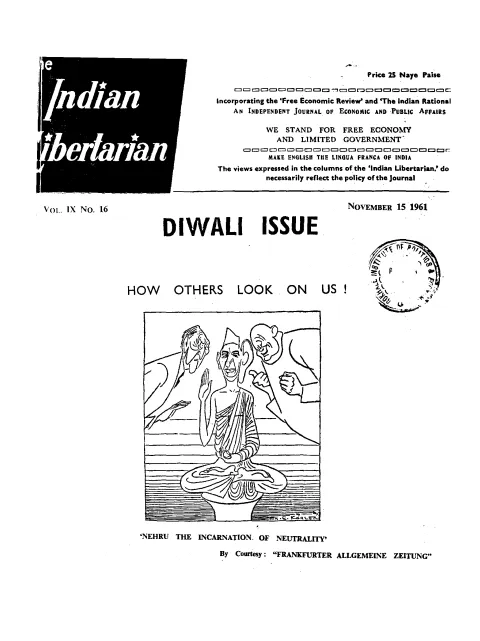
periodical issue
The Indian Libertarian
Independent Journal of Economic and Public Affairs
By MA Venkata Rao, M. N. Tholal
The Indian Libertarian, Libertarian Publishers (Private) Ltd. · Bombay · 1961
16 pages
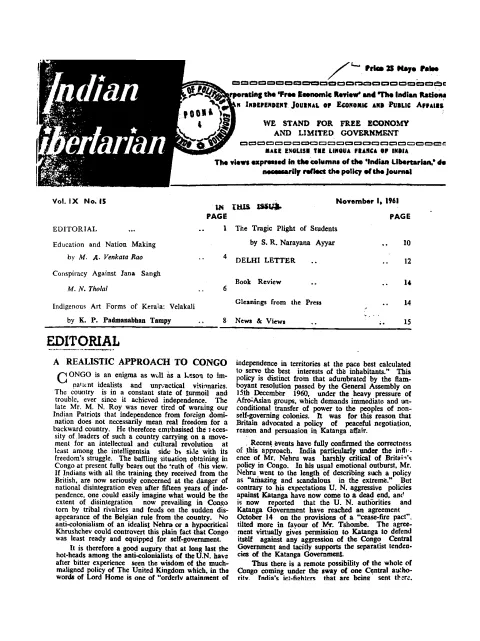
The Indian Libertarian
Summary
This November 1, 1961 issue of The Indian Libertarian (Vol. IX No. 15), the Bombay fortnightly published by Libertarian Publishers and edited by D. M. Kulkarni, leads with an unsigned editorial, ‘A Realistic Approach to Congo’, which praises India’s measured support for the Katanga cease-fire and criticises Nehru’s harsher anti-colonialist rhetoric, invoking the late M. N. Roy’s warning that political independence does not by itself mean real freedom for a backward society. The four bylined essays in the issue range across education, party politics, regional culture, and the condition of students: M. A. Venkata Rao on ‘Education and Nation Making’, M. N. Tholal on ‘Conspiracy Against Jana Sangh’, K. P. Padmanabhan Tampy on the Kerala dance-drama ‘Velakali’, and S. R. Narayana Ayyar on ‘The Tragic Plight of Students’. The masthead motto has shifted from ‘Libertarian Democracy’ to ‘We Stand for Free Economy and Limited Government’. The full 16-page issue is in the rendered pages.
Key points
-
The unsigned editorial, “A Realistic Approach to Congo,” praises India’s measured support for the Katanga cease-fire while criticising Nehru’s harsher anti-colonialist rhetoric.
-
The editorial invokes the late M. N. Roy’s warning that political independence alone does not guarantee real freedom for a backward society.
-
M. A. Venkata Rao’s “Education and Nation Making” argues education is the central instrument of nation-building, distinguishing genuine schooling that cultivates moral and intellectual independence from mere literacy or vocational drill.
-
M. N. Tholal’s “Conspiracy Against Jana Sangh” examines communal disturbances around the Aligarh Muslim University Convocation, arguing the Jana Sangh was unfairly scapegoated while Congress evaded the real communal concessions at issue.
-
K. P. Padmanabhan Tampy’s “Indigenous Art Forms of Kerala: Velakali” describes the martial dance-drama associated with the Padmanabhaswamy Temple in Trivandrum, detailing its costume, make-up and enactment of the Kurukshetra battle.
-
S. R. Narayana Ayyar’s “The Tragic Plight of Students” blames overcrowded institutions and the decay of teaching authority, rather than students themselves, for indiscipline and unrest.
-
Narayana Ayyar calls for restoring the moral relationship between teacher and taught as the precondition for any improvement in student life, arguing education has been reduced to mere instruction and exam-passing.
-
The issue’s masthead motto has shifted from “Libertarian Democracy” to “We Stand for Free Economy and Limited Government,” marking a change in the journal’s stated self-description.
Essays
Education and Nation Making
By MA Venkata Rao
Venkata Rao argues that education is the central instrument of nation-making and warns against exaggerating either the political or the social side of national integration at the expense of the individual. He distinguishes the kind of training that produces capable citizens from mere literacy or vocational drill, contending that genuine education must cultivate moral and intellectual independence so that students can resist mass conformity. He ties the health of the nation to the quality of its schools and the values they impart, treating education as prior to and more fundamental than political or economic reform.
- Education is the primary instrument of nation-making.
- Warns against subordinating the individual to political or social integration.
- Distinguishes true education from literacy or vocational drill.
- Education must build moral and intellectual independence.
- The nation’s health depends on the values its schools impart.
Conspiracy Against Jana Sangh
By M. N. Tholal
Tholal examines the communal disturbances in Uttar Pradesh, especially the unrest around the Aligarh Muslim University Convocation, and argues that the Jana Sangh has been unfairly scapegoated. He contends that the real trouble stems from concessions to communal Muslim opinion and from the Congress’s reluctance to confront it, while the Jana Sangh is blamed to deflect attention. He is sharply critical of how Nehru and the Congress handle communal questions, treating the ‘conspiracy’ against the Jana Sangh as a symptom of the ruling party’s own evasions.
- Centres on communal disturbances in Uttar Pradesh and at Aligarh Muslim University.
- Argues the Jana Sangh is unfairly scapegoated.
- Locates the real cause in concessions to communal Muslim opinion.
- Faults Nehru and the Congress for evading the communal question.
Indigenous Art Forms of Kerala: Velakali
By K. P. Padmanabhan Tampy
Padmanabhan Tampy, writing as ‘Rhythm’s Regional Editor’, describes Velakali, a spectacular martial dance-drama of Kerala associated with the Padmanabhaswamy Temple in Trivandrum. He details its major embellishments, the elaborate costume and make-up of the performers, and the battle of Kurukshetra that the dance enacts, with Pandavas and Kauravas portrayed in stylised combat. The piece is a documentary appreciation of a folk art form, preserving its visual conventions and ritual associations for a general readership.
- Describes Velakali, a martial dance-drama of Kerala.
- Links it to the Padmanabhaswamy Temple, Trivandrum.
- Details costume, make-up, and major embellishments.
- Enacts the battle of Kurukshetra with Pandavas and Kauravas.
The Tragic Plight of Students
By S. R. Narayana Ayyar
Narayana Ayyar surveys the deteriorating condition of Indian students and the indiscipline and unrest of the day, locating the fault less in the students than in the system around them. He criticises overcrowded institutions, the decay of teaching authority, and a public culture that has corroded discipline and respect, arguing that genuine education has given way to mere instruction and examination-passing. He calls for restoring the moral relationship between teacher and taught as the precondition for any improvement in student life.
- Surveys the deteriorating condition and indiscipline of students.
- Blames the system rather than the students themselves.
- Criticises overcrowded institutions and the decay of teaching authority.
- Argues education has been reduced to instruction and exam-passing.
- Calls for restoring the moral teacher-student relationship.
Generated by the v1.5 extraction pipeline. Awaiting editorial review.
Metadata and summary are AI-extracted from the source PDF and reviewed for editorial accuracy. The original work is available via the Read PDF tab above (where present); paragraph-level citation inside the PDF is deferred to a future engagement.