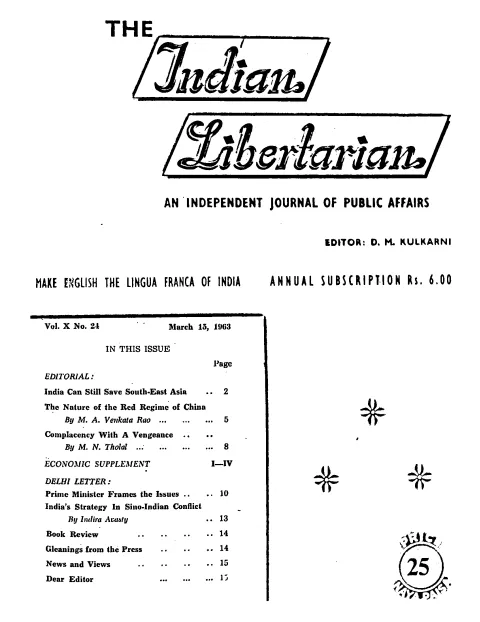
periodical issue
The Indian Libertarian
An Independent Journal of Public Affairs
By MA Venkata Rao, M. N. Tholal
Libertarian Publishers Private Ltd., First floor, Arya Bhuvan, Sandhurst Road West, Bombay 4 · Bombay · 1963
16 pages
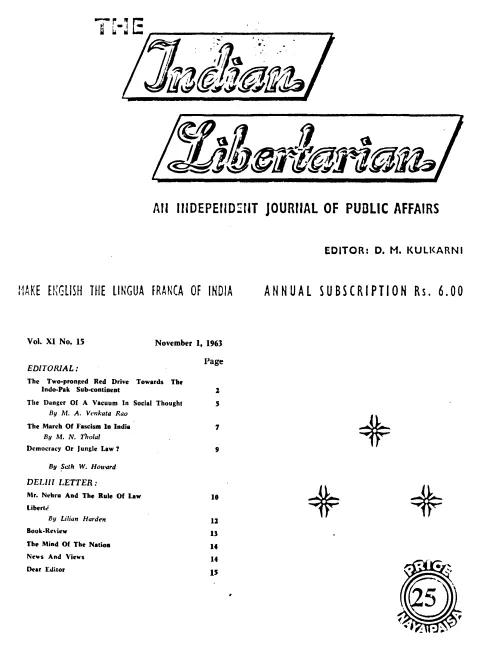
The Indian Libertarian
Summary
The Indian Libertarian, Vol. XI No. 15 (November 1, 1963), is a fortnightly issue of the Bombay classical-liberal journal edited by D. M. Kulkarni and published by the Libertarian Publishers. This issue leads with an editorial on what it calls a ‘two-pronged Red drive’ against the Indo-Pakistan subcontinent, arguing that Chinese and Soviet communism threaten the region and urging Indo-Pak rapprochement and alignment with the West. The remaining articles range across social philosophy (M. A. Venkata Rao on the vacuum in Indian social thought), a polemic warning of ‘creeping fascism’ under Nehru’s government (M. N. Tholal), a defence of liberal democracy against authoritarianism (Seth W. Howard), a Delhi Letter on Nehru and the rule of law, and a book review of an American social-thought volume. Regular departments — ‘The Mind of the Nation’, ‘News and Views’, and ‘Dear Editor’ — round out the issue. The recurring frame across all pieces is anti-communism abroad and a defence of individual liberty, the rule of law, and free enterprise at home.
Key points
-
The editorial, “The Two-pronged Red Drive Towards The Indo-Pak Sub-continent”, argues that Chinese and Soviet communism are exploiting the India-Pakistan rift and urges both Indo-Pak rapprochement and closer alignment with the West.
-
It rejects non-alignment as a posture inadequate to the communist threat and criticises Indian complacency about the scale of the danger.
-
M. A. Venkata Rao’s “The Danger Of A Vacuum In Social Thought” argues that the decline of traditional religious sanction has left a gap in Indian social thought that collectivist and totalitarian ideologies threaten to fill.
-
Venkata Rao calls for liberals to supply a constructive social philosophy grounded in individual freedom and reason before communism occupies the vacuum.
-
M. N. Tholal’s “The March Of Fascism In India” warns that Congress dominance under Nehru fosters concentrated, unchecked executive power dressed in democratic and socialist language.
-
Seth W. Howard’s “Democracy Or Jungle Law?” defends constitutional liberal democracy against the lawlessness he associates with communist and authoritarian rule, tracing a ‘path to communism’ through the erosion of legal restraint.
-
The Delhi Letter, “Mr. Nehru And The Rule Of Law”, examines tensions between the executive and judiciary and touches on Kashmir’s constitutional future and the standing of the Supreme Court.
-
Lilian Hardenberg’s companion piece, “Liberte”, proposes a test for economic policy rooted in individual freedom, drawing comparisons to Western liberal democracies.
-
Morton C. Blackman reviews a volume on “Social Thought In America”, while “The Mind Of The Nation” digests press opinion including items on Congress dominance and India’s retention of the Formosa seat.
Essays
The Two-pronged Red Drive Towards The Indo-Pak Sub-continent
The unsigned editorial argues that international communism is mounting a ‘two-pronged Red drive’ toward the Indo-Pakistan subcontinent — one prong Chinese, one Soviet — exploiting the India-Pakistan rift. It surveys the ‘grand strategy of world communism’ and contends India underestimates the threat. It calls for Indo-Pakistani reconciliation, closer alignment with the West, and rejection of non-alignment as a posture inadequate to the danger.
- Frames Chinese and Soviet communism as a coordinated two-pronged threat to the subcontinent
- Argues the India-Pakistan quarrel is exploited by the communist powers
- Urges Indo-Pak rapprochement as a strategic necessity
- Criticises Indian complacency and non-alignment in the face of the Red drive
The Danger Of A Vacuum In Social Thought
By MA Venkata Rao
M. A. Venkata Rao diagnoses a ‘vacuum in social thought’ in India: the decline of received religious and traditional sanctions has not been replaced by a coherent liberal-humanist philosophy, leaving the field open to collectivist and totalitarian ideologies. He argues that nature abhors a vacuum and that unless liberals supply a constructive social philosophy grounded in individual freedom and reason, communism or other authoritarian creeds will fill the void.
- A vacuum in social thought invites totalitarian ideologies to fill it
- Decline of traditional religious sanction leaves a gap liberalism must fill
- Calls for a constructive liberal-humanist social philosophy
- Frames the contest as between individual freedom and collectivism
The March Of Fascism In India
By M. N. Tholal
M. N. Tholal warns of a ‘march of fascism in India’, arguing that under Nehru’s leadership and the dominance of the Congress the country drifts toward concentrated, unchecked executive power and one-party rule. He reads centralising tendencies, the weakening of opposition, and the erosion of checks as symptoms of a creeping fascism dressed in democratic and socialist language.
- Argues Nehru-era Congress dominance fosters creeping authoritarianism
- Reads one-party concentration of power as ‘fascism’ in substance
- Warns that socialist and democratic rhetoric masks the drift
- Calls for a strong opposition to check executive power
Democracy Or Jungle Law ?
By Seth W. Howard
Seth W. Howard poses the choice ‘Democracy or Jungle Law?’, defending constitutional liberal democracy against the lawlessness he associates with communist and authoritarian rule. He traces a ‘path to communism’ through the erosion of legal restraint and argues that without the rule of law society reverts to the law of the jungle.
- Frames the political choice as democracy versus ‘jungle law’
- Defends the rule of law as the foundation of civilised order
- Traces a ‘path to communism’ through erosion of legal restraint
- Warns against authoritarian victimisation of citizens
Delhi Letter: Mr. Nehru And The Rule Of Law / Liberté
By Lilian Harden
The Delhi Letter, ‘Mr. Nehru And The Rule Of Law’, written by the journal’s Delhi correspondent, examines tensions between the executive and the judiciary in India and questions the government’s commitment to the rule of law, touching on the future of Kashmir (‘Kashmir’s Future’) and the standing of the Supreme Court. The page also carries ‘Liberté’ by Lilian Hardenberg (M.I.P.E.), a short piece on the test of an economic policy and the relation of individual freedom to economic order, citing liberal precedents from Western democracies.
- Examines executive-judiciary tension and the rule of law under Nehru
- Touches on Kashmir’s constitutional future
- ‘Liberté’ offers a test for economic policy rooted in individual freedom
- Draws comparisons to Western liberal democracies
Book-Review: Social Thought In America
By Morton C. Blackman
A book review by Morton C. Blackman of a volume on ‘Social Thought In America’ surveys the development of American social and economic thought, discussing figures and currents in the liberal and reformist traditions and relating them to the journal’s classical-liberal concerns.
- Reviews a book on the history of social thought in America
- Surveys American liberal and reformist intellectual currents
- Relates American debates to the journal’s classical-liberal outlook
The Mind Of The Nation
‘The Mind Of The Nation’ reprints and comments on press opinion of the day, including items headed ‘Party Or Government?’, a piece on a bomb-and-Chinese threat, and a note on India for retaining its Formosa (Taiwan) seat — surfacing the issue’s anti-communist and pro-Western foreign-policy stance through quoted commentary.
- Digest of press opinion curated by the editors
- Includes ‘Party Or Government?’ on Congress dominance
- Carries foreign-policy items on China and the Formosa/Taiwan seat
- Reinforces the issue’s anti-communist orientation
Generated by the v1.5 extraction pipeline. Awaiting editorial review.
Metadata and summary are AI-extracted from the source PDF and reviewed for editorial accuracy. The original work is available via the Read PDF tab above (where present); paragraph-level citation inside the PDF is deferred to a future engagement.