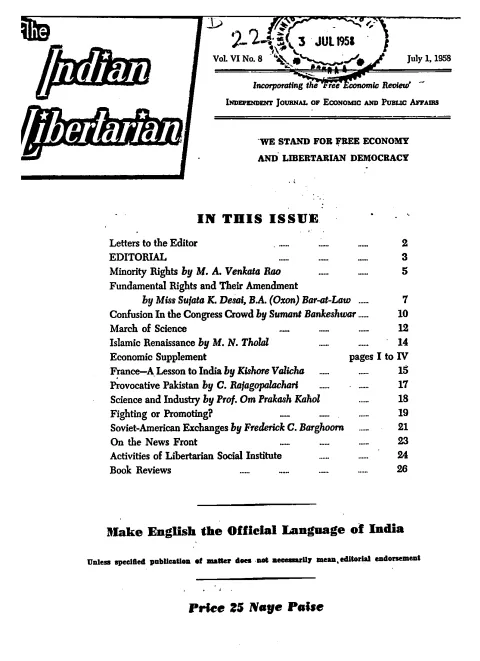
periodical issue
The Indian Libertarian
Independent Journal of Economic and Public Affairs
By MA Venkata Rao, M. N. Tholal
Arya Bhuvan, Sandhurst Road, Bombay 4 · Bombay · 1958
30 pages
The Indian Libertarian
Summary
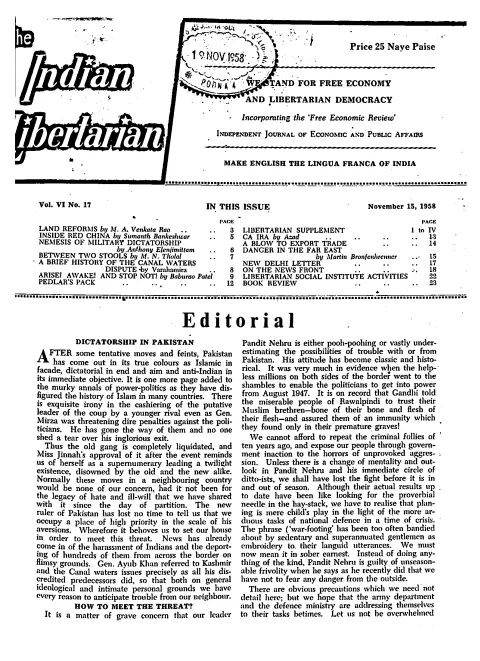
The Indian Libertarian, Vol. VI No. 17 (15 November 1958), is an issue of the Bombay classical-liberal fortnightly edited by Miss Kusum Lotwala. In the rendered pages the issue leads with an editorial on the new military dictatorship in Pakistan, reading Ayub Khan’s coup as a warning about the fragility of democracy in the subcontinent and pressing for a re-orientation of India’s foreign policy. M. A. Venkata Rao’s ‘Land Reforms’ offers a liberal critique of statist agrarian policy, Sumanth Bankeshwar reports from ‘Inside Red China’, Anthony Elenjimittam analyses the ‘Nemesis of Military Dictatorship’, M. N. Tholal weighs India ‘Between Two Stools’ of the Cold War, Varahamira gives a factual history of the Indo-Pakistan canal-waters dispute, and Baburao Patel contributes a rousing nationalist-liberal exhortation (‘Arise! Awake! And Stop Not!’). The issue also carries the four-page Libertarian Supplement — Prof. G. N. Lawande’s monetary essay ‘Do Banks Create Money?’ — plus ‘CA IRA’ (Azad), ‘A Blow to Export Trade’, and Martin Bronfenbrenner’s ‘Danger in the Far East’. Throughout, the issue defends free enterprise, individual liberty and the rule of law while sustaining a vigilant anti-communist, pro-Western line.
Key points
-
The editorial, ‘Dictatorship in Pakistan’, reads General Ayub Khan’s coup as the collapse of fragile parliamentary democracy and a warning that demands a re-orientation of India’s foreign policy.
-
M. A. Venkata Rao’s ‘Land Reforms’ critiques statist, coercive approaches to agrarian restructuring, arguing that secure property rights and free initiative, not bureaucratic control, sustain agricultural output.
-
Sumanth Bankeshwar’s ‘Inside Red China’ surveys the repressive methods of Chinese Communist rule, describing regimentation and the human cost of collectivisation as a warning for India’s own borders.
-
Anthony Elenjimittam’s ‘Nemesis of Military Dictatorship’ argues that military regimes carry within them the seeds of their own eventual collapse and cannot deliver durable legitimacy.
-
M. N. Tholal’s ‘Between Two Stools’ argues non-alignment leaves India caught uncomfortably between the Western and communist blocs, serving neither its security nor its liberal values.
-
Varahamira’s ‘A Brief History of the Canal Waters Dispute’ recounts the partition-era division of the Indus river system between India and Pakistan and the disputes it produced.
-
Baburao Patel’s ‘Arise! Awake! And Stop Not!’ opens from Nehru’s August 1958 remarks and borrows its refrain from Vivekananda to call Indians to civic awakening.
-
The four-page Libertarian Supplement carries Prof. G. N. Lawande’s monetary essay ‘Do Banks Create Money?’ alongside Martin Bronfenbrenner’s ‘Danger in the Far East’.
Essays
Editorial: Dictatorship in Pakistan
The editorial, ‘Dictatorship in Pakistan’, responds to the military takeover by General Ayub Khan, treating it as the predictable collapse of a fragile parliamentary order and a cautionary example for India. It argues that the coup demands a re-orientation of India’s foreign policy and a sober reckoning with the instability on India’s borders, while reaffirming that genuine democracy must rest on free institutions rather than strongman rule.
- Reads Ayub Khan’s coup as the collapse of fragile parliamentary democracy
- Treats Pakistan’s dictatorship as a warning for India
- Calls for a re-orientation of Indian foreign policy
- Defends free institutions against strongman rule
Land Reforms
By MA Venkata Rao
M. A. Venkata Rao examines ‘Land Reforms’, offering a liberal critique of the prevailing statist approach to agrarian restructuring. He weighs the economics of land redistribution and ceilings against incentives, productivity and property rights, arguing that reforms pursued through coercion and bureaucratic control tend to depress output, and that durable agrarian progress depends on secure ownership and free initiative.
- Critiques statist, coercive approaches to land reform
- Weighs redistribution and ceilings against productivity
- Defends secure property rights and incentives in agriculture
- Argues bureaucratic control depresses farm output
Inside Red China
By Sumanth Bankeshwar
Sumanth Bankeshwar reports from ‘Inside Red China’, describing the methods of the Chinese Communist regime — the suppression of dissent, the regimentation of economic and social life, and the human cost of collectivisation — and reading these as the logical outcome of communist rule. The piece reinforces the journal’s warning that the same ideology threatens India’s borders and institutions.
- Surveys the repressive methods of Chinese Communist rule
- Describes regimentation and the human cost of collectivisation
- Treats China as an object lesson in communist governance
- Links the threat to India’s own situation
Nemesis of Military Dictatorship
By Anthony Elenjimittam
Anthony Elenjimittam analyses the ‘Nemesis of Military Dictatorship’, arguing that military regimes carry within them the seeds of their own undoing. Drawing on contemporary and historical examples, he contends that dictatorship cannot supply legitimate or durable governance and that countries reverting to it ultimately reap instability rather than order.
- Argues military dictatorship sows the seeds of its own collapse
- Denies that dictatorship can deliver durable legitimacy
- Draws on historical and contemporary examples
- Concludes dictatorship breeds instability, not order
Between Two Stools
By M. N. Tholal
M. N. Tholal places India ‘Between Two Stools’ in the Cold War, arguing that non-alignment leaves the country caught uncomfortably between the Western and communist blocs and serving neither its security nor its liberal values. He presses for a clearer ideological and strategic stance aligned with the free world.
- Critiques non-alignment as falling ‘between two stools’
- Argues the posture serves neither security nor liberal values
- Presses for a clearer alignment with the free world
- Frames the choice in Cold War terms
A Brief History of the Canal Waters Dispute
By Varahamira
Writing as ‘Varahamira’, the author sets out ‘A Brief History of the Canal Waters Dispute: Some Facts’, recounting the partition-era division of the Indus river system between India and Pakistan and the ensuing disagreements over water sharing. The piece supplies a factual chronology intended to inform readers about a dispute the journal sees as central to subcontinental relations.
- Chronicles the Indus canal-waters dispute since Partition
- Lays out the facts of water division between India and Pakistan
- Treats the dispute as central to Indo-Pak relations
- Aims at informing rather than polemic
Arise! Awake! And Stop Not!
By Baburao Patel
Baburao Patel’s ‘Arise! Awake! And Stop Not!’ is a rousing exhortation, opening from Prime Minister Nehru’s August 1958 remarks and calling on Indians to rouse themselves against complacency, drift and the erosion of national vigour. Borrowing its title from the Upanishadic-Vivekananda call, the piece blends nationalist fervour with the journal’s liberal insistence on individual effort and responsibility.
- A stirring nationalist-liberal exhortation to civic awakening
- Opens from Nehru’s August 1958 remarks
- Borrows its ‘Arise, awake’ refrain from Vivekananda
- Blends patriotic fervour with a call to individual responsibility
Libertarian Supplement
The four-page Libertarian Supplement carries Prof. G. N. Lawande’s monetary essay ‘Do Banks Create Money?’. Lawande explains the mechanics of credit creation by the banking system, distinguishing deposits, reserves and the multiplier effect, and assesses the inflationary risks and policy questions raised when banks expand credit beyond a sound base.
- Explains how the banking system creates credit and money
- Distinguishes deposits, reserves and the credit multiplier
- Examines the inflationary risk of credit expansion
- Published as the issue’s Libertarian Supplement (G. N. Lawande)
CA IRA
By Azad
‘CA IRA’ by ‘Azad’ is a topical commentary surveying recent weeks’ events with a liberal eye, treating government measures and political drift with characteristic scepticism and reaffirming the journal’s commitment to economic freedom and limited government.
- Topical liberal commentary on recent events
- Sceptical of government measures and political drift
- Reaffirms economic freedom and limited government
- Written under the pseudonym ‘Azad’
A Blow to Export Trade
‘A Blow to Export Trade’ argues that a particular government policy measure damages India’s export competitiveness, warning that controls and fiscal burdens on exporters undercut foreign-exchange earnings the economy needs. The piece exemplifies the journal’s free-trade orientation.
- Argues a policy measure harms India’s export competitiveness
- Warns controls undercut needed foreign-exchange earnings
- Exemplifies the journal’s free-trade orientation
Generated by the v1.5 extraction pipeline. Awaiting editorial review.
Metadata and summary are AI-extracted from the source PDF and reviewed for editorial accuracy. The original work is available via the Read PDF tab above (where present); paragraph-level citation inside the PDF is deferred to a future engagement.