periodical issue
The Indian Libertarian
An Independent Journal of Economic and Public Affairs — Diwali Issue
By MA Venkata Rao, M. N. Tholal
The Indian Libertarian · Bombay · 1961
24 pages
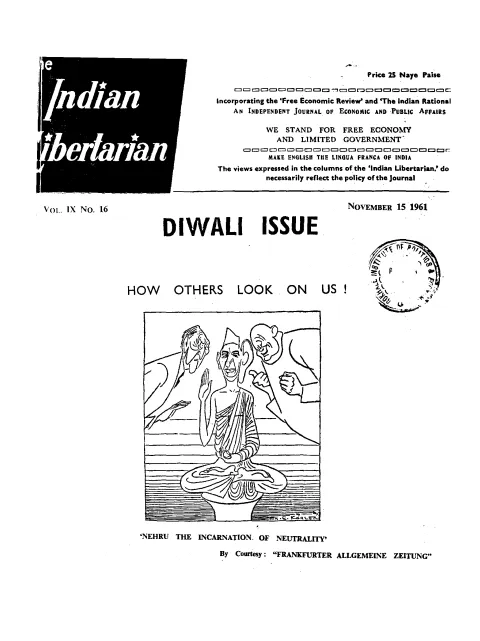
The Indian Libertarian
Summary
This Diwali (Vol. IX No. 16, 15 November 1961) number of The Indian Libertarian, a Bombay classical-liberal journal that ‘stands for free economy and limited government’, opens with a message from C. Rajagopalachari praising the journal’s defence of freedom against ‘the ignorant and wicked doctrines of State compulsion’. In the rendered pages the issue’s argumentative centre is national integration: a lead editorial on the Bombay North by-election contest between Acharya Kripalani and Krishna Menon, followed by essays from M. A. Venkata Rao on the cultural foundations of national integration and M. N. Tholal on Muslims and national integration, plus a cultural piece by K. T. Padmanabhan Tampy on the Kerala art-form Thullal. Later sections (Economic Supplement, Delhi Letter, Book Review, Swatantra Manifesto, Gleanings, News and Views) were present in the chunk but are largely beyond the rendered essay pages.
Key points
-
C. Rajagopalachari opens the Diwali issue with a message praising the journal’s defence of freedom against the ignorant and wicked doctrines of State compulsion.
-
The lead editorial The Patriot vs. The Fellow-Traveller frames the Bombay North by-election as a contest between Acharya Kripalani, backed by the Swatantra-PSP-Jana Sangh Troika, and Krishna Menon, backed by Nehru.
-
The editorial accuses Nehru of abandoning propriety to help his protege Menon, casting Kripalani as a man of selfless service and Menon as a fellow-traveller of the Red Moscowites.
-
M. A. Venkata Rao’s Aspects of National Integration traces communal outbreaks such as the Jabalpur riots to a clash of religiously rooted cultures rather than mere disorder.
-
Venkata Rao argues genuine national integration requires a shared spiritual and cultural foundation, not force or exhortation, and reviews India’s historical capacity to absorb diverse communities.
-
M. N. Tholal’s Muslims and National Integration weighs assimilation against the demands of a creative, secular culture and the tension between communal loyalty and shared national life.
-
K. T. Padmanabhan Tampy’s cultural essay on Thullal, Kerala’s popular solo dance-narrative art form, credits the poet Kunchan Nambiar with originating the genre and describes its three recognised varieties.
Essays
Editorial: The Patriot vs. The Fellow-Traveller
The editorial, ‘The Patriot vs. The Fellow-Traveller’, frames the Bombay North parliamentary by-election as a contest of national importance between Acharya Kripalani, backed by the Swatantra, Praja Socialist and Jana Sangh ‘Troika’, and Krishna Menon, backed by Nehru and supported by the Communists. In the rendered pages it casts Kripalani as a man of selfless service, probity and humility, and Menon as the embodiment of ‘duplicity cunning, showmanship and insolence’, a fellow-traveller of the ‘Red Moscowites’.
- Centres on the Bombay North by-election as a nationally significant fight.
- Kripalani is backed by the Swatantra/PSP/Jana Sangh ‘Troika’; Menon by Nehru and the Communists.
- Casts the contest as patriot (Kripalani) versus fellow-traveller (Menon).
- Accuses Nehru of abandoning propriety to help his protege Menon.
Aspects of National Integration
By MA Venkata Rao
M. A. Venkata Rao’s ‘Aspects of National Integration’ argues that communal outbreaks such as the Jabalpur riots stem from a conflict of cultures rooted in religion, and that genuine national integration cannot be produced by exhortation or police power alone but requires a shared spiritual and cultural foundation. In the rendered pages he surveys how India’s plural civilisation has historically absorbed diverse communities, and weighs the conditions under which Hindu and Muslim cultural traditions can be reconciled within a single modern nation.
- Traces communal conflict (e.g. the Jabalpur outbreak) to a clash of religiously rooted cultures.
- Argues integration cannot be achieved by force or slogans alone.
- Stresses a shared spiritual/cultural basis as prerequisite for a modern nation.
- Reviews India’s historical capacity to absorb diverse communities.
Muslims and National Integration
By M. N. Tholal
M. N. Tholal’s ‘Muslims and National Integration’ takes up the problem of national integration as it bears specifically on India’s Muslims. In the rendered pages it weighs the relationship between Islamic identity and Indian nationhood, discussing assimilation, the demands of a creative and secular culture, and the tension between communal loyalty and a shared national life.
- Focuses national-integration debate on the position of Muslims.
- Weighs assimilation against the demands of a creative, secular culture.
- Examines tension between communal identity and national belonging.
Indigenous Art—Forms of Kerala: THULLAL
By K. T. Padmanabhan Tampy
K. T. Padmanabhan Tampy’s ‘Indigenous Art—Forms of Kerala: THULLAL’ is a cultural essay on Thullal, the popular solo dance-narrative art-form of Kerala associated with the poet Kunchan Nambiar. In the rendered pages it describes the origin, performance conventions and three recognised varieties of Thullal, and situates the form within the wider devotional and dramatic traditions of Kerala.
- Surveys Thullal, a popular Kerala solo dance-narrative form.
- Credits the poet Kunchan Nambiar with originating the genre.
- Describes the three recognised varieties and their performance conventions.
Generated by the v1.5 extraction pipeline. Awaiting editorial review.
Metadata and summary are AI-extracted from the source PDF and reviewed for editorial accuracy. The original work is available via the Read PDF tab above (where present); paragraph-level citation inside the PDF is deferred to a future engagement.