periodical issue
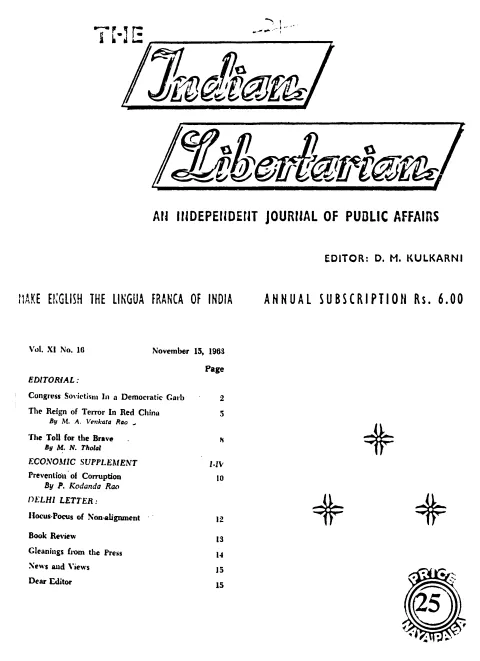
The Indian Libertarian
An Independent Journal of Public Affairs
By MA Venkata Rao, M. N. Tholal, P Kodanda Rao
The Indian Libertarian · Bombay · 1963
20 pages
The Indian Libertarian
Summary
This issue of The Indian Libertarian (Vol. XI No. 16, 15 November 1963), edited by D. M. Kulkarni, sustains the journal’s classical-liberal, anti-collectivist line. The rendered pages pair a domestic critique with an external one: the editorial attacks Nehruvian Congress planning as ‘Congress Sovietism in a Democratic Garb’, while M. A. Venkata Rao surveys ‘The Reign of Terror in Red China’. M. N. Tholal’s ‘The Toll for the Brave’ reflects through Gandhi’s autobiography, and P. Kodanda Rao argues for stronger machinery for the prevention of corruption. A Delhi Letter on the ‘Hocus-Pocus of Non-alignment’ continues the journal’s running attack on Indian foreign policy.
Key points
-
The editorial ‘Congress Sovietism In a Democratic Garb’ argues that Congress planning and socialism amount to Soviet-style collectivism dressed in democratic forms, eroding the very democracy it claims to serve.
-
M. A. Venkata Rao’s ‘The Reign of Terror In Red China’ portrays Communist China as a police state ruling through terror and indoctrination, using it as a cautionary case against collectivism.
-
M. N. Tholal’s ‘The Toll for the Brave’ reflects on courage and self-mastery through episodes from Gandhi’s autobiography, ‘The Story of My Experiments with Truth’.
-
P. Kodanda Rao’s ‘Prevention of Corruption’ treats corruption as a problem of institutional design rather than mere individual morality, and a Delhi Letter, ‘Hocus-Pocus of Non-alignment’, continues the journal’s running attack on Indian foreign policy.
-
Kodanda Rao calls for robust procedures and official accountability, tying clean public life to the wider liberal concern with disciplining state power.
Essays
Editorial: Congress Sovietism In a Democratic Garb
The editorial, ‘Congress Sovietism In a Democratic Garb’, argues that the Congress government’s drift toward state planning and socialism amounts to Soviet-style collectivism dressed in democratic forms. In the rendered pages it warns that democratic socialism, far from preserving liberty, drives democracy into a corner and concentrates economic power in the state at the expense of individual freedom.
- Equates Congress planning and socialism with Soviet-style collectivism.
- Argues ‘democratic socialism’ erodes the very democracy it claims to serve.
- Warns against concentration of economic power in the state.
The Reign of Terror In Red China
By MA Venkata Rao
M. A. Venkata Rao’s ‘The Reign of Terror In Red China’ describes the coercive character of the Chinese Communist state, portraying it as a police state that maintains itself through terror, indoctrination and the suppression of dissent. In the rendered pages he uses Red China as a warning of where collectivist concentration of power leads, contrasting it with the liberties of a free society.
- Characterises Communist China as a police state ruling by terror.
- Stresses indoctrination and suppression of dissent as instruments of control.
- Uses China as a cautionary case against collectivism.
The Toll for the Brave
By M. N. Tholal
M. N. Tholal’s ‘The Toll for the Brave’ reflects on courage and sacrifice through the lens of Mahatma Gandhi’s autobiography, ‘The Story of My Experiments with Truth’. In the rendered pages it draws on episodes from Gandhi’s life to consider what bravery and self-mastery cost, weaving the personal narrative into a broader meditation on moral character.
- Reflects on bravery and sacrifice via Gandhi’s autobiography.
- Draws on episodes from Gandhi’s life to examine self-mastery.
- Frames courage as a moral and personal discipline.
Prevention of Corruption
By P. Kodanda Rao
P. Kodanda Rao’s ‘Prevention of Corruption’ addresses the problem of public corruption and the institutional machinery needed to check it. In the rendered pages it argues that effective prevention requires more than exhortation — robust procedures and accountability of officials — and ties the integrity of public life to the wider liberal concern with limiting and disciplining state power.
- Treats corruption as a problem of institutional design, not mere morality.
- Calls for stronger machinery and accountability to prevent corruption.
- Links clean public life to the discipline of state power.
Generated by the v1.5 extraction pipeline. Awaiting editorial review.
Metadata and summary are AI-extracted from the source PDF and reviewed for editorial accuracy. The original work is available via the Read PDF tab above (where present); paragraph-level citation inside the PDF is deferred to a future engagement.