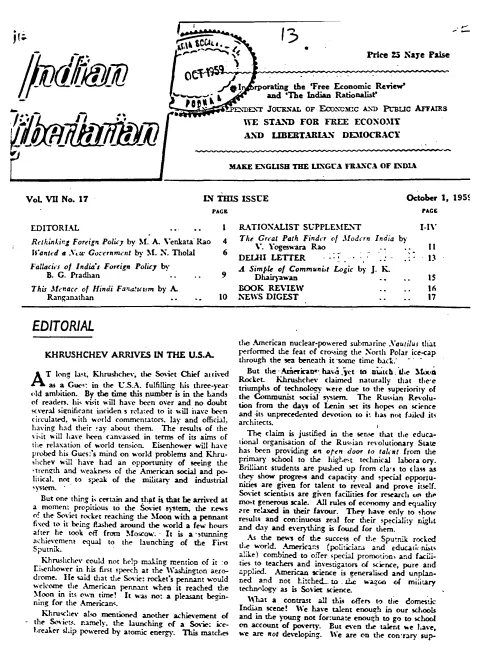
periodical issue
The Indian Libertarian
Independent Journal of Economic and Public Affairs
By Francois Bondy, Azad
The Indian Libertarian, Arya Bhuvan, Sandhurst Road, Bombay 4 · Bombay · 1958
28 pages
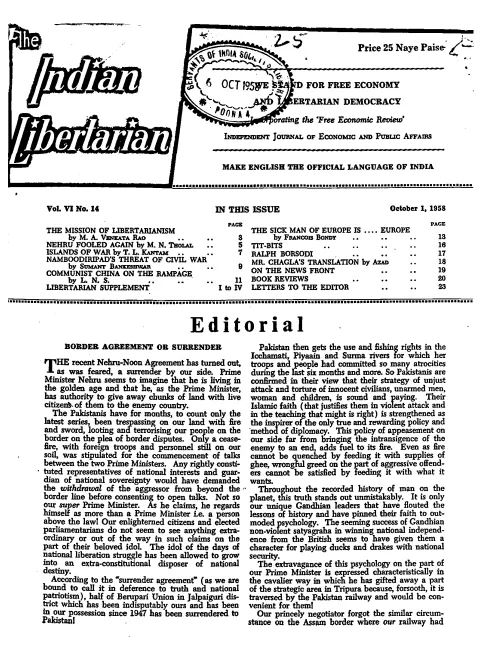
The Indian Libertarian
Summary
This 1 October 1958 issue of The Indian Libertarian (Vol. VI No. 14), the fortnightly ‘Independent Journal of Economic and Public Affairs’ edited by Kusoom Lotwalla, opens with an editorial on the Nehru-Noon border agreement that ceded territory to Pakistan, which the paper reads as a surrender rather than a settlement. In the rendered pages the issue mixes the journal’s signature classical-liberal manifesto writing with sharply anti-Nehru, anti-communist commentary on the politics of 1958: M. A. Venkata Rao restates the philosophical mission of libertarianism, M. N. Thoiral attacks the Berubari/border deal with Pakistan, and a cluster of foreign-affairs pieces (T. L. Kantam on the Formosa/Quemoy crisis, L. N. S. on ‘Communist China on the Rampage’, and an item on American policy toward Pakistan and Iran) track the Cold War as it reached the subcontinent. Sumant S. Bankeshwar’s piece warns that the newly elected communist government of E. M. S. Namboodiripad in Kerala foreshadows civil war and a communist beach-head in India.
Key points
-
The 1 October 1958 issue of The Indian Libertarian (Vol. VI, No. 14), edited by Kusoom Lotwalla, opens with the editorial ‘Border Agreement or Surrender’, condemning the Nehru-Noon agreement that ceded the Berubari union and Hussainiwala-area enclaves to Pakistan without parliamentary sanction.
-
M. A. Venkata Rao’s ‘The Mission of Libertarianism’ presents the philosophical case for the libertarian movement, tracing liberal thought from the European Enlightenment through the rise of socialism and arguing the subordination of the individual to the State is the central error of the age.
-
M. N. Tholal’s ‘Nehru Fooled Again’ attacks the same border agreement as evidence that the Prime Minister has once more been outmanoeuvred by Pakistan, raising the question of Parliament’s sovereignty over territorial cessions.
-
T. L. Kantam’s ‘Islands of War?’ surveys the Quemoy and Matsu crisis and the ‘two Chinas’ question, weighing the danger that the contest between Communist China and Nationalist Formosa could draw the great powers into war.
-
Sumant S. Bankeshwar’s ‘Namboodiripad’s Threat of Civil War’ attacks the elected communist government of E. M. S. Namboodiripad in Kerala, warning of Chinese and Soviet ‘volunteers’ for ‘liberation’ and criticising Panch Sheel as cover for communist advance.
-
A piece by L. N. S., ‘Communist China on the Rampage’, reads the 1958 Middle East crisis as evidence of a wider communist offensive and questions the wisdom of Indian non-alignment in the face of it.
Essays
Editorial: Border Agreement or Surrender
The unsigned editorial, ‘Border Agreement or Surrender’, condemns the Nehru-Noon agreement under which India conceded territory (including the Berubari union and the Hussainiwala-area enclaves) to Pakistan. It argues the deal hands away land and fishing rights without parliamentary sanction or any reciprocal gain, treats it as a capitulation driven by Nehru’s appeasement instinct, and frames the loss of national territory as the price of the government’s refusal to stand firm.
- Reads the Nehru-Noon border agreement as a surrender of Indian territory to Pakistan rather than a negotiated settlement.
- Stresses the cession of land and fishing rights and the absence of any reciprocal concession from Pakistan.
- Casts the agreement as a product of Nehru’s appeasement of Pakistan and of executive action without proper parliamentary sanction.
- Situates the territorial loss within a broader critique of the government’s foreign-policy weakness.
Essay 10
By MA Venkata Rao
M. A. Venkata Rao’s ‘The Mission of Libertarianism’ is a programmatic essay setting out the philosophical case for the libertarian/classical-liberal movement against the post-war drift toward state planning and collectivism in Europe and India. It traces liberal thought from the European Enlightenment through the rise of socialism, argues that the subordination of the individual to the State is the central error of the age, and presents libertarianism as the corrective that restores individual liberty and limited government.
- Frames libertarianism as the heir of the European Enlightenment’s defence of individual liberty.
- Diagnoses the modern drift toward state planning and collectivism as the central political error of the age.
- Argues the subordination of the individual to the State must be reversed to recover freedom.
- Positions the movement against the socialist and collectivist consensus of post-war India.
Essay 11
‘Nehru Fooled Again’, by M. N. Thoiral, attacks the Nehru-Noon agreement over the India-Pakistan border, arguing that the Prime Minister has once more been outmanoeuvred by Pakistan and has surrendered Indian land (the Berubari union and adjoining enclaves). The piece dwells on the sovereignty of Parliament over such cessions and treats the deal as evidence of a recurring pattern of naivety in Nehru’s dealings with Pakistan.
- Charges that Nehru has again been ‘fooled’ by Pakistan in the border negotiations.
- Focuses on the cession of the Berubari union and adjacent enclaves.
- Raises the question of Parliament’s sovereignty over territorial cessions.
- Reads the agreement as part of a repeated pattern of weakness toward Pakistan.
Essay 12
‘Islands of War?’, by T. L. Kantam, surveys the Far East flashpoint around the offshore islands of Quemoy and Matsu and the ‘two Chinas’ question, contrasting Communist China and the Nationalist regime on Formosa (Taiwan). It examines the danger that the contest over these islands could draw the great powers into war and reflects on the unresolved status of China after 1949.
- Frames the offshore islands of Quemoy and Matsu as a potential trigger for great-power war.
- Discusses the ‘two Chinas’ problem: Communist China versus the Nationalist government on Formosa.
- Connects the Far East crisis to the wider Cold War balance.
Essay 13
Sumant S. Bankeshwar’s ‘Namboodiripad’s Threat of Civil War’ attacks the elected communist government of E. M. S. Namboodiripad in Kerala, reading its rhetoric as a threat of civil war and a beach-head for international communism inside India. The piece warns that Chinese and Soviet ‘volunteers’ for ‘liberation’ could march into India, criticises the doctrine of Panch Sheel as cover for communist advance, and rejects what it calls the Congress’s complacency about ‘the tiny State of Kerala’.
- Treats the Namboodiripad government in Kerala as a communist threat of civil war.
- Warns of Chinese and Soviet ‘volunteers’ marching into India for ‘liberation’.
- Criticises Panch Sheel as cover for communist expansion.
- Faults the Congress and Nehru for complacency toward communism at home.
Essay 14
‘Communist China on the Rampage’, by L. N. S., reads the 1958 Middle East crisis and the wider Cold War as evidence of communist aggression, linking events in the Suez/Middle East theatre to Soviet and Chinese ambitions and warning of the dangers of Indian neutrality in the face of an expansionist communist bloc.
- Frames Communist China and the Soviet bloc as on the offensive in 1958.
- Links the Middle East crisis to the global communist advance.
- Questions the wisdom of Indian non-alignment against an expansionist bloc.
Generated by the v1.5 extraction pipeline. Awaiting editorial review.
Metadata and summary are AI-extracted from the source PDF and reviewed for editorial accuracy. The original work is available via the Read PDF tab above (where present); paragraph-level citation inside the PDF is deferred to a future engagement.