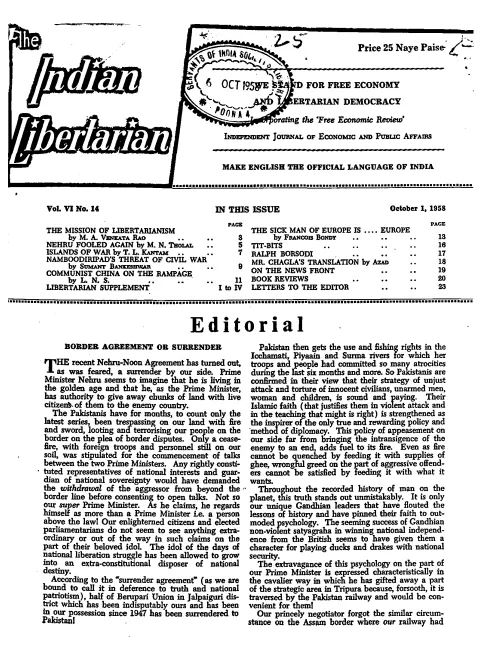
periodical issue
The Indian Libertarian
Independent Journal of Economic and Public Affairs
By MA Venkata Rao, A Ranganathan, J. K. Dhairyawan
The Indian Libertarian, Arya Bhuvan, Sandhurst Road, Bombay 4 · Bombay · 1959
24 pages
The Indian Libertarian
Summary
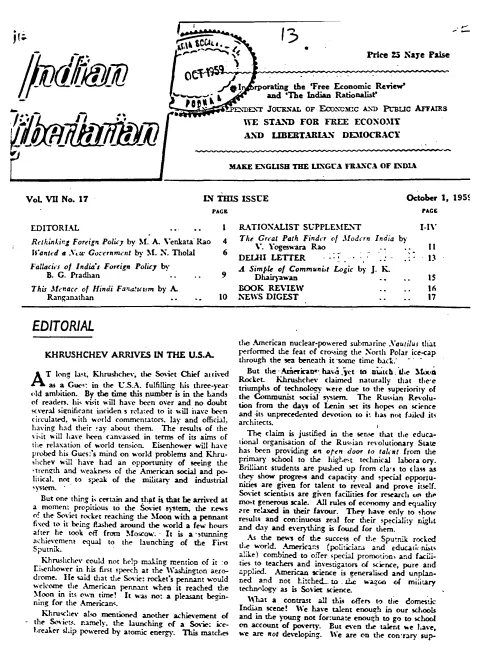
This 1 October 1959 issue of The Indian Libertarian (Vol. VII No. 17), the fortnightly classical-liberal journal edited by Kusoom Lotwalla and now incorporating ‘The Indian Rationalist’, is dominated by the China-India border crisis and by the journal’s twin causes of free-market liberalism and rationalism. The editorial reads Khrushchev’s visit to the United States through Cold War eyes, contrasting Soviet propaganda triumphs (Sputnik, the moon rocket) with the realities of the Communist system. The foreign-policy cluster is sharply critical of Nehru: M. A. Venkata Rao calls for a rethinking of foreign policy in light of Chinese aggression along the McMahon Line and in NEFA/Tibet, M. N. Thoiral demands ‘a new government’ and attacks the doctrine of non-violence, and B. G. Pradhan dissects the ‘fallacies’ of India’s foreign policy and the failure of Panch Sheel. A. Ranganathan defends English against ‘Hindi fanaticism’, and V. Yogeswara Rao profiles Dayananda Saraswati as ‘the great path finder of modern India’. The issue also carries the journal’s four-page Rationalist Supplement (a plan for a rationalist society and a piece on individuality).
Key points
-
The editorial Khrushchev Arrives in the U.S.A. reads the Soviet leader’s visit as Cold War propaganda theatre, conceding the impact of the Sputnik and moon-rocket launches timed to coincide with it.
-
The editorial argues these Soviet triumphs reflect a system that pours resources into prestige projects and state power while neglecting the ordinary citizen, contrasting this with India’s under-developed education and talent.
-
M. A. Venkata Rao’s Rethinking Foreign Policy argues that Chinese aggression along the disputed Himalayan frontier exposes the bankruptcy of Nehru’s foreign policy.
-
Venkata Rao reviews Chou En-lai’s repudiation of the McMahon Line and Chinese incursions into NEFA and Tibet, calling for a realist reassessment that treats China as a threat.
-
M. N. Thoiral’s Wanted a New Government attacks the Nehru government’s commitment to non-violence as a liability in the face of Chinese aggression and demands a change of government.
-
B. G. Pradhan’s Fallacies of India’s Foreign Policy centres on the McMahon Line dispute and the breakdown of Panch Sheel as a basis for trust with China.
-
A. Ranganathan’s This Menace of Hindi Fanaticism defends English against the imposition of Hindi as India’s sole national language, echoing the journal’s slogan to make English the country’s lingua franca.
-
V. Yogeswara Rao’s The Great Path Finder of Modern India profiles Mool Shankar, or Dayananda Saraswati, founder of the Arya Samaj, as a pioneering reformer of modern India.
Essays
Editorial: Khrushchev Arrives in the U.S.A.
The editorial, ‘Khrushchev Arrives in the U.S.A.’, reads the Soviet leader’s three-week-long ambition to visit America as a moment of Cold War theatre. It concedes the propaganda power of Soviet scientific triumphs — Sputnik and a moon rocket launched just as Khrushchev arrived — but insists these reflect a system that concentrates all resources on prestige projects and state power while neglecting the ordinary citizen. It contrasts Soviet science, generalised and state-directed, with the under-developed condition of Indian education and talent.
- Frames Khrushchev’s U.S. visit as Cold War propaganda theatre.
- Concedes the impact of Soviet space triumphs (Sputnik, the moon rocket) timed to the visit.
- Argues these reflect a state that pours resources into prestige projects at the citizen’s expense.
- Contrasts state-directed Soviet science with India’s under-developed talent and education.
Rethinking Foreign Policy
By MA Venkata Rao
M. A. Venkata Rao’s ‘Rethinking Foreign Policy’ argues that Chinese aggression along the disputed Himalayan frontier exposes the bankruptcy of Nehru’s foreign policy. He reviews Chou En-lai’s repudiation of the McMahon Line, Chinese incursions into NEFA and the suppression of Tibet, and contends that India’s faith in Panch Sheel and non-alignment left it unprepared. The essay calls for a hard-headed reassessment that recognises China as a threat rather than a friendly fellow-traveller.
- Argues Chinese aggression on the Himalayan border has discredited Nehru’s foreign policy.
- Reviews Chou En-lai’s repudiation of the McMahon Line and incursions into NEFA and Tibet.
- Holds Panch Sheel and non-alignment responsible for India’s unpreparedness.
- Calls for a realist reassessment that treats China as a threat.
Wanted a New Government
By M. N. Thoiral
‘Wanted a New Government’, by M. N. Thoiral, is a frontal attack on the Nehru government, arguing that its commitment to non-violence and its handling of Parliament and the China border have failed the nation. The piece treats the doctrine of non-violence as a liability in the face of Chinese aggression and calls, as its title declares, for a change of government.
- Demands a change of the Nehru government.
- Attacks non-violence as a doctrine ill-suited to confronting Chinese aggression.
- Criticises the government’s handling of Parliament and the border crisis.
Fallacies of India’s Foreign Policy
By B. G. Pradhan
B. G. Pradhan’s ‘Fallacies of India’s Foreign Policy’ dissects what the author sees as the errors underlying Nehru’s approach to China and the wider world. It examines the McMahon Line dispute, the collapse of Panch Sheel as a basis for trust, and the contradictions of a foreign policy that combines professed friendship with China against the evidence of Chinese conduct on the frontier.
- Catalogues the ‘fallacies’ underlying Nehru’s foreign policy.
- Centres on the McMahon Line dispute and the breakdown of Panch Sheel.
- Argues professed friendship with China is contradicted by Chinese aggression.
This Menace of Hindi Fanaticism
By A Ranganathan
A. Ranganathan’s ‘This Menace of Hindi Fanaticism’ defends English against the drive to impose Hindi as the sole national language. Responding to the Prime Minister’s assurances and to resolutions on the language question, the essay argues that the fanatical promotion of Hindi threatens national unity and the interests of non-Hindi regions, and it aligns with the journal’s cover slogan that English should be the lingua franca of India.
- Defends English against the imposition of Hindi as the sole national language.
- Treats ‘Hindi fanaticism’ as a threat to national unity and to non-Hindi regions.
- Echoes the journal’s cover demand to ‘Make English the Lingua Franca of India’.
The Great Path Finder of Modern India
By V. Vogeswara Rao
V. Yogeswara Rao’s ‘The Great Path Finder of Modern India’ is a profile of Mool Shankar — Dayananda Saraswati — the founder of the Arya Samaj, presented as a pioneering reformer of modern India. The piece sketches his life and his programme of religious and social reform.
- Profiles Mool Shankar / Dayananda Saraswati, founder of the Arya Samaj.
- Presents him as a pioneering modern Indian reformer.
- Sketches his religious and social reform programme.
Generated by the v1.5 extraction pipeline. Awaiting editorial review.
Metadata and summary are AI-extracted from the source PDF and reviewed for editorial accuracy. The original work is available via the Read PDF tab above (where present); paragraph-level citation inside the PDF is deferred to a future engagement.