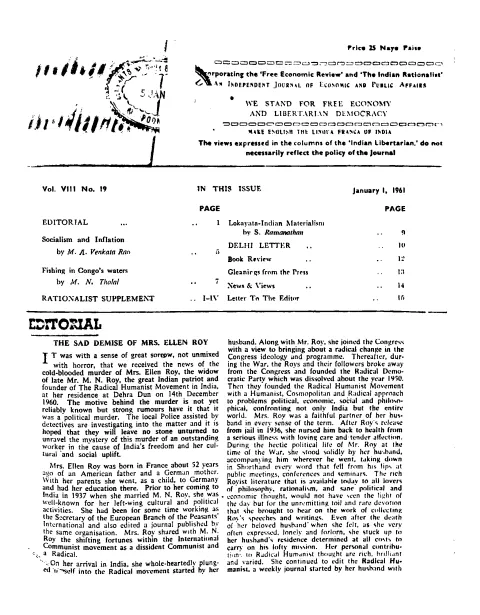
periodical issue
The Indian Libertarian
Independent Journal of Economic and Public Affairs
The Indian Libertarian, Arya Bhuvan, Sandhurst Road, Bombay 4 · Bombay · 1960
24 pages
The Indian Libertarian
Summary
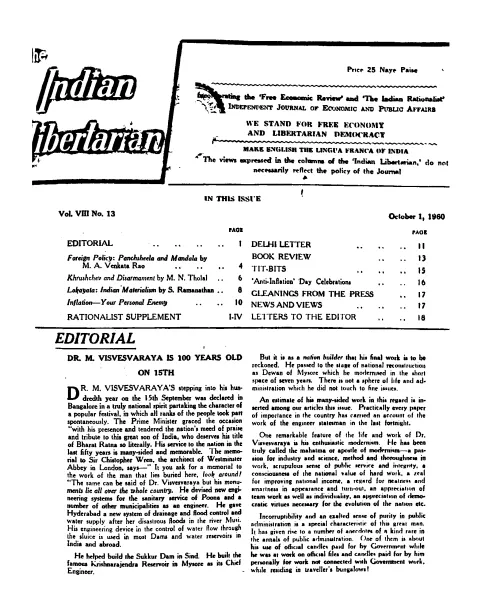
This 1 October 1960 issue of The Indian Libertarian (Vol. VIII No. 13), the fortnightly classical-liberal journal edited by Kusoom Lotwalla, opens with an editorial marking the centenary of the engineer-statesman Sir M. Visvesvaraya, holding him up as a model of public service, integrity and nation-building. The substantive articles range across foreign policy, economics and Indian thought: M. A. Venkata Rao contrasts Nehru’s doctrine of Panchsheela and non-interference with Kautilya’s realist Mandala theory of the balance of power; M. N. Thoiral examines Khrushchev’s disarmament diplomacy at the United Nations against the backdrop of the Cold War and the Congo crisis; and S. Ramanathan continues a study of Lokayata, the materialist (Charvaka) tradition in Indian philosophy, as a rationalist heritage. A reprinted Swatantra Party statement, ‘Inflation — Your Personal Enemy’, explains inflation as a tax on incomes and savings. The issue also carries the journal’s four-page Rationalist Supplement.
Key points
-
The editorial commemorates the hundredth birthday of Sir M. Visvesvaraya on 15 September, surveying his engineering achievements including the Krishnarajendra Reservoir, the Sukkur dam, and sanitary and flood-control works for Poona.
-
It holds up Visvesvaraya’s tenure as Dewan of Mysore, his administrative reforms and his scrupulous integrity as a model of public service for modern India.
-
M. A. Venkata Rao’s essay sets Nehru’s doctrine of Panchsheela non-interference against Kautilya’s ancient Mandala theory of balance-of-power statecraft, arguing the realist Kautilyan view better suits a nation facing aggressive neighbours.
-
M. N. Thoiral’s ‘Khrushchev and Disarmament’ reads the Soviet leader’s disarmament proposals at the United Nations as Cold War manoeuvring rather than genuine peace-making, weighing them against Soviet conduct in the Congo.
-
S. Ramanathan’s continuing study of Lokayata, the materialist Charvaka school of classical Indian philosophy, traces its rationalist, anti-supernatural doctrines as an indigenous rationalist heritage.
-
A reprinted Swatantra Party statement, ‘Inflation — Your Personal Enemy’, adopted on the party’s 18 September Party Day, defines inflation as a hidden tax that erodes incomes and savings.
-
The inflation statement frames the fight against rising prices as both a personal and a national concern for ordinary citizens.
-
The issue also carries the journal’s four-page Rationalist Supplement, continuing its programme of rationalist and classical-liberal commentary alongside the main fortnightly’s political and economic coverage.
Essays
Editorial: Dr. M. Visvesvaraya is 100 Years Old on 15th
The editorial commemorates the hundredth birthday (15 September) of Sir M. Visvesvaraya, the engineer who became Dewan of Mysore. It celebrates his many-sided career — the Krishnarajendra Reservoir, the Sukkur dam, sanitary and flood-control engineering for Poona and other cities, and his administrative reforms — and presents his scrupulous integrity, devotion to public service and sense of the national value of hard work as a model of citizenship for modern India.
- Marks the centenary of Sir M. Visvesvaraya on 15 September.
- Surveys his engineering achievements: Krishnarajendra Reservoir, Sukkur dam, and sanitary/flood-control works.
- Praises his work as Dewan of Mysore and his administrative reforms.
- Holds up his integrity and public-service ethic as a model for the nation.
Foreign Policy: Panchsheela and Mandala
By MA Venkata Rao
M. A. Venkata Rao’s ‘Foreign Policy: Panchsheela and Mandala’ sets Nehru’s doctrine of non-interference (Panchsheela) against Kautilya’s ancient Mandala theory of statecraft, which treats foreign relations as a balance of power among neighbouring states. The essay argues that the realist Kautilyan view — ‘Nehru versus Kautilya’ — is the sounder guide for a nation facing aggressive neighbours, and that Panchsheela’s non-interference is naive in the face of power politics.
- Contrasts Nehru’s Panchsheela non-interference with Kautilya’s Mandala theory.
- Frames the choice as ‘Nehru versus Kautilya’ — idealism versus realist statecraft.
- Argues a balance-of-power approach is the sounder guide for India.
- Treats Panchsheela as naive in the face of power politics.
Khrushchev and Disarmament
By M. N. Thoiral
M. N. Thoiral’s ‘Khrushchev and Disarmament’ examines the Soviet leader’s disarmament proposals at the United Nations, reading them as Cold War manoeuvre rather than genuine peace-making. The piece weighs what kind of peace Khrushchev offers against Soviet conduct behind the Iron Curtain and in the Congo, and is sceptical that the disarmament drive reflects any real change in Soviet aims.
- Examines Khrushchev’s disarmament proposals at the United Nations.
- Reads them as Cold War tactics rather than genuine peace-making.
- Sets the proposals against Soviet conduct in the Congo and behind the Iron Curtain.
- Doubts any real change in Soviet aims.
Lokayata: Indian Materialism
By S. Ramanathan
S. Ramanathan’s ‘Lokayata: Indian Materialism’ (continued from the June issue) is a study of the Lokayata or Charvaka school, the materialist and rationalist current in classical Indian philosophy. The essay traces its doctrines and its sceptical rejection of supernatural authority, presenting it as an indigenous rationalist heritage congenial to the journal’s own rationalist programme.
- Studies the Lokayata/Charvaka school of Indian materialism.
- Traces its rationalist, anti-supernatural doctrines.
- Presents it as an indigenous Indian rationalist tradition.
- Continued from an earlier (June) installment.
Inflation — Your Personal Enemy
‘Inflation — Your Personal Enemy’ reprints a Swatantra Party statement adopted on its 18 September Party Day. It defines inflation as a hidden tax that erodes the value of incomes and savings, sets out how it harms ordinary people, and casts the fight against it as a personal as well as a national concern.
- Reprints a Swatantra Party statement adopted on its 18 September Party Day.
- Defines inflation as a hidden tax on incomes and savings.
- Explains how inflation harms ordinary citizens.
- Frames the fight against inflation as a personal concern.
Generated by the v1.5 extraction pipeline. Awaiting editorial review.
Metadata and summary are AI-extracted from the source PDF and reviewed for editorial accuracy. The original work is available via the Read PDF tab above (where present); paragraph-level citation inside the PDF is deferred to a future engagement.