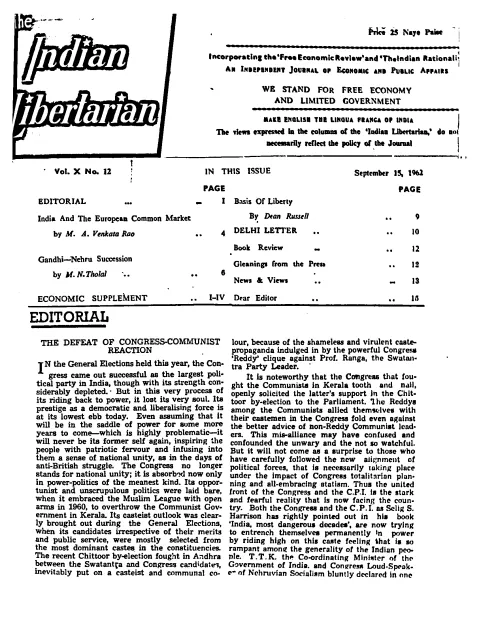
periodical issue
The Indian Libertarian
Independent Journal of Free Economy and Public Affairs
By MA Venkata Rao, M. N. Tholal
The Indian Libertarian, Arya Bhuvan, Sandhurst Road, Bombay 4 · Bombay · 1961
20 pages
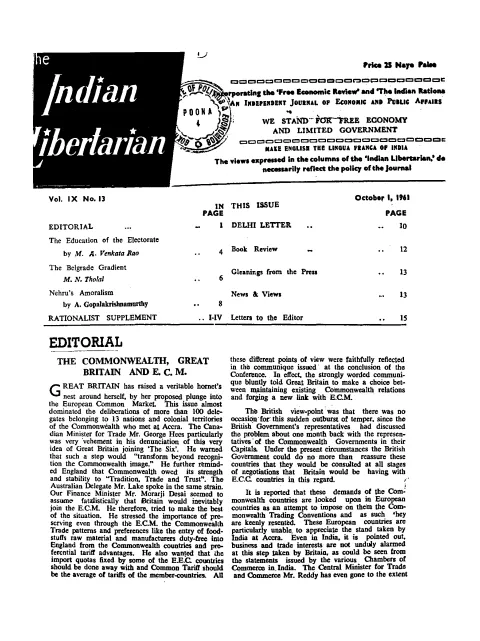
The Indian Libertarian
Summary
This 1 October 1961 issue of The Indian Libertarian (Vol. IX No. 13) appears under a new editor, D. M. Kulkarni, and a revised banner — ‘Independent Journal of Free Economy and Public Affairs’, with the cover slogan now ‘We stand for free economy and limited government’. The editorial weighs Britain’s bid to join the European Common Market against its Commonwealth ties, reporting the Accra conference of Commonwealth trade ministers and the fears of Canada, Australia and India about British entry. The featured articles turn to democracy and foreign affairs: M. A. Venkata Rao argues that the health of Indian democracy depends on ‘the education of the electorate’; M. N. Thoiral assesses the 1961 Belgrade Conference of non-aligned nations (‘The Belgrade Gradient’); and A. Gopalakrishnamurthy mounts a sharp attack on what he calls ‘Nehru’s Amoralism’, faulting the Prime Minister’s non-alignment and his response to the Soviet resumption of nuclear testing. The issue, complete in twenty pages, also carries the journal’s Rationalist Supplement and standing departments (Delhi Letter, Book Review, Gleanings from the Press, News & Views, Letters).
Key points
-
The editorial, “The Commonwealth, Great Britain and E.C.M.,” reports the Accra conference of more than 100 Commonwealth trade delegates on Britain’s bid to join the European Common Market.
-
It records objections from Canada’s George Hees, Australia’s Lake, and India’s Morarji Desai that British entry into the Common Market would erode Commonwealth trade preferences.
-
Britain’s reassurance that nothing need change at once is set against Commonwealth anxieties, with the editorial invoking Lester B. Pearson on the intangible strength of shared Commonwealth values.
-
M. A. Venkata Rao’s “The Education of the Electorate” ties the health of Indian democracy to the political understanding of its voters, examining party demagoguery and the manipulation of mass opinion at elections.
-
Venkata Rao argues an uneducated electorate turns elections into manipulation and treats civic education as the precondition for sound self-government.
-
M. N. Tholal’s “The Belgrade Gradient” assesses the September 1961 Belgrade Conference of twenty-five non-aligned nations, reading it as evasive in the face of Cold War realities including the resumption of nuclear testing.
-
A. Gopalakrishnamurthy’s “Nehru’s Amoralism” argues the Prime Minister is not the moralist he is reputed to be but an amoralist who “helps himself” under the guise of high principle.
-
Gopalakrishnamurthy reads Nehru’s non-alignment, his Belgrade diplomacy, and his muted response to the Soviet resumption of nuclear testing as evidence of self-serving expediency masked by principle.
Essays
Editorial: The Commonwealth, Great Britain and E.C.M.
The editorial, ‘The Commonwealth, Great Britain and E.C.M.’, examines the storm Britain raised by proposing to join the European Common Market. Reporting the Accra conference of more than 100 Commonwealth trade delegates, it records the objections of Canada (George Hees), Australia (Lake) and India (Morarji Desai) that British entry would weaken Commonwealth trade preferences and food-stuff advantages, and it sets the British view — that nothing need change at once — against Commonwealth anxieties, invoking Lester B. Pearson on the strength of the Commonwealth lying in undefined but genuine recognition of shared value.
- Reports the Accra conference of Commonwealth trade ministers on Britain’s Common Market bid.
- Records objections from Canada, Australia and India that entry would erode trade preferences.
- Sets the British reassurance against Commonwealth fears over food-stuff and tariff advantages.
- Invokes Lester B. Pearson on the intangible strength of the Commonwealth.
The Education of the Electorate
By MA Venkata Rao
M. A. Venkata Rao’s ‘The Education of the Electorate’ argues that the quality of a democracy depends on the political understanding of its voters. Surveying the characteristics of the electorate at election time, the demagoguery of parties, and the gap between rational deliberation and mass opinion, he contends that without an educated and informed electorate, elections degenerate into manipulation, and he treats civic education as the precondition for sound self-government.
- Ties the health of democracy to the political understanding of the electorate.
- Examines party demagoguery and the manipulation of mass opinion at elections.
- Argues an uneducated electorate turns elections into manipulation.
- Treats civic education as the precondition for sound self-government.
The Belgrade Gradient
By M. N. Tholal
‘The Belgrade Gradient’, by M. N. Thoiral, assesses the September 1961 Belgrade Conference of twenty-five non-aligned nations. The piece weighs the conference’s evasions and gestures against the realities of the Cold War — including the resumption of nuclear testing — and is sceptical that the assembled neutralist leaders offered any firm or principled response to the dangers of the moment.
- Assesses the 1961 Belgrade Conference of 25 non-aligned nations.
- Reads the conference as evasive in the face of Cold War realities.
- Connects the meeting to the resumption of nuclear testing.
- Doubts the neutralist leaders offered a firm or principled stand.
Nehru’s Amoralism
By A. Gopalakrishnamurthy
A. Gopalakrishnamurthy’s ‘Nehru’s Amoralism’ is a sustained attack on the Prime Minister’s foreign policy, arguing that Nehru is not the moralist he is taken to be but an amoralist who ‘helps himself’ under the guise of high principle. The essay reads the Belgrade conference, India’s non-alignment, and Nehru’s muted response to the Soviet resumption of nuclear testing as evidence of a policy that subordinates moral consistency to expediency.
- Argues Nehru is an ‘amoralist’, not the moralist he is reputed to be.
- Reads his non-alignment and Belgrade diplomacy as self-serving expediency.
- Faults his muted response to the Soviet resumption of nuclear testing.
- Charges that high principle masks a policy of helping oneself.
Generated by the v1.5 extraction pipeline. Awaiting editorial review.
Metadata and summary are AI-extracted from the source PDF and reviewed for editorial accuracy. The original work is available via the Read PDF tab above (where present); paragraph-level citation inside the PDF is deferred to a future engagement.