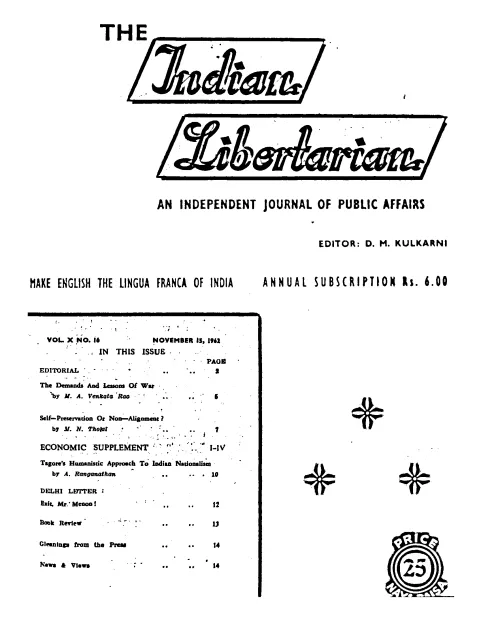
periodical issue
The Indian Libertarian
An Independent Journal of Economic and Public Affairs
By MA Venkata Rao, M. N. Tholal, C. Rajagopalachari
The Indian Libertarian, Published by D. M. Kulkarni for the Libertarian Social Institute, Arya Bhuvan, Sandhurst Road, Bombay 4 · Bombay · 1962
16 pages
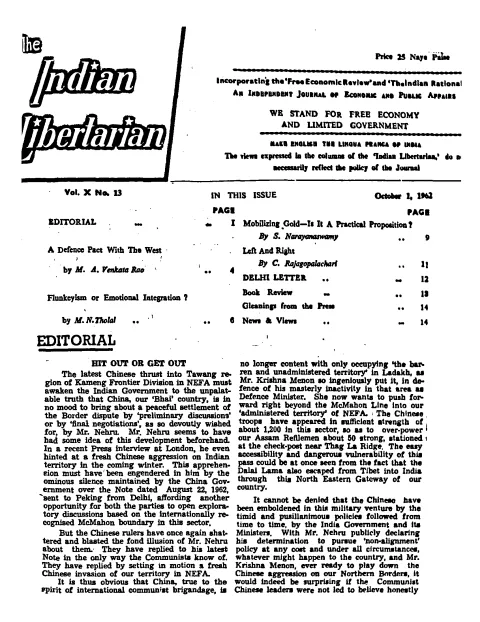
The Indian Libertarian
Summary
This 1 October 1962 issue of The Indian Libertarian (Vol. X No. 13) appears against the backdrop of escalating Chinese incursions into the North-East Frontier Agency. Its unsigned lead editorial, ‘Hit Out Or Get Out,’ attacks the Nehru government’s irresolution toward Chinese aggression in NEFA, while the bylined articles range across foreign-policy alignment, national integration, monetary policy, and the meaning of ‘Left’ and ‘Right’ in Indian politics. Contributors include M. A. Venkata Rao on a Western defence pact, M. N. Tholal on emotional versus enforced integration, S. Narayanaswamy on the practicality of mobilizing private gold, and C. Rajagopalachari on the Left/Right distinction. A ‘Delhi Letter’ surveys the India-China-Nepal triangle. The issue carries the journal’s standing masthead slogan, ‘We Stand For Free Economy And Limited Government.‘
Key points
-
The 1 October 1962 issue, Vol. X No. 13, appears against escalating Chinese incursions into the North-East Frontier Agency, with its lead editorial ‘Hit Out Or Get Out’ attacking the Nehru government’s irresolution.
-
M. A. Venkata Rao argues the Chinese threat exposes the bankruptcy of non-alignment and presses the case for a defence pact with the West despite the cost to India’s declared neutralist posture.
-
M. N. Tholal distinguishes genuine national integration from what he calls flunkeyism and merely emotional integration, invoking Gandhi’s writings to argue that real unity requires tolerance rather than imposed sentiment.
-
S. Narayanaswamy examines whether mobilizing India’s privately held gold and jewellery is a practical proposition for reserves and development finance, noting the deep popular attachment to gold as security.
-
Narayanaswamy reviews the limited success of earlier gold-mobilization appeals and the administrative and political obstacles standing in the way of a fresh scheme.
-
C. Rajagopalachari’s ‘Left And Right’ challenges the conventional political vocabulary, arguing that state control and centralized planning grouped under the Left banner do not necessarily serve the common people.
-
Rajagopalachari defends economic freedom and decentralization as having at least as strong a claim to the progressive label as socialist planning does.
Essays
A Defence Pact With The West
By MA Venkata Rao
M. A. Venkata Rao argues that India’s predicament in the face of Chinese aggression exposes the bankruptcy of non-alignment and presses the case for a defence pact with the West. He weighs the costs of formal alignment against the dangers of continued isolation, contending that the threat from a Communist neighbour leaves India little practical alternative to seeking Western security guarantees even at some cost to its declared neutralist posture.
- Frames the Chinese threat as the decisive test of India’s non-alignment policy
- Advocates a defence pact / alignment with the West for security
- Weighs the political costs of abandoning neutralism against the risks of isolation
- Situates India’s choice within Cold War bloc politics
Flunkeyism or Emotional Integration?
By M. N. Tholal
M. N. Tholal distinguishes genuine national integration from what he calls ‘flunkeyism’ and merely emotional integration. Invoking the example and writings of Mahatma Gandhi, he argues that real unity among India’s communities cannot be manufactured by sentiment or imposed fashion but must rest on tolerance and substantive fellowship between Hindus and other communities.
- Separates authentic integration from ‘flunkeyism’ and emotional integration
- Draws on Gandhi’s example and writings on Hindu-Muslim tolerance
- Treats national unity as a matter of substance rather than sentiment
Mobilizing Gold—Is It A Practical Proposition?
By S. Narayanaswamy
S. Narayanaswamy examines whether mobilizing India’s privately held gold and jewellery is a practical proposition for shoring up the nation’s reserves and financing development. Opening with the maxim ‘Nobody who thinks of some new plan for raising bullion at Lausanne, begins to legislate,’ he reviews the obstacles — popular attachment to gold as security, the modest results of past appeals, and the administrative and political difficulties — and assesses what a gold-mobilization scheme could realistically yield.
- Asks whether private gold can be mobilized to bolster reserves and development finance
- Notes the deep popular attachment to gold as a store of security
- Reviews the limited success of earlier appeals and the practical obstacles
- Connects the question to India’s monetary and foreign-exchange position
Left And Right
By C. Rajagopalachari
C. Rajagopalachari interrogates the labels ‘Left’ and ‘Right’ in Indian political debate, arguing that the conventional usage misdescribes the real choices before the country. He contends that the policies grouped under the ‘Left’ banner — state control, public-sector expansion, and centralized planning — do not in fact serve the common people, and that a politics of economic freedom and decentralization has at least as strong a claim to the progressive label.
- Challenges the conventional ‘Left’ / ‘Right’ political vocabulary
- Argues state control and planning do not necessarily serve the common people
- Defends economic freedom and decentralization as genuinely progressive
- Aims to recover the labels from socialist appropriation
Generated by the v1.5 extraction pipeline. Awaiting editorial review.
Metadata and summary are AI-extracted from the source PDF and reviewed for editorial accuracy. The original work is available via the Read PDF tab above (where present); paragraph-level citation inside the PDF is deferred to a future engagement.