periodical issue
The Indian Libertarian
Independent Journal of Free Economy and Public Affairs
By MA Venkata Rao, M. N. Tholal, J. M. Lobo Prabhu
The Indian Libertarian, Arya Bhuvan, Sandhurst Road, Bombay 4 · Bombay · 1960
24 pages
The Indian Libertarian
Summary
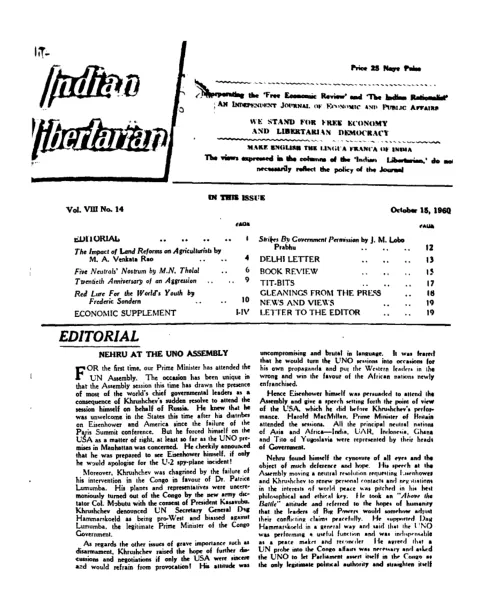
This October 15, 1960 issue of The Indian Libertarian (Vol. VIII No. 14), a Bombay fortnightly edited by Kusum Lotwala, gathers an unsigned editorial with several signed articles on Cold War diplomacy, domestic land policy, and anti-communist polemic. In the rendered pages the editorial assesses Nehru’s first appearance at the UN General Assembly against the backdrop of Khrushchev’s theatrics over the Congo and disarmament; M. A. Venkata Rao examines the impact of land reforms on agriculturists following an All-India Agriculturists’ Federation seminar; M. N. Tholal dissects the ‘five neutrals’ resolution and Khrushchev’s bid to sway the American elections; an unsigned piece marks the twentieth anniversary of the Soviet annexation of the Baltic States; Frederic Sondern reports on Soviet propaganda at the Vienna World Youth Festival; and J. M. Lobo Prabhu argues against state-permissioned strikes. The issue’s editorial center is classical-liberal and firmly anti-communist, defending free economy and ‘libertarian democracy’ against both Soviet expansionism and domestic statist drift.
Key points
-
The editorial ‘Nehru at the UNO Assembly’ reads Khrushchev’s Congo intervention on behalf of Patrice Lumumba as propaganda aimed at newly enfranchised African nations while crediting Nehru with a useful mediating role.
-
M. A. Venkata Rao’s ‘The Impact of Land Reforms on Agriculturists’ reports on an All-India Agriculturists’ Federation seminar at Bangalore, 24-25 September, warning that land ceilings follow a ‘communist pattern’.
-
Venkata Rao notes small agriculturists cannot afford election expenses far above the statutory Rs 10,000 limit, forcing reliance on urban political patrons.
-
M. N. Tholal’s ‘Five Neutrals’ Nostrum’ argues Khrushchev’s real aim in visiting the USA was to influence the American presidential elections, evidenced by his numerous press conferences.
-
An unsigned piece marks the twentieth anniversary of the Soviet annexation of the Baltic States, recalling mass deportations to NKVD dungeons and forced-labour camps.
-
It cites the Baltic States’ Freedom Council’s manifesto appealing to the free world not to lose sight of the Baltic problem.
-
Frederic Sondern’s ‘Red Lure For the World’s Youth’ reports on the Vienna World Youth Festival as a heavily funded Soviet propaganda effort aimed at capturing non-Soviet youth.
-
J. M. Lobo Prabhu contributes an essay arguing against state-permissioned strikes as part of the issue’s defence of free economy and libertarian democracy.
Essays
Editorial
The editorial ‘Nehru at the UNO Assembly’ treats the Indian Prime Minister’s first personal attendance at the UN General Assembly as a response to Khrushchev’s decision to lead the Soviet delegation himself. In the rendered pages it reads Khrushchev’s conduct over the Congo crisis and his championing of Patrice Lumumba as propaganda directed at newly enfranchised African nations, contrasts it with Eisenhower’s and Hammarskjold’s positions, and credits Nehru with moving a neutral resolution and performing a useful mediating role while doubting the sincerity of Soviet calls for disarmament.
- Nehru attends the UN Assembly in person for the first time, prompted by Khrushchev attending on behalf of Russia.
- Khrushchev’s intervention in the Congo on behalf of Lumumba is read as propaganda aimed at African nations.
- Eisenhower is persuaded to attend; Macmillan, Nasser, Nehru, Tito and others lead their delegations.
- Nehru moves a neutral resolution and is credited with a useful, indispensable mediating function.
- The editorial doubts Khrushchev’s sincerity on disarmament and the U-2 incident.
The Impact of Land Reforms on Agriculturists
By MA Venkata Rao
M. A. Venkata Rao’s ‘The Impact of Land Reforms on Agriculturists’ reports on a seminar on land reforms held by the All-India Agriculturists’ Federation at Bangalore on 24-25 September, which revealed opinion among leading agriculturists in the South about land-reform legislation. In the rendered pages he warns that ceilings and acquisition aimed at the landowning class follow a ‘communist pattern’, that small agriculturists cannot afford the cost of contesting elections to defend their interests, and that egalitarian ‘equality of deprivation’ will push the state toward imposing ceilings on urban incomes as well, levelling incomes downward.
- Reports on the All-India Agriculturists’ Federation seminar at Bangalore, 24-25 September.
- Argues land-reform ceilings and acquisition follow a ‘communist pattern’ motivated by socialisation of land.
- Small (25-acre) agriculturists cannot meet election expenses far above the statutory limit of Rs. 10,000.
- Such farmers must rely on city magnates, swelling urban politicians’ influence at the expense of rurals.
- Warns that demands for ‘equality of deprivation’ will extend ceilings to urban incomes too.
Five Neutrals’ Nostrum
By M.N. Tholal
M. N. Tholal’s ‘Five Neutrals’ Nostrum’ is a sceptical reading of Khrushchev’s behaviour at the UN, opening from C. Rajagopalachari’s hope that Khrushchev would make amends for his conduct at the Paris Summit. In the rendered pages Tholal argues that Khrushchev’s real objective in coming to the USA was to influence the American elections, evidenced by his many press conferences, and that he calculates the Americans are a ‘soft people’ who can be pushed; the essay frames the five-neutrals resolution as ineffective against this design.
- Opens from Rajagopalachari’s expectation that Khrushchev would make amends after the Paris Summit.
- Argues Khrushchev’s chief aim in the USA was to influence the American presidential elections.
- Cites the number of Khrushchev’s press conferences as evidence of this electoral motive.
- Contends Khrushchev believes the Americans are a ‘soft people’ susceptible to pressure.
- Treats the five-neutrals resolution as an inadequate response.
Twentieth Anniversary of an Aggression
‘Twentieth Anniversary of an Aggression’ is an unsigned piece marking 1960 as the twentieth anniversary of the Red Army’s 1940 invasion and forcible incorporation of the Baltic States into the Soviet Union. In the rendered page it recalls the suppression of Baltic independence, mass deportations to NKVD dungeons and forced-labour camps, and cites a manifesto by the Baltic States’ Freedom Council representing Estonians, Latvians and Lithuanians appealing to the free world not to lose sight of the Baltic problem.
- Marks 1960 as the twentieth anniversary of the Soviet annexation of the Baltic States.
- Recalls the 1939-40 invasion and forcible incorporation into the USSR.
- Describes mass deportations, disappearances into NKVD dungeons, and forced-labour camps.
- Cites the Baltic States’ Freedom Council’s manifesto to the free world.
- Frames Soviet occupation of the Baltics as a continuing assault against Europe.
Red Lure For the World’s Youth
By Frederic Sondern
Frederic Sondern’s ‘Red Lure For the World’s Youth’ reports on the World Youth Festival in Vienna, presented as a long-running, heavily funded Soviet propaganda jamboree designed to capture the minds of young people in the non-Soviet world. In the rendered pages Sondern argues that the Kremlin staged the festival as part of an unflagging drive, that only a small percentage of delegates were actively communist while many were naive young people drawn by slogans or a low-cost trip, and that Russia scored a propaganda victory the West should learn from.
- Describes the Vienna World Youth Festival as a recurring Soviet-funded propaganda event.
- Frames it as part of the Kremlin’s long-term drive to capture young minds outside the Soviet bloc.
- Notes only a small percentage of delegates were actively communist or reliable fellow-travellers.
- Many attendees were naive young people drawn by slogans, curiosity, or a low-cost trip.
- Concludes Russia scored a propaganda victory that should teach the West a lesson.
Strikes By Government Permission
By J. M. Lobo Prabhu
J. M. Lobo Prabhu’s ‘Strikes By Government Permission’ argues against a scheme of state-permissioned strikes, treating it as a contradiction that subordinates a worker’s freedom to government licence. In the rendered page Lobo Prabhu frames currency and economic instruments as tools that can serve either liberty or totalitarian ends, and contends that requiring official permission for strikes is an instrument of an opposite, statist nature.
- Critiques the idea of strikes conditioned on government permission.
- Treats permissioned strikes as a contradiction of the worker’s freedom.
- Frames economic instruments as serving either liberty or totalitarian government.
- Argues such permission is an instrument of an opposite, statist nature.
Generated by the v1.5 extraction pipeline. Awaiting editorial review.
Metadata and summary are AI-extracted from the source PDF and reviewed for editorial accuracy. The original work is available via the Read PDF tab above (where present); paragraph-level citation inside the PDF is deferred to a future engagement.